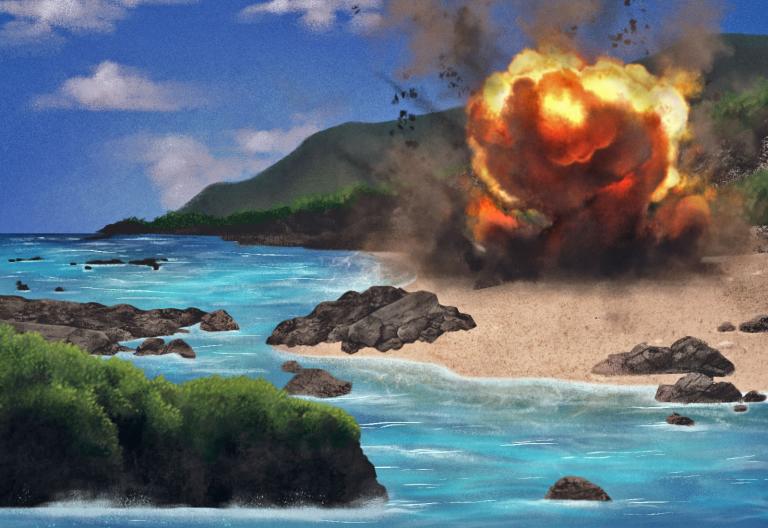
The U.S. Supreme Court has agreed to hear a case that could determine the future of a beach with cultural and ecological importance to the Indigenous CHamoru people of Guam. The case is an appeal from the U.S. Air Force, which wants to continue the open detonation of obsolete munitions on Tarague Beach in northern Guam — a site located directly above the sole-source aquifer providing 80 percent of the island’s drinking water. To Moneaka Flores, a CHamoru activist on Guam, the appeal is a frustrating step back in a multiyear fight to protect her family’s ancestral land.
“This is actually a delay for justice for us,” said Flores. “We were moving forward in the District Court, and I consider this move by the Department of War to challenge it at the Supreme Court as a strategy to delay justice for our people and to answer to the law.”
Before World War II, Tarague Beach was where Flores’ grandfather and great-grandfather grew coconut trees to cultivate copra, dried coconut meat that was then the island’s biggest export, and where they raised pigs and fished. When the Imperial Japanese Army invaded Guam the same day it bombed Pearl Harbor, Flores’ family hid at their Tarague Beach ranch until they were captured. Like other CHamoru people on Guam, her family endured forced labor, forced marches, and other brutalities under Japanese occupation.
Following the U.S. recapture of Guam, the CHamoru people were reeling from more than two years of torture, abuse, and malnutrition, during which Indigenous women were forced into sexual slavery for Japanese soldiers. Amid this trauma and the obliteration of property by U.S. bombs, the military seized nearly two-thirds of the land to build bases, airfields, and training ranges. Although community resistance has led to land returns over time, the Department of Defense still controls almost a third of Guam, and Flores’ family never regained their Tarague Beach property.
“My great-grandparents were devastated to lose Tarague Beach,” Flores said. “They couldn’t imagine their lives not going down there to fish and to hunt and to be in that jungle and in the ocean.”
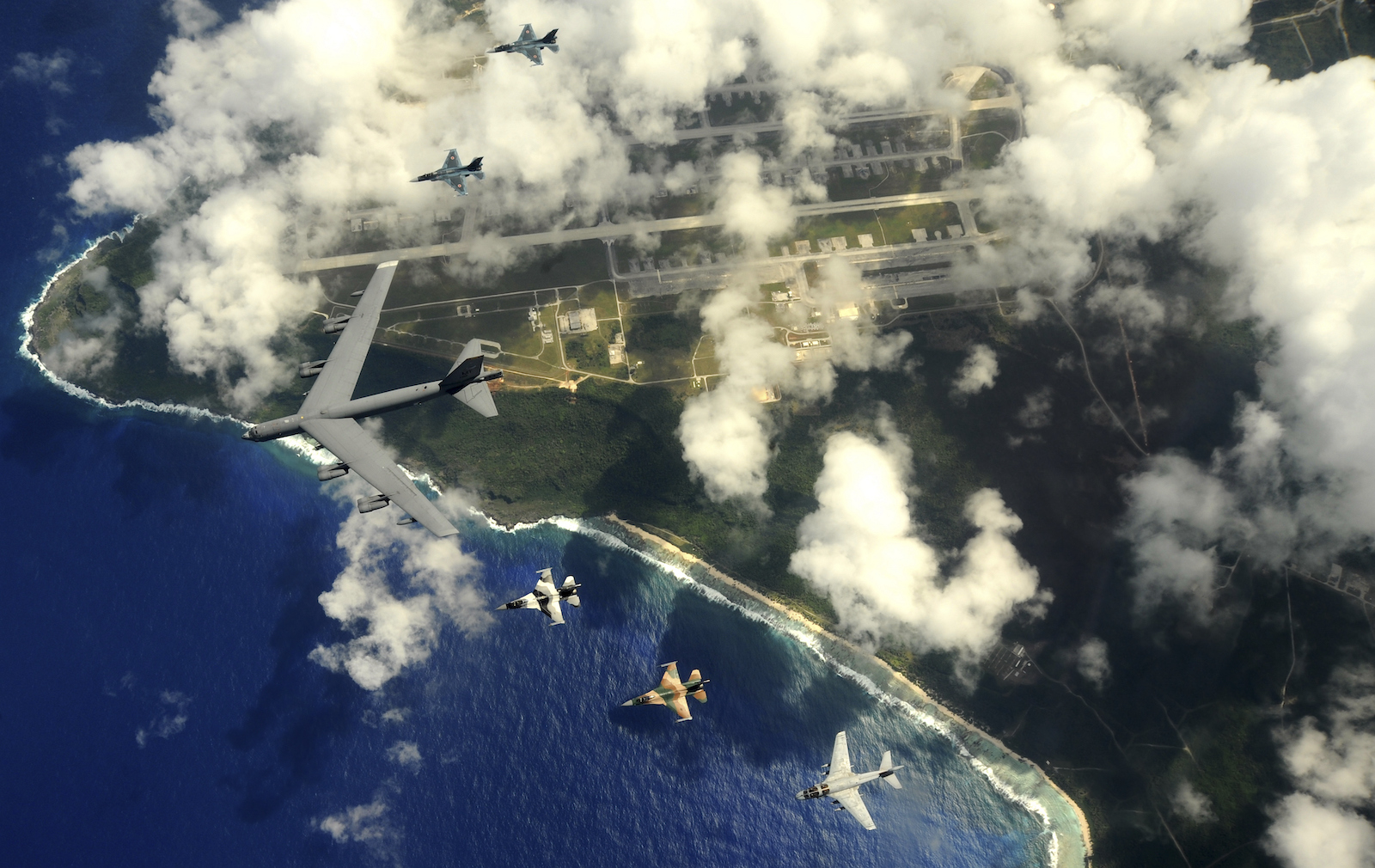
Today, the beach is part of Andersen Air Force Base, requiring local residents to obtain military access to visit. The explosive ordnance disposal range is on the easternmost edge, but the rest of the beach continues to be home to endangered sea turtles and migratory seabirds. A website for military families advertises its campgrounds and playgrounds, noting, “One of the best things about Tarague is that it’s never crowded!”
Flores’ family eventually purchased land at a nearby beach, where they continue to ranch. Occasionally, they can see smoke rising from the open detonation of legacy bombs, weapons, and other out-of-date military ordnance.
The Air Force has applied for permits to conduct these open detonations since 1982. In 2018, the National Academies of Sciences published a report confirming viable, less-polluting alternatives to open detonation. Flores sued the military in 2022 with Prutehi Litekyan, a community group she founded, arguing that the Air Force needed to analyze alternative disposal methods and locations under the National Environmental Policy Act, or NEPA. The agency, however, maintains it only needs to comply with the Resource Conservation and Recovery Act, or RCRA, which does not mandate an analysis of alternative sites.
“The message that they’re sending us in refusing to follow the law is that we’re not worth their concern, we’re not worth the resources that it takes for them to take the safest measures to protect our island and our people,” Flores said. Advocates secured a victory last year when a federal appeals court ordered the military to comply with NEPA. But with the Supreme Court now accepting the case, that precedent is at risk.
The Air Force hopes the appeals court ruling will be overturned. The agency, which did not respond to a request for comment, contends its compliance with RCRA, a 1976 law managing hazardous waste disposal, exempts it from NEPA’s requirements. Under RCRA, the Air Force only needs a permit indicating the disposal meets certain environmental protection criteria and doesn’t need to analyze other disposal options.
Neil Weare, co-director of Right to Democracy, a nonprofit advocating for people in U.S. territories, views the case in a broader colonial framework. “We once again have the U.S. Supreme Court granting review to reconsider a lower court ruling that placed limits on federal power in U.S. territories,” Weare said. “This is part of a long trend where the Supreme Court consistently shows near total deference to federal power over people in U.S. territories.”
Weare said most of the Puerto Rico cases that the Supreme Court has taken up in recent years involved reversing a ruling by lower courts that sided with the territory. He noted that May will be the 125th anniversary of the Insular Cases, a set of Supreme Court precedents from the early 20th century that limit how much the Constitution applies in territories and justify their colonial status, in part due to the presence of “alien races.”
David Henkin, an attorney at the nonprofit Earthjustice representing Flores and other community members, said that a ruling could take another year. “We could be looking at waiting until sometime in the spring to be back where we are right now,” Henkin said.
Henkin said compared to RCRA, NEPA requires a more holistic review of how federal actions affect communities, mandating the consideration of viable alternatives. For Tarague Beach, alternatives might include conducting the detonations further from fishing grounds and the sole-source aquifer, or transporting the munitions to the U.S. mainland for disposal.
“The Air Force has blatantly ignored things like impact on culture, the fact that these lands are stolen. It doesn’t even factor into the equation for them,” Henkin said. “That is blatantly illegal.”
To Flores, the situation at Tarague Beach is inextricable from Guam’s colonial history and the ongoing military buildup.
“When we think about open detonation, we think about it against many decades now and many generations of environmental racism and injustice that we’ve had to endure from Agent Orange, PFAS, to dieldrin, to nuclear contamination from the testing in the Marshall Islands,” she said.
“The fact that the military insists on continuing this practice before analyzing the alternatives, before analyzing the impacts to the community, is a serious breach of trust. It’s an attack on our survival as Indigenous peoples in our own homeland.”
A message from
Your support keeps our climate news free.
Grist is the only award-winning newsroom focused on exploring equitable solutions to climate change. It’s vital reporting made entirely possible by loyal readers like you.
At Grist, we don’t believe in paywalls. Instead, we rely on our readers to pitch in what they can so that we can continue bringing you our solution-based climate news. Donate today to keep our site free.