👋 Hi, everybody! This week, we’re sharing some highlights from our book club conversation with Nick Fuller Googins about his debut novel, The Great Transition. If you didn’t make it to our gathering last week, and you’ve yet to give this book a try, I cannot recommend it enough. I needed this novel bad — it made me laugh, it made me cry, it renewed my faith in humanity and my motivation for climate work in a way I didn’t even realize I was craving. And our conversation with Nick touched on some of those ideas — in particular, humanity’s incredible capacity for cooperation, and how we sustain the urgency of addressing the climate crisis while balancing our human needs for rest, joy, and inspiration.
While you’re adding to your reading list, remember to RSVP for our next book club, where we’ll be discussing Climate Wayfinding with author Katharine K. Wilkinson. Sign up today if you want to enter our drawing for a chance to win a free copy of the book!
In today’s newsletter, we’ve also got news for you about scientific progress, international climate agreements, and (everyone’s favorite thing) beans.
This post originally appeared in Grist’s weekly solutions newsletter, Looking Forward. Not on our list yet? Subscribe here to get it in your inbox every Friday.
Rest, cooperation, and levers of power: A conversation with Nick Fuller Googins
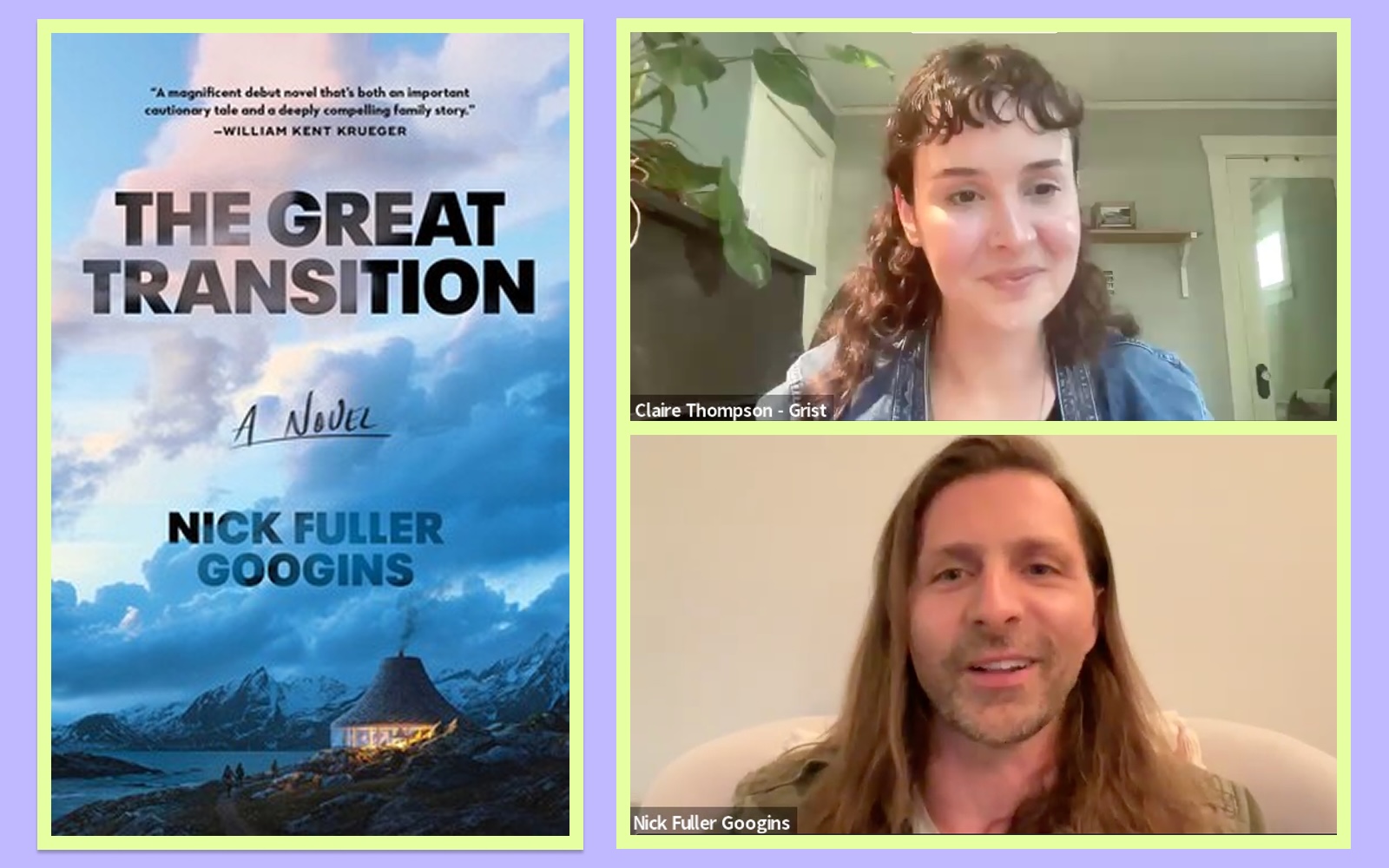
The Great Transition shows us a future in which the world has reorganized itself — with new cities built on equitable housing lotteries, familiar companies restructured as worker cooperatives, and an ethic of volunteerism that helps sustain the global network of clean energy, among other things. The biggest holiday is known as “Day Zero,” celebrating the day the world reached net-zero carbon emissions.
But even as it offers a vision of what a sustainable future could look like, the book makes us grapple with some weighty questions: Is there truly a destination? And what will we have to sacrifice to get there? Will we ever have solved the climate crisis, or does the climb never cease, and progress never get less fragile? The couple at the center of the book, Kristina and Larch, represent opposite stances on this. And their teenage daughter, Emi, struggles to sort through her own feelings, having been born after the first Day Zero.
In our book club discussion last week, we dug into some of these questions together — we talked about whether we saw ourselves more in Kristina or Larch, and how we think about what we want to pass on to future generations. We also got to hear author Nick Fuller Googins’ thoughts and reflections on the book’s themes.
As Nick shared with us, much of the content was inspired by his own lived experiences, extrapolated into a fictional future. He explored some of his own inner conflict between Larch and Kristina’s worldviews. He took inspiration from moments of incredible mobilization that he has been a part of, like the Standing Rock protests in 2016. And he drew on his many years as an educator: He currently teaches fourth grade in Maine.
In the highlights below, Nick talks about how all these things informed the world he envisioned in The Great Transition. Our conversation has been edited for length and clarity.
* * *
Q. I want to talk about the idea of our responsibility to future generations. I feel like that’s a big theme of the book, whether it’s our own family or the entire world. Is that something that’s motivating for you in your climate work, your teaching work, your writing — this idea of legacy?
A. Yes, definitely. This is something that I’ve been kind of going down this rabbit hole on — we might be the only species that has the ability to send ourselves years or generations into the future. It’s really amazing. There are some animals that can do this for, like, the next season, but we can do this for generations, which is what enables us to do so many amazing things. Even social movements — for people to be like, “We’ve had monarchy for 500 years, but what if we didn’t? And if we start fighting it now, it’s not gonna end in our lifetime, but maybe for our grandkids.”
It can be really hopeful, but then also really sad. Our kids, our grandkids, what are their lives gonna be like? It’s hard not to think about. For me, it’s the climate, and then also school safety and school shootings, where I’m just like, This is so bad and scary. I want to be fighting it all the time. But I also want to have a life and enjoy time with my family and go on walks. But then, you know, the voice in your head is like, “We don’t have time to do this.” Especially with the climate, with the timeline — everything we do now is gonna have such a big impact down the road. So it’s absolutely something I think about and struggle with myself.
Q. You get into this tension through two of the central characters in the book: Kristina and Larch. On the one hand (Kristina) there’s doing it all, never giving up the fight. And then on the other (Larch) there’s also wanting to enjoy the good things, celebrate the progress, not make the perfect the enemy of the good. I read another interview with you where you described being in a Larch phase of your life, and maybe having had a Kristina phase earlier on. Is that how you think about it?
A. Definitely. Even within a day. I’m on the negotiating committee with our teachers union, and it’s been long. I don’t leave the meetings with the superintendent and the district feeling inspired. Leaving something like that, I’m in Kristina mode — like, this is so messed up. We just want a little dignity. And then, you know, today here in Portland is a rainy day. And I also just wanna relax and watch some TV with my wife. So I struggle with those going back and forth, even day-to-day.
Q. Since you mentioned your union — as a union steward myself, I was really interested in the role that labor organizing played in this book. We see it during the transition, the workers organize to ensure the fairness of that whole mass mobilization. In the future scenes where society has restructured, we hear about worker-owned cooperatives. Tell me more about how you think about the intersection between the labor movement and the climate movement.
A. Sometimes I’ll think about power, and what are the real levers of power. There are so many things that have worked in human history to make good things happen. There’s not one strategy. But just in my life, a big defining moment was 2003, the anti-war marches against the Iraq War. It felt really good and did nothing. And that was informative to me — marches and protests, you never know what’s going to happen. Some door could open up. I don’t wanna squash the role of protesting and marching, but just in my experience, I had seen that not work at all. And I had seen labor power work so fast.
I was in Los Angeles during one of the teacher strikes. Public schools are also like daycare for a lot of working families — so the whole city ground to a halt. It was basically like a general strike. And then they won in, like, three days. Those experiences are informative to me. We are the people that make the world function and if we stop, that’s power. I’m in a phase right now where I’m just really excited about that possibility. It was really fun to play it out on the page.
In fourth grade right now, we just finished up a unit on the industrial revolution. And I have the kids role-play child laborers in a mill. I’m the evil mill owner. And then they’re learning about unions and strikes, and they go form a union and go on strike. And you know, as I’m teaching it year after year, I’m reminded of the weekend and overtime and child safety and all the things that unions won for us that we kind of take for granted now, but were really hard-fought and considered ludicrous at the time.
Q. I really appreciated all the flashback scenes to moments in the crisis and the transition that emphasized how many ordinary people were just trying to help. I think in that way, the book did leave me feeling like I believe in humanity.
A. Good, I’m glad. This is my first book, and many first novels are very autobiographical. Like so many, I feel like I’ve been lucky to see many instances of people helping each other. Total strangers. It’s left me believing that we as a species are really good and we really want to help each other. I see this with kids all the time. We are wired for cooperation, not competition.
When COVID first happened, the mutual aid that popped up was beautiful. I’ve been in some horrible ice storms in Maine where everyone is coming together and cooking breakfast for the line workers that come up from Massachusetts to fix our power lines — people fighting at a community kitchen basically for the chance to volunteer. We just wanna help out so badly. And then the big thing — this was very autobiographical for the book — is that I got to go to the Standing Rock camp and protests. And it was such an inspirational experience. Just going around this massive camp of thousands of people, and everybody is wanting to help out in the kitchen or chop firewood or just be a part of a big movement, be a part of something. I think it’s baked into our DNA.
More from Grist
⚖️ On the global stage
This week, more than 140 U.N. member countries voted to formally adopt an advisory opinion from the International Court of Justice that found that nations have a legal obligation to address climate change, and that the countries most impacted can seek reparations. Read more
🛢️ Oil in trouble
There’s more evidence that the global fuel crisis could be driving a long-term shift away from fossil fuels — particularly in Asia. Countries, companies, and individuals are relying more on bikes, scooters, and public transit, as well as remote work and even four-day work weeks, habits that could stick around. Read more
🌊 The house of the rising sea
A paper caught flack this month for suggesting New Orleans relocate itself to escape rising seas. Although the strategy is controversial, most agree that planning for the future of sea level rise is a necessity — and the conversation needs to include those whose livelihood depends on the ocean, like fishers. Read more
In other news
- Researchers in Europe are extracting data from a 1.7-mile ice core — the longest such record of Earth’s climate, dating back 1.2 million years (Gizmodo)
- A new study puts numbers to the carbon, money, and lives saved by practices like prescribed burns and forest thinning (Inside Climate News)
- This geologist is on a mission to prepare people for the growing threat of landslides as glaciers retreat (National Geographic)
- The nascent field of ‘cyborg botany’ could transform plants into living sensors tracking environmental health (Atmos)
- Beans are having a moment — which is great news for the environment, and our health (NPR)
And finally, looking forward to …
… continuing to adapt, look forward, and try to be good ancestors. Thank you to Looking Forward reader Heather Forbes for sharing this drabble, which captures both the importance of human labor and what it means to consider future generations.
🛠️🛠️🛠️
“That’s it! Whatever you did, it’s working.”
I wiped my hands on my thighs and swung round the doorframe, looking up. The turbine blades were indeed moving. I got a thumbs up and swung back in to check the inverter. We had power again after our latest move inland, away from inundating saltwater. Ingress seemed to be slowing, and maybe this would be the last time we’d have to do this.
I imagined my family here in 20, 30 years’ time, round the fire in the evening, light glinting on the water amongst the trees.
“Whatever you did, it’s working.”
— a drabble by Heather Forbes
🛠️🛠️🛠️
A drabble is a 100-word piece of fiction — in this case, offering a tiny glimpse of what a clean, green, just future might look like. Want to try writing your own (and see it featured in a future newsletter)? We would love to hear from you! Please send us your visions for our climate future, in drabble form, at [email protected]
👋 See you next week!