👋 Hi, everybody! On Wednesday, we met with the Looking Forward book club to discuss Under the Sky We Make, by Kimberly Nicholas. As always, it was a wonderful event (in a week when I personally was in dire need of a bright spot). Many thanks to everybody who joined us and shared thoughtful insights about how you deal with The Feels when it comes to climate change, and where you see regeneration taking the place of exploitation.
Below, we have a Q&A with Nicholas about how things have changed since her book came out in 2021, and what she’s learned from her work as a scientist about how we can make a difference no matter how the world around us is shifting. Also this week, we’ve got some news about green jobs, a massive solar project, and climate wins in court — plus, another upcoming event centered around emotional resilience.
This post originally appeared in Grist’s weekly solutions newsletter, Looking Forward. Not on our list yet? Subscribe here to get it in your inbox every Friday.
We can still fix it
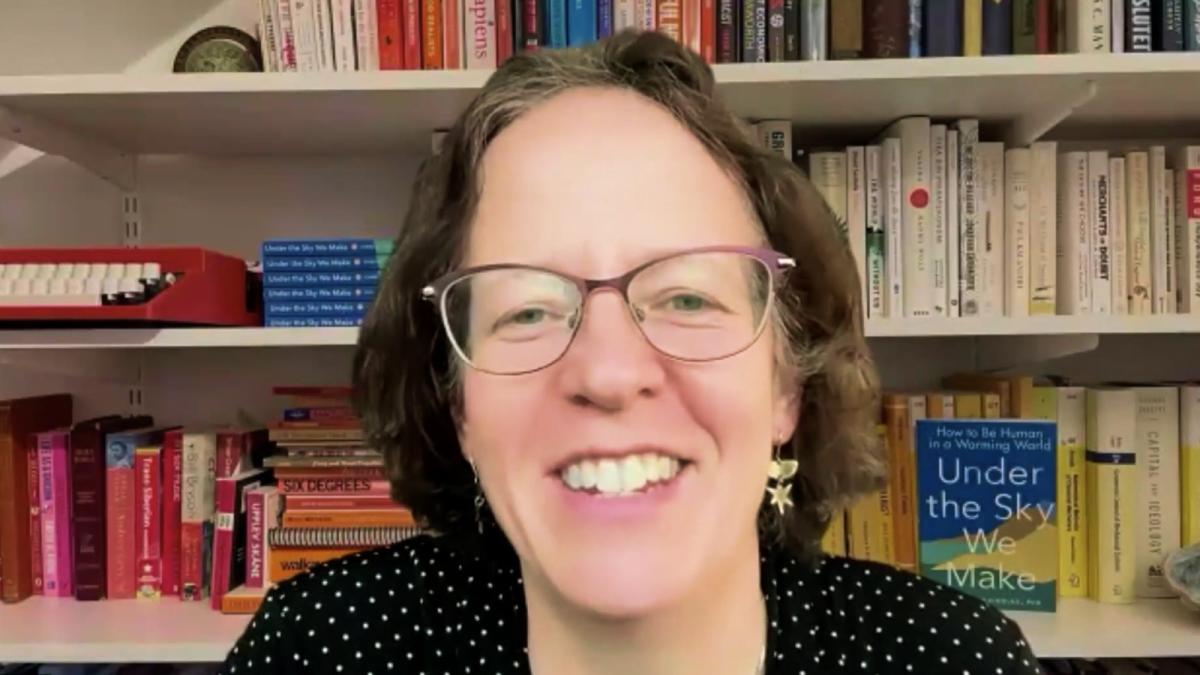
Climate scientist Kimberly Nicholas wrote her book, Under the Sky We Make: How to Be Human in a Warming World, as a call to action. The book takes readers through climate facts and feelings, and what we can do about them, organized under the declarative statements: It’s warming. It’s us. We’re sure. It’s bad. We can fix it.
Ultimately, the story she wanted to tell was a human story as well as a scientific one, Nicholas told us at our book club gathering this week. Nicholas told us at our book club gathering this week. The book draws heavily on her own experiences, not only as a scientist but as a person who has experienced the impacts of climate change close to home and tried to make meaning out of dire situations with family and friends. Written five years after the adoption of the Paris Agreement — an international treaty that set the goal of limiting global warming to 1.5 degrees Celsius above preindustrial levels — the book also emphasizes the crucial importance of the years we are living through now, and humbly offers a place on Team Climate to anyone and everyone seeking purpose in their lives.
In the five years since the book was published, “it’s bad” has only gotten more true. But, crucially, we can still fix it. And it still matters very much that we don’t give up on doing that. “We could turn the ship around tomorrow if we wanted to,” Nicholas said. “That’s true every single day.”
At our book club discussion, Nicholas talked about some of the most immediate and impactful ways we can effect change as individuals, in our own spheres of influence. She also discussed her ongoing work as a scientist and advocate and some of her favorite climate fiction reads. Here are a few highlights from our conversation.
* * *
Q. You wrote this book at the start of the decade, and a lot of it is looking toward what we need to do in the next decade to avert the worst of climate change. Now we’re about halfway through — and experiencing some pretty strong headwinds, certainly here in the U.S. From your vantage point, how are you feeling about our prognosis and all that we need to accomplish still by 2030?
A. Well, it’s hard for me to read the dedication of my book — which is, “To 2030. I hope we did right by you.” We know that we’re not on the right path. Some good things are happening, but not fast enough. We’re certainly not on track, from the latest climate science, to limit warming well below 2 or in the neighborhood of 1.5 degrees [Celsius] of warming, and we’re headed for really bad impacts. And that is really tough.
I had kind of a grieving process for 1.5, I would say. It is not yet official that 1.5 is completely out of reach, but it was much more feasible when I wrote the book than it is now. Things could still change. They could still improve. But we’ve lost a lot of ground in the last several years since I wrote the book.
It’s been hard to acknowledge all the missed opportunities. I think in my case, it’s helped me to set more limits. I have so many friends and colleagues — and maybe many here can relate — who have suffered health and mental health crises and burnout, and aren’t able to keep working if they burn the candle at both ends, don’t take rest and breaks, don’t take care of our own health and our relationships and the people around us.
Q. I appreciate that. Sustainability applies on an individual level, too. I do also appreciate the case you make in the book for personal climate action, and what we can have control over as individuals. Could you share a little bit more about that, and how you view personal climate responsibility?
A. I really wrote my book with my friends from college in mind as a target audience. They’re a wonderful and fun group. And, you know, this is a group of college-educated folks who are in the top 10 percent of income globally — many of them well above it, living in the California Bay Area. Many people are surprised to learn that that only starts at $38,000 a year or more. So if you earn more than that, you’re among the 10 percent wealthiest people on Earth.
And that group has tremendous privilege and power, especially those of us lucky enough to live in a democracy. As we see now, democracy is fragile. It’s a system that has to keep being reinvented and rights have to be used and fought for and upheld. But those three factors of education, income, and political systems that allow free participation, like democracy, are incredibly powerful. And they put those of us who are lucky enough to be in that group — which I think is most of my readers — in positions of power that we could just use so much more effectively.
In the book, I do talk a lot about personal climate action in terms of not only consumer action, things like flying and driving and eating a plant-based diet, but also in terms of politics and engaging as citizens, which is actually our biggest climate superpower.
We have a new climate action guide, SHIFT, where that climate superpower of citizen action is actually the number one thing. But a lot of it is about what we can do together, and building the bridge between individual and collective action.
Q. You use this terminology in the book of “bright spots” — examples of where things are working, where regeneration is actually being practiced, things we can look at and try to proliferate. What are some bright spots that you are excited about heading into this year or beyond?
A. I’m really excited about a project I’m getting a chance to lead, which I got rejected for three times and then the fourth time was the charm. It’s called Unbreak the Planet, and it’s about finding pathways to live within the safe and just Earth system boundaries, of which climate is one and then there are seven more.
It’s giving me a lot of energy and excitement about identifying what works.
If I look back on the last few years, the things that have given me the most positive feedback have been answering questions that people care about so that they can actually take meaningful action. Paula Kuss was a master student of ours who wrote a thesis about how to reduce cars in cities. We wrote that up for The Conversation and it got a lot of traction.
It’s not scientifically the sexiest and the most interesting to, like, read 800 reports and compile what they say, what actually works. But that’s kind of where we’re at, I think, of what people need that is actionable and usable. I don’t have my finger on the global thermostat to determine the final temperature we end up at, and none of us do. But I can see those things making a small contribution in the right direction, and that gives me a lot of energy.
Q. Something we like to do in Looking Forward is envision the future that we want to work toward — which you also describe in the book, having that vision and then sort of working backward from it. I’d love to hear about what you envision the future could look like, if we get it right and manage to stay within the 1.5 degrees C goal, or close to it, and live sustainable, rich, meaningful lives in the process.
A. I do come back to what I wrote at the beginning of the book, about centering the well-being of people and nature. That is kind of the fundamental thing we have to do. And to me, I am thinking of it now as being really built out of health and relationships. Health of us as individuals, keeping our bodies healthy, recognizing we are organic creatures that have basic needs, and that we largely rely on nature to meet those needs. Having a positive and reciprocal and healthy and happy relationship with nature is really fundamental.
I’m on the U.N. biodiversity panel, so I’m working on the Second Global Assessment of Biodiversity and Ecosystem Services. My chapter is about good quality of life in harmony with nature. So I’m thinking a lot about what that could mean and look like. One thing I realize is that there’s not one single vision — we don’t live in a single world. There’s so much variation in local circumstances and realities. We have a very strong contribution by Indigenous and local communities to this report, and those ways of thinking and knowing need to be woven in and and respected.
I guess I don’t have a single final answer, but I rely a lot on climate fiction and I highly recommend climate fiction. I don’t know if I’m that good at answering this question, but novelists are really good at it because those are the people who invent world-building for a living. So I find it really helpful and fun and generative to read climate fiction and to engage with art and other creative endeavors — which I have no talent in, but really appreciate and enjoy inhabiting. The experience of living in a different reality or seeing things in a different way, and recognizing some of the diversity of what those visions can look like, I think is really helpful.
Share your thoughts
In our breakout discussions during the book club we talked a bit about the feelings that living through climate change can elicit, and what we do with them. And if you haven’t already heard, we are getting ready to launch a new special feature in this newsletter: Ask a Climate Therapist.
Climate-aware therapist Leslie Davenport will be addressing some of your burning questions about climate change and mental health. Do you have a question for Leslie? Maybe you’re wondering about how to cope with climate-related grief, or anxiety, or feelings of burnout? Maybe you’d like to know how to talk about climate change with young kids, or with your family and friends who don’t quite get it? Fill out this form to share your questions for the column.
More from Grist
🦺 The Earth’s corps
The American Climate Corps — a national green workforce program launched under President Biden — is no more. But some states are finding ways to keep the work going. California and Washington each have their own climate corps with state funding, while in places like North Carolina, AmeriCorps members are still engaged in hurricane recovery efforts. Read more
♨️ Waste not, make hot
Crypto mining gobbles up a lot of energy and produces a lot of waste heat in the process. New projects in Finland are finding ways to harness that heat and send it to homes. It’s not the most efficient heating solution out there — and, experts say, not enough to argue that there’s a climate case for more crypto — but in some cases where mining facilities already exist, capturing their heat can help reduce reliance on fossil fuels. Read more
🔌 Charging ahead
As our homes and cars increasingly run on electricity, researchers and utility managers are looking for creative ways to avoid overstraining the grid. One approach is called active managed charging, which staggers when EVs are actually drawing power from the grid, while ensuring each vehicle is charged when its driver needs it. Read more
🌎 And one more thing
Join us and our friends at the Climate Mental Health Network for this upcoming webinar, Thriving in an Age of Disasters: How to Build Emotional Resilience & Take Action. At this event, you’ll hear from researchers, advocates, and authors about how we can build emotional resilience while staying grounded, hopeful, and engaged in the midst of disasters and uncertainty. (The conversation will be moderated by Grist’s own Kate Yoder.) Participants will gain tools and resources for cultivating emotional resilience, alongside concrete strategies for taking meaningful, values-aligned action in their communities. All are welcome to join — and if you can’t make it live, feel free to sign up to get the recording! Register here.

In other news
- On fallow farmland, California is developing what will become the nation’s largest solar and battery project (Canary Media)
- A federal judge ordered the Department of Energy to reinstate grants in blue states that were canceled during the government shutdown (Latitude Media)
- And another federal judge overturned Trump’s second attempt to halt an offshore wind project — meaning construction can proceed, for now (The New York Times)
- As climate change threatens wildlife populations, former hunters and poachers are becoming conservation leaders (Atmos)
- Some experts are trying to calculate the financial benefits of nature as a means of protecting it — but the approach is controversial (Inside Climate News)
And finally, looking forward to …
… living in reciprocity with nature, as Nicholas described. And being both good descendants and good ancestors.
🫛🫛🫛
Usually, the photo on your desk fades into the background. But sometimes it still takes your breath away. You wonder at the fact that your family’s farm used to grow just one crop, as far as the eye could see.
Your great-grandfather is in the photo, half-smiling at the camera. You know he loved this land. He started the vegetable garden that was the first seed of what the farm is today. You think he’d be proud of the way these 32 acres teem with life — two dozen or so species you cultivate on purpose, plus new volunteers and visitors.
— a drabble by Claire Elise Thompson
🫛🫛🫛
A drabble is a 100-word piece of fiction — in this case, offering a tiny glimpse of what a clean, green, just future might look like. Want to try writing your own (and see it featured in a future newsletter)? We would love to hear from you! Please send us your visions for our climate future, in drabble form, at lookingforward@grist.org
👋 See you next week!