agriculture
-
Sen. Grassley: Screw conservation, let’s grow more corn!
Here in the U.S., our grocery bills are rising faster than they have since Gerald Ford bumbled about the Oval Office. Across the globe, the recent surge in crop prices is putting sufficient food out of reach of millions of people. The dismal human dimension of the food crisis has been amply (if sporadically) covered […]
-
![]()
![]()
How the organic movement can regain its relevance
Buying organic makes you feel good … but does it make you think? On June 25, I spoke at the Organic Summit in Boulder, Colo., to an audience consisting largely of people who work in the organic food industry. This column is an adapted version of my talk. In his wildly popular satirical blog Stuff […]
-
Farm animals consume 17 percent of wild-caught fish
Here's a guest post from Jennifer Jacquet of the Sea Around Us Project and the UBC Fisheries Centre in Vancouver, B.C.
-----
It is one thing to grind up wild fish to feed to farmed fish, but it is quite another to grind up these perfectly edible fish to feed factory-farmed pigs and poultry. After all, when is the last time you saw a chicken catch a fish?
In the not-so-distant past, pigs and chickens ate grass, some grains, and food scraps. Today, in the throes of a perverse industrial food system that favors cheap protein and quick growth (with often astonishing results such as Mad Cow disease), we now feed farm animals lots of small, tasty fish.
Lots.
-
Corn tries to look a little too sweet
This week's $4.8 billion merger of Corn Products International and Bunge Ltd. probably didn't catch your eye, but with revenues projected to increase 29 percent this year to $4 billion, you might consider paying attention -- for the sake of your belly and the environment.
Corn syrup manufacturers are going on the offensive -- and that includes a charm offensive. The Corn Refiners Association -- an industry trade group -- launched a new marketing campaign yesterday that coincided with the announcement of the multi-billion dollar merger.
-
![]()
![]()
Iowa’s chefs and their farmer-suppliers get busy recovering from disaster
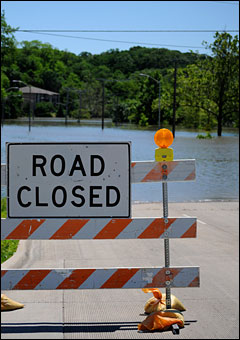
Roads and restaurants may be closed, but Iowa is getting back on its feet. Photo: Kurt Michael Friese The weather here in Iowa City has been gorgeous for more than a week. Is Mother Nature trying to make amends? While she smiles on us, she’s still causing trouble for our friends to the south. The […]
-
The costs of unsustainable agriculture
Here's a guest post from Rodale Institute CEO Tim LaSalle.
-----
Tom Philpott is right to highlight the tremendous ecological debt we've built up by depending on nitrogen fertilizer to run our crop production system. Depending on mined and fossil-fuel produced nitrogen for our food is no more sustainable than depending on peaking oil and mountain-top removed coal for our energy.
There's no more "cheap" food and fuel, because, really, there never was. The huge irony -- currently obscured by the psychological jolt of widespread shortages of food and fuel -- is that we were just learning of how not cheap industrial food has been:
-
Florida will buy out sugar company to restore Everglades
Nearly 300 square miles of sugar plantation in the Everglades will once again become marsh, as Florida Gov. Charlie Crist announced Tuesday that the state will buy the land from U.S. Sugar Corp. If all goes to plan, the $1.75 billion deal may be the largest environmental restoration in the history of the United States. […]
-
Agriculture and energy solutions to avoid the fate of North Korea
John Feffer has a good article over at Asia Times Online.
It points out the deep danger we're in -- how teetery both the world and America's food and energy systems are. It is well worth a read, particularly because of its clear articulation of the bind we're in -- the strategies we've used in the past to get out of disaster will only accelerate collapse in the long-term.. The tools we're using to get more food out of the ground take food from the future.
-
The toll of the shrimping industry on Southeast Asia
Southeast Asia would have fared better during the tsunami and the recent cyclone if the majority of the region's coastal mangrove forests were intact. Everyone accepts that. But many of the mangroves have been cut for firewood, largely to make way for shrimp farming. The cost of the mangrove-loss to coastal fisheries is great, since much of the food chain spends its early years amongst the trees' roots.
But the human cost, besides those lost in the flood waters, is also great: Labor abuses in the farmed shrimp industry are rampant. Read "The True Cost of Shrimp" (PDF) for details on the child labor, human trafficking, beatings, torture, and murder associated with these farms. There are also toxins that farm workers get to enjoy spraying into the shrimp pens to keep the critters from succumbing to infections. So, what to do?