Australia
-
Sea-dweller stops McConaughey in his tracks
The recent discovery of Irukundi jellyfish off the coast of Fraser Island, Australia, has stopped production of Fool's Gold, a sure-to-be-Oscar-contender starring Matthew McConaughey and Kate Hudson. The teensy-tiny toxic creatures ("no larger than a thumbnail") are usually found only in northern Queensland, but -- you guessed it -- warming temperatures seem to be pushing the deadly (and we mean deadly) critters south.
The upside: Now that global warming has deprived the world of the wacky romantic-comedy stylings of Matt and Kate for a few whole days, maybe the administration will finally have the motivation it needs to do something about global warming.
Yeah. And maybe Matthew McConaughey will finally go a whole day without taking his shirt off in public.
-
A cool new ad campaign from Victoria, Australia
This article, in which Al Gore lays out his basic position on nukes, contains nothing much new. He's said it all before in, among other places, our interview.
Thanks to Gristmill reader LA, however, for drawing my attention to this intriguing final bit:
Mr Gore ... yesterday met with [Victoria, Australia] Premier Steve Bracks and his deputy John Thwaites. He described Victoria as forward thinking on climate change and said he would take a number of local initiatives back to the United States.
He was particularly impressed with the Bracks Government's "black balloons" advertising campaign, which links household energy usage with the amount of carbon dioxide it releases into the air.
"I'm going to take that ad back and show it to some folks there, maybe put it on YouTube," he said.Well, I don't know if Gore put it there, but the ad's on YouTube now. Here it is:
-
Heart of a Howard
Australia plagued by historic drought, not-so-responsive leadership Wondering how Australia’s doing? It’s dry as a dead dingo, thanks for asking. The “Sunburnt Country” is undergoing a severe drought — the worst in 1,000 years, according to one expert. The lack of precipitation could cut agricultural output by 20 percent, and it’s only going to get […]
-
![]()
![]()
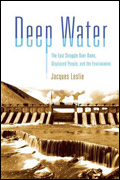
Jacques Leslie’s Deep Water sheds light on dam dramas
What does hell look like to an environmentalist? In the classic Encounters With the Archdruid, writer John McPhee imagines this particular inferno. The outer ring, he writes, is a moat filled with DDT. Inside lies another moat brimming with burning gasoline, and still deeper are masses of bulldozers and chainsaws. In the middle — at […]
-
New Asia-Pacific climate pact is long on PR, short on substance
Staunch U.S. allies, enviro activists, and just about everyone else was caught flat-footed last week when the U.S., Australia, and four Asian countries unveiled a new pact intended to help curb greenhouse-gas emissions. In the days since, some details about the surprise alliance have trickled out, but its mission and intended impact remain murky. Known […]
-
![]()
![]()
Bill Bryson’s books offer environmental ethics with a light touch
A Walk in the Woods, the venerable travel writer's best-selling 1998 account of hiking a portion of the Appalachian Trail, conjured memories of adventures I'd had as a kid in the forests where I grew up. Bryson seems to capture my dueling feelings about the woods: beautiful and inspiring from a distance -- "an America that millions of people scarcely know exists" -- yet disorienting and at times menacing from within. "[The] trees surround you, loom over you, press in from all sides," Bryson writes. "Woods choke off views and leave you muddled and without bearings. They make you feel small and confused and vulnerable, like a small child lost in a crowd of strange legs."
-
Poop is not funny
OK, maybe a little. Hot off the, er, presses: a company in Australia is seeking donations of kangaroo dung to make recycled paper. Inspired by African and Asian operations that make sheets from elephant excrement, Joanna Gair hopes to make "Roo Poo Paper" a household name. The "pooey" product has proven useful as a conservation fundraiser in some places and is, of course, a hit with the kids. "It's taken my breath away just how popular this [idea] is," Gair says. Which is not a funny quote at all.
Folks in Milford, Nebraska, might want to consider the same plan, since they just spent four months battling a massive, burning pile of manure at a feedlot. The 100-foot-long heap, estimated to weigh 2,000 tons, began smoldering due to organic action at its center (here's to the power of composting!). After the state Department of Environmental Quality cited clean-air violations, concerned parties spent several weeks pulling the pile apart, and finally quelled the fire. What a relief that is.
-
Uprisings down under
Who says there are no good protests anymore? Australian environmentalists used ice sculptures yesterday to protest their country's refusal to jump on the Kyoto wagon. Maybe frozen icons are just what the U.S. needs! (Insert hackneyed Al Gore joke here.)
-
An Aboriginal elder battles construction of a radioactive-waste dump in Australia
In the 1950s and ’60s, the British military conducted a dozen full-scale nuclear tests in the desert of southern Australia. To the military, the region was a wasteland, the best possible place for such a project; to the Aboriginal people who had lived in the desert for millennia, the land was their home. Eileen Kampakuta […]