Big Ag
-
![]()
![]()
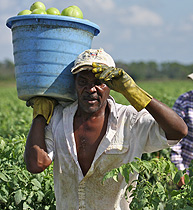
Another win for the Coalition of Immokalee Workers
Photo: Scott RobertsonOver the past week, much attention has been focused on the “B” part of that classic U.S. sandwich, the BLT. The swine flu outbreak has quite rightly raised questions about the environemtal/public health implications of modern industrial hog production. Almost lost amid the furor was much happier news about the “T” part of […]
-
![]()
![]()
Vilsack: biotech will solve our ag problems
USDA chief Tom Vilsack has been in Italy at the G8 meeting, talking ag policy with reporters. As the global hunger crisis lingers and climate-change and population fears fester, Vilsack is using the opportunity to push agri-biotech as the solution to the globe’s food needs. Here is the Financial Times: Mr Vilsack said the challenge […]
-
![]()
![]()
NPR: Industrial ag in India on the verge of collapse
Field of screamsIn a glowing Atlantic profile back in 1997, Greg Easterbrook declared Norman Borlaug the “Forgotten Benefactor of Humanity.” Borlaug is the intellectual father of what became known as the “Green Revolution,” the concerted effort by the U.S. government, leading foundations, and large agribusinesses in the 1960s and ’70s to deliver the gift of […]
-
![]()
![]()
Locavores are ruining food and free range pork will kill us
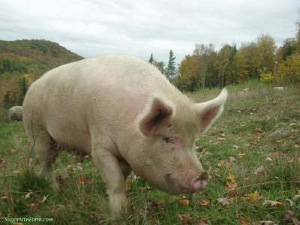
Get thee to a CAFO!Photo: pubwvjIn a recent op-ed, in The New York Times gravely informed its readers that free-range pork is deadly stuff. Despite evidence that incidence of trichinosis is very rare in the US–about 40 cases a year, and mostly caused by eating wild game (usually bear)-James E. McWilliams says that pork laced […]
-
![]()
![]()
Big Ag: give us carbon credit, but don't cap our emissions
As Congress gears up to consider climate legislation, agribusiness is getting sweaty palms -- and for good reason.
-
Farmers markets need rules if we want them to help the food system
Daniel Duane in Mother Jones warns you about farmers markets becoming “farmers markets”: In 1994, there were 1,755 farmers markets in the United States; by 2008, there were 4,685. In the big scheme of things, this is terrific news; it means Americans are learning to feed themselves properly. But not all parts of the country […]
-
New legislation would make the meat industry ‘just say no’ to antibiotic abuse
As debate around food safety regulation heats up — some might say, overheats — sublimely named Louise Slaughter (D-N.Y.) has introduced a House bill that would significantly affect farming practices in the United States. Called the Preservation of Antibiotics for Human Treatment Act, the bill would effectively prevent CAFOs (confined animal feedlot operations) from dousing […]
-
Would new food-safety legislation 'criminalize organic farming'? No
The Internets are abuzz with accounts of a House bill, allegedly sponsored by Monsanto and pushed through Congress by its lackeys, that would "criminalize organic farming" and even backyard gardening. The object of frenzy: H.R. 875, known as the Food Safety Modernization Act of 2009, a bill that attempts to bolster the broken food-safety system.
Here's how one critic, whose work circulates widely on sustainable-food listservs, characterizes it:
The bill is monstrous on level after level -- the power it would give to Monsanto, the criminalization of seed banking, the prison terms and confiscatory fines for farmers, the 24 hours GPS tracking of their animals, the easements on their property to allow for warrantless government entry, the stripping away of their property rights, the imposition by the filthy, greedy industrial side of anti-farming international "industrial" standards to independent farms -- the only part of our food system that still works, the planned elimination of farmers through all these means.
Wait, did she just say "the planned elimination of farmers"?
I've been reading hysterical missives about H.R. 875 for weeks. I could never square them with the text of the bill, which is admittedly vague. For example, the bill seeks to regulate any "food production facility" which it defines as "any farm, ranch, orchard, vineyard, aquaculture facility, or confined animal-feeding operation."
But then again, the USDA already regulates farms. And "24 hours GPS tracking of ... animals"? Not in there. "Warrentless government entry" to farms? Can't find it.
More recently, reading around the web, I found more reasoned takes on H.R. 875. The bill may not be worth supporting -- and from what I hear, it has little chance of passing. But it hardly represents the "end of farming," much less the end of organic farming. The Organic Consumers Association, an energetic food-industry watchdog, recently called the paranoia around H.R. 875 the "Internet rumor of the week."
-
Popular fumigant found to be a potent greenhouse gas
Update [2009-3-14 16:17:10 by Tom Philpott]:The original version of this post, titled "Strawberry Surprise," contained errors that I regret. I had mistakenly read the below-linked account of an MIT study to mean that sulfuryl fluoride was registered for use by the EPA as a pre-planting fumigant for strawberries. Actually, the chemical is registered only for post-harvest use on food, as well as a structural fumigant for termites. I also reversed the phrases "methyl bromide" and "methyl iodide" on two occasions. Again, I regret these errors.
-----------------
Chemical fumigants are a staple of the industrial-food system. They're used to sterilize soil before planting large monocrops, and also to control pests in stored food like grain and dried fruit. The building industry, too, uses them, mainly to fight termites. In the past, fumigants have caused much environmental damage, and tend to be quite toxic for humans, too. Now comes news that the building industry's new favorite fumigant -- sulfuryl fluoride -- is a greenhouse gas 4,800 times more potent than carbon dioxide, according to a recent MIT study.