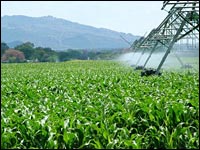
Big Ag
-
An innovative Alabama CSA shows the way forward.
When Wal-Mart announced plans to become the world's biggest purveyor of organically grown food last week, the polite applause from the enviro gallery grated on my ears. (Here's a spirited recent debate on Gristmill.) Even the New York Times editorial page could see through this move. While some greens cooed at at Wal-Mart's magnamity, the Grey Lady unleashed an appropriately cynical analysis:
There is no chance that Wal-Mart will be buying from small, local organic farmers. Instead, its market influence will speed up the rate at which organic farming comes to resemble conventional farming in scale, mechanization, processing and transportation. For many people, this is the very antithesis of what organic should be.... For "Wal-Mart" and "organic" to make sense in the same sentence, the company will have to commit itself to protecting the Agriculture Department standard that gives "organic" meaning.
I have no doubt that Wal-Mart's greenie admirers will hold the company's feet to the fire on that one. But the USDA's organic standards are already being drained of meaning. Rather than chide Goliath to behave nicely, enviros should consider helping David get his shit together. Check out what they're getting up to over in Birmingham, Ala.
-
A speculation about why ADM’s HFCS business is booming.
In the first quarter of 2006, as I reported yesterday, Archer Daniels Midland somehow managed to boost the price of high-fructose corn syrup (HFCS) despite mounting concern over the sweetener's health effects.
The company booked a cool $113 million profit from HFCS over the quarter, more than three times more than it netted in the same period a year before ($33 million). This, despite a slowing domestic market for sweet soft drinks, as consumers increasingly switch to juice and bottled water. The company's official explanation -- "increased sweetener and starch selling prices" -- doesn't explain how it managed to make price hikes stick.
I think I've figured it out. And the explanation has everything to do with Brazil, sugarcane, and ethanol.
-
On the art and brutal economics of small-scale farming

Since moving to the North Carolina mountains in 2004 to launch a farm project, I've learned some sobering lessons about idyllic rural life.
To wit, small-scale organic farming is an art form -- and as with most artistic endeavors, the hours are long and the pay is crap. How did I wind up penniless and exhausted, sporting a beat-up pair of Carhartts? You'd think I had set up shop as an abstract painter in some squalid, ruinously priced Williamsburg, Brooklyn, garret.
(There's much to love about the farming life, too: for example, the volunteer broccoli raab that's sprouting up everywhere in one part of the garden, a triumph of unintentional permaculture. Saute it with a little olive oil, garlic, crushed chile, and vinegar, and you remember why you came to the farm in the first place.)
The USDA's Economic Research Service recently released two reports on the state of farm economics. The information contained therein can help greens as they formulate an agenda for the 2007 Farm Bill (which may be even more important than defending biofuel and hybrids from critics.)
-
The Meatrix II: Now playing at a website near you

Ladies and gentleman. Boys and girls. The Meatrix II: Revolting is finally here. Help Leo, Moopheus, and Chickity fight factory farms. -
Agriculture interests push ambitious renewable-energy goal
A few more strange bedfellows have recently been coaxed into the sack with the enviros, hawks, and labor advocates pushing for a smarter U.S. energy strategy. The newbies include growers of corn, soy, wheat, trees, and even dairy cows, all of which could play a role in cultivating homegrown energy sources. Farmers have gotten wind […]
-
A food-politics writer expresses angst at the obscurity of his topic

The other day, a prominent Canadian journalist paid me a visit to interview me for his book on building a sustainable future. At one point, I expounded on the closed-nutrient cycle of old-school organic farming, contrasting it with what writer Michael Pollan deemed the "industrial-organic" way. In the old-school organic style, which relies on animals, farm wastes are recycled into the soil, providing all the nutrients necessary for the next harvest. The industrial-organic farmer, by contrast, imports his or her soil fertility -- just like the conventional farmer. The difference is that the organic farmer is likely shipping in composted manure from far-flung places, while the conventional grower is hauling in a processed petroleum product.
"The problem," I continued -- my interlocutor's eyes may well have been glazing over -- "is that most small vegetable farms these days, including my own, don't have enough animals to produce the nitrogen we need. So our transition to real organic farming is ongoing."
The journalist then asked me a question that stopped me short: "Do you think real organic farming could feed the world?" I stammered something like "I hope so," and had him jot down a couple of books to look up. It wasn't until after he left that I realized why his question made me so uneasy.
-
![]()
![]()
How the feds make bad-for-you food cheaper than healthful fare
If you’re going to talk about poverty, food, and the environment in the United States, you might as well start in the Corn Belt. So good, and so good for you — until it’s turned into soda. Photo: stock.xchng. This fertile area produces most of the country’s annual corn harvest of more than 10 billion […]
-
ADM is doing for soil what Exxon has done to air
Amid all the hoopla over President Bush's State of the Union address, Archer Daniels Midland's quarterly report (PDF), released Tuesday, got little attention outside of Wall Street -- where it drew cheers, sending ADM's share price to an all-time high.
At the company's conference call with analysts, the Wall Street Journal reports, John M. McMillin of Prudential Securities "likened [Archer Daniels Midland] to Exxon Mobil Corp., which just announced its own record-breaking profit and jokingly suggested the company might be called upon to explain its profits."
Actually, McMillin's comparison isn't all that comical. Just as ExxonMobil clawed its way to the top of the corporate heap by peddling an environmentally ruinous commodity whose real costs don't burden its balance sheet, ADM's "blowout" profits can be traced directly to government largesse. Oh yeah, and both companies owe much of their surging profitability to making fuel for cars.
-
The WSJ documents GM contamination
The Wall Street Journal came out with a terrific page-one article documenting "genetic pollution" -- the damage caused when genetically modified crops cross-pollinate with conventional crops.
The article leads with an organic farmer in Spain whose sells his red field corn at a premium to nearby chicken farmers, who prize the product because it "it gives their meat and eggs a rosy color." (I'd be willing to bet that rosy color also translates to higher nutrition content.)
Now the farmer is screwed -- his seeds, carefully bred over time, have become contaminated by GM corn from nearby farms. The rich red color of his corn, like his premium, has vanished into the ether.