biofuels
-
Saddening video report on Indonesian palm oil plantations
Here is a short, painful four-minute news report about palm oil plantations -- watch it and weep:
-
Feeding ethanol waste to cows
Perhaps the most persistent debate around corn ethanol involves its “net energy balance” — that is, whether it consumes more energy in production than it delivers as a fuel. Even the studies that credit the fuel with a robust energy balance, like this one from the USDA, acknowledge that it’s pretty much a wash unless […]
-
Umbra on cooking oil, again
Dear Umbra, You missed a fantastic opportunity to promote biodiesel use of the cooking oil. There are many people collecting frying oil from restaurants and the like, and perhaps the reader could find a person collecting as well. Check newspaper ads for persons collecting or check the restaurants in your neighborhood for who is collecting. […]
-
The global nature of global warming
This is my formal rebuttal to Brooke Coleman (director of the Renewable Energy Action Project), specifically to comments found in Tom Philpott's latest corn ethanol article. I'm using my access to the bully pulpit to pull it out of comments, like I did the last time a corn ethanol enthusiast joined the discussion.
Welcome to the best environmental blog on the planet, Brooke. You don't seem to have a very high opinion of this community, but maybe you'll warm up to us. I don't speak for the whole community of course, I'm just one of the many who come here to learn and engage in reasoned debate.
You seem to think that anything is better than oil. But believe it or not, in the real world, we sometimes have to pick between the lesser of two evils, at least until something better comes along.
Plowing under the world's remaining grasslands and forests to grow industrial agrofuels dwarfs the damage done by oil spills. What happens when you take grain off the world food market and stuff it into American gas tanks? I'll tell you. Someone somewhere on this planet takes advantage of the high prices to plant more of it to fill the hole in the human food chain. Where is the arable land they need to do that? It is under an existing carbon sink or has another crop on it already. The second leading cause of global warming is deforestation. How hard is that concept to understand? Global warming is global. What we do here screws everybody.
-
The corn industry hopes Congress will pull its fat out of the fire
I used to love to start my writing day by taking a poke or two at the corn-based ethanol industry — you know, the biggest greenwash ever. Photo: mrobenalt These days, the debunking of corn fuel almost seems like it’s piling on. Today, two major newspapers — the LA Times and The Wall Street Journal […]
-
Food prices going up, along with everything else
From an article in the Telegraph by Ambrose Evans-Pritchard (Hat tip to Gristmill reader KO):
What has abruptly changed is the twin revolution of biofuel politics and Asia's switch to an animal-protein diet. Together, they have shattered the fragile equilibrium.
Investors who want to take advantage of agflation must tread with care, both for moral reasons and questions of timing.Riiiight ... moral reasons.
The way I see it, you can go the PETA route and call the closest thing the environmental movement has to a hero (Nobel Laureate Al Gore) a hypocrite for eating meat, replete with a bulbous-nosed, pot-bellied caricature, or you can admonish your politicians to stop supporting biofuels. I suppose you could do both. I'm concentrating my firepower on the biofuel side of the equation.
Industrial agrofuels are still in their infancy. They have to be stopped now, before it's too late. As consumers, voters, and peaceful protesters, we have a measure of power. Let's start using it. Find an effective way to convince humanity to eat fewer animal products and I'll support that effort also.
More quotes from the article under the fold:
-
Is there really so much money in environmental devastation that it can’t be stopped?
In the Nov. 12 New Yorker, Elizabeth Kolbert published an article (unavailable online; abstract here) typical of her style: spare, restrained, vivid, cogent, devastating. The topic was Canada’s tar sands, now being profitably exploited by the major oil companies: Shell, Conoco-Phillips, Chevron, and ExxonMobil. And they’ve only just begun. According to Kolbert, the oil majors […]
-
An alternative view on biofuels, from a Briton in Sudan
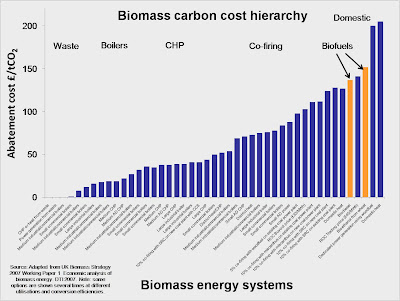 I've just discovered a great blog maintained by Clive Bates, a self-described "selfless public servant, amateur chef, novice mountaineer, lawless cyclist, overweight runner and occasional optimist." He is being modest: he's the former head of ASH (Action on Smoking and Health) in the UK and more recently the Head of Environmental Policy at the UK Environment Agency.
Over the last two years, Bates has written extensively and persuasively on a wide range of topics, particularly on environmental and energy policies, and climate change.
In his latest post, about biofuel policy, Bates states:
Instead of asking how to reduce transport emissions from road fuel substitution, we should be asking how to make use of land to tackle climate change in the most effective way possible. In coming up with the biofuels targets, policy-makers have asked, and answered, the wrong question. It's not hard to see why ... transport policy-makers have to find transport policies. The results: waste, damage and lost opportunities to do better ...
He starts off:
-
Is it something in the air?
Interesting things are happening in the francophone world. Last week I reported that the Quebec government had decided to stop supporting any new ethanol plants based on corn as a feedstock. Now the French government, perhaps flowing out of its broad social dialogue on the environment (known as "Le Grenelle français de l'environnement"), is reported to be thinking of slashing subsidies benefiting the production of ethanol in the country.
Ooh la la, what in the world is going on?
