cars
-
It’s not the key to making renewables work
In his post on the potential of our current grid to support electric cars, John McGrath mentioned V2G in passing.
Electric cars (either hybrids or full EVs) have the potential to be a real-life silver bullet. Anyone who advocates for increased use of renewables is inevitably confronted with the problem of intermittency. With wind, the rule of thumb is that if grid energy supplied by wind grows to more than 25-30%, utilities need to spend prohibitive amounts on "spinning reserve" to even out supply.
Well, a nation driving plug-in hybrids makes for a spinning reserve of amazing proportions according to one estimate (PDF), the U.S. fleet would power the U.S. electrical grid seven times over.What these estimates neglect is the capital costs of the batteries themselves. The assumption seems to be that since car owners have the batteries anyway, the economics can be calculated based on operating costs -- electricity and inconvenience.
-
Read and be dazzled by the techno-futurism
 David asked contributors for end-of-year lists. Since I normally focus on conservative assumptions, I thought I'd use it as an excuse to look at future breakthroughs and cost improvements.
I was going to weasel by calling these "possibilities," but instead I decided to use the time-tested technique of public psychics: I'll call them predictions, crow over any that come true, and pretend the rest never happened.
1. Power storage that will make electric cars cheaper than gasoline cars.
Ultracapacitors, various lithium systems, lead carbon foam (PDF), and aluminum are among the candidates. The first storage device with a price per kWh capacity of $200 or less, mass-to-power ratio as good or better than LiOn, and ability to retain 75% or more of capacity after 1,000 cycles in real world driving temperatures and conditions wins.
-
Hybrids connected to the electrical grid could change the energy game
The U.S. Department of Energy has concluded that the existing U.S. electrical grid -- without additional construction for generation or transmission -- could accommodate 180 million cars that draw their power from night-time (off-peak) electricity. That's about 85% of the cars in the country.
The full report is not yet available, but based on the press release, there's lots of good news -- with some bad news mixed in.
-
An interview with Greasecar founder Justin Carven
Justin Carven. In the span of just two years, Justin Carven invented the first waste-oil conversion kit for diesel engines, graduated from Hampshire College, drove a vegetable-oil-fueled van across the country, and started his very own company. Six years later, Greasecar Vegetable Fuel Systems is selling so many conversion kits that Carven is talking about […]
-
Flex-fuel vehicles greenwash Detroit’s SUV addiction.
David mentioned something about it when it came out a couple of months ago, but as Grist wraps up its first week of biofuel coverage, it's worth pointing to again: after much testing and comparing, Consumer Reports finds the whole live-green-go-yellow, E85 thing pretty much a sham.
As Grist readers will know, the government gives automakers a credit against their mileage requirements for every flex-fuel vehicle (able to run on ethanol, gas, or a mix).
CR's conclusion: Detroit is using it a lever to help it churn out more gas-guzzling SUVs, and the policy is working to increase fossil fuel consumption, not stem it.
The most depressing finding, for me: the greenwash appears to be sticking with the general public:
-
An interview with Seattle biodiesel distributor Dan Freeman
Dan Freeman. As a kid, Dan Freeman experimented with using alcohol to run lawnmowers and minibikes. (Oh, to have been a fly on the wall for that parent-son conversation.) These days, he runs Dr. Dan’s Alternative Fuel Werks, a Seattle-based biodiesel retail and distribution company with customers ranging from school districts to organic farmers to […]
-
![]()
![]()
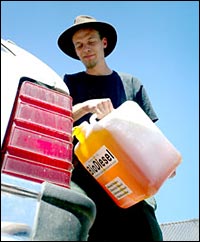
Using grease and other goodies, small biodiesel producers are making a big difference
If you live in a city of any size, you’ve likely seen them out there: boxy little ’80s-era foreign cars, bumpers adorned with pro-ecology and anti-war slogans, and references to “grease.” Even the fumes they emit may smell different: literally like French fries, in some cases; like generic used vegetable oil in others. Foh sizzle […]
-
![]()
![]()
Find out which cars can run on ethanol and biodiesel
Going bio with your auto doesn’t mean you have to invest in some strange contraption your neighbors will stare at. In fact, upward of 4 million cars currently on the road in the United States are already compatible with E85, a blend of 85 percent ethanol and 15 percent gasoline. More automakers are making new […]
-
Car-maker planning to expand the family
The Prius may soon be more than just one oh-so-stereotyped hybrid motor vehicle. Toyota's talking about starting a family of the cars, and in this case I'd have to support wanton reproduction.
The automaker announced this week that they are considering creating a line of the gasoline-electric cars. It could include a wagon and a smaller, Smart-Car-esque inner-city model.