Grist List
-
![]()
![]()
Grow a real garden in a LEGO greenhouse
Well, here's an innovative urban gardening solution -- a greenhouse made of transparent LEGO bricks that grows real plants in LEGO mulch.
-
![]()
![]()
People know how to eat better, they just can't afford it
We know, we know -- you just got done patting yourself on the back over that New York Times graphic showing that healthy food is cheaper than fast food. If you were operating on a really tight budget, we're sure you'd be able to pull off super-wholesome eating for your whole family! Here's the thing, though: For most actual poor people, it's not that simple.
-
![]()
![]()
How DIY and the ‘IKEA effect’ make us green
The "IKEA effect" says that we value things we have built ourselves (even if those things are frankly a little crappy). I'd propose an extension -- call it the "DIY effect," which says we tend to hold onto, repair, and upgrade things we build ourselves, breaking us out of the consumerist cycle of trashing what's old so we can capitalize on the (often-illusory) advantages of the latest and greatest.
-
![]()
![]()
Navy Secretary says getting off fossil fuels is just like ditching sail power
Ray Mabus, Secretary of the U.S. Navy, has a refreshing historical perspective on the Navy's efforts to end its dependence on our increasingly expensive and environmentally destructive supplies of oil. From a speech he recently gave at the National Clean Energy Summit 4.0:
In the 1850s, we went from sail to coal. In the early 19th century, we went from coal to oil, and in the 1950s, we pioneered nuclear.
-
![]()
![]()
Report: We have plenty of water, we’re just dumb with it
We have enough clean water worldwide, we're just not using it well, a new study says. The report, produced by the Challenge Program on Water and Food, looked at 10 river basins, from the Ganges to the Nile to the Andes, and found that, "There is clearly sufficient water to sustain food, energy, industrial and environmental needs during the 21st century."
-
Critical List: Energy Dept. picks more winners; natural gas boom comes to Ohio
The Department of Energy, always picking winners, you know? The first Quadrennial Technology Review, to be released today, favors technologies that could come into commercial use in 10 years — i.e. consumer goods you can spend money for. This could mean DOE favors EVs over new clean energy technologies.
This company, Renmatix, will probably make it under the wire, though. It says it has the right technology to make commercially viable biofuels from biomass and just opened a plant to forward development of the technique.
The natural gas boom comes to Ohio.
Although Beijing usually gets a bad rap on pollution, Central and South Asia are not great places to live if you like inhaling clean air, either. -
![]()
![]()
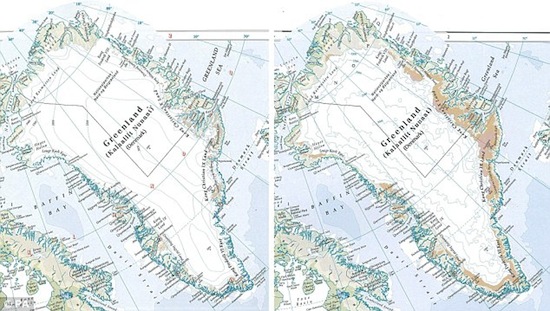
Atlas error overstates Greenland's (still significant!) ice loss
Here's the good news: Greenland did not lose 15 percent of its ice cover in the last 10 years, as the Times [Usually] Comprehensive Atlas of the World said it did. This is, in fact, really good news, since this amount of melting would raise sea levels three to five feet. The publisher, HarperCollins subsidiary Collins Geo, has retracted the 15 percent figure but says it's "reviewing" the map -- but in the meantime, a whole bunch of scientists went "whoa whoa whoa there."
-
![]()
![]()
Well, that's one way to recycle your bottle caps
This Chuck Close-style self-portrait by Mary Ellen Croteau is entirely made of discarded bottle caps. (A lot of them are from sodas, but deodorant caps, childproof pill container lids, soap bottle-style pumps, and tops from bottles of saline solution and eyedrops are also represented, along with probably many more.) This is possibly not a practical recycling solution for everyone, but you gotta admit it looks amazing.
-
![]()
![]()
Engineers: We have all the tech we need to cut carbon
Apparently the world's engineers are getting sick of being told that cutting emissions is an engineering problem. Eleven of the biggest engineering organizations have released a joint statement saying, in effect, "You want carbon cuts? We can give you carbon cuts. Just say the word, smart guy."
We already have all the tech necessary to cut emissions 85 percent by 2050, say the engineers. What we don't have is support from governments -- laws that prioritize carbon reduction, and funding to put the technology into action.