interview
-
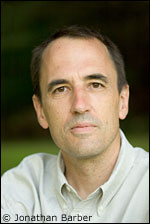
Jim Moriarty, president of Surfrider Foundation, answers questions
Jim Moriarty. What work do you do? I work at an environmental, action-sports-oriented nonprofit called Surfrider Foundation. What does your organization do? We exist for the protection and enjoyment of oceans, waves, and beaches. Two examples: we fight for clean water and beach access. How do you get to work? Mini Cooper S or telecommute. […]
-
Tierra Del Forte, eco-jeans designer, answers questions
Tierra Del Forte. What work do you do? I’m a designer and the founder of Del Forte Denim. How does it relate to the environment? We design and manufacture a line of premium organic denim for women. We also strive to educate consumers about the dangers of conventional cotton agriculture and the restorative effect of […]
-
A chat with Andy Revkin about Inhofe’s attack
 Andrew Revkin has been reporting on climate and science for The New York Times for over 10 years. He recently completed a book about his experiences in the Arctic: The North Pole Was Here, a straightforward but appealing you-are-here account of visiting the top of our home planet, where the air is thin, the "ground" is ice floating on the ocean, and everything is changing. The story is intended to be accessible to anyone over the age of ten. (The first chapter is available for free on the NYT site.)
You might think it unlikely that a children's book would warrant the attention or ire of a U.S. senator -- but then, you may not know Marc Morano. Morano is a communications director for Senator James Inhofe (R-Oklahoma), a former staffer at The Rush Limbaugh Show, and the first in the media to publicize the smears of the Swift Boat veterans. Since joining Inhofe's staff, Morano has issued communiques from the office of the Senate Environment Committee, which Inhofe chairs, blasting reporters that fail to give equal time to climate skeptics. (Read about Morano's attacks on AP reporter Seth Borenstein and ex-NBC anchor Tom Brokaw.)
Neither the senator nor his attack dog appear to have read Revkin's book, but it has drawn their fire nonetheless -- not because of what it says, but because it was written by a reporter.
According to a story broken by Greenwire (paid subscription required) on Wednesday, Morano called into doubt the 20 years of Revkin's reporting on climate change issues because "sales of Revkin's book ... would be enhanced by his paper's coverage of climate." Morano said: "We're not just shooting arrows."
I contacted Revkin to hear his point of view on the strange situation.
-
Israeli eco-activist and student Roey Angel answers questions
Roey Angel. With what environmental organization are you affiliated? I’m a graduate student at the Arava Institute for Environmental Studies, a regional center for academic studies and research. It’s a rather unique place where Palestinians, Israelis, and Jordanians — as well as North Americans and Europeans — study the environment, live together, and do joint […]
-
![]()
![]()
An interview with Jeff Goodell, author of Big Coal
In 2001, around the time Dick Cheney’s secret-recipe energy plan made its debut, Jeff Goodell went to West Virginia to report on coal’s rising fortunes. He’d been sent to do a story for The New York Times Magazine, but the material spilled over into a book, Big Coal: The Dirty Secret Behind America’s Energy Future, […]
-
Blake Mycoskie, founder of eco-friendly driving school, answers questions
Blake Mycoskie. What’s your job title? I’m cofounder and chair of Drivers Ed Direct. How does your work relate to the environment? Photo: Drivers Ed Direct. We teach kids to drive in hybrids, which makes them more comfortable with the technology and educates them about environmental responsibility. We believe this makes them more likely to […]
-
Interview with makers of Who Killed the Electric Car?
Hoping to share a little bit of the spotlight with that other eco-themed documentary -- alongside which it debuted at the Sundance film festival -- Who Killed the Electric Car? will drive (without emissions!) into theaters next month (or tomorrow, if you're in NYC or L.A.).
On June 9, I sat down for a wide-ranging discussion with Chris Paine, the director, Chelsea Sexton, an activist prominently featured in the film, and Wally Rippel, an engineer who played a role in developing the power system for the late, lamented GM EV-1.
For still more electric-car interview fun, go here.
-----
DR: So I started watching this movie, about this one peculiar car, and then about halfway through all the sudden I'm watching a movie about fuel economy and global warming and energy security. Did you use the former as a hook for the latter, or did the former just carry you into the latter?
CP: That's an excellent question. When I started filming I wasn't thinking [about the bigger issues], but by the time we were editing it's like, this is such a great microcosm.
It's more than a car story, you know. I mean, much more than a car story.
DR: How did you hear about the EV? I'm sure I'm not the only one who had no idea it even existed before the movie came out.
-
Ed Wilson, Earthwatch CEO, answers Grist’s questions
Ed Wilson. What’s your job title? President and CEO of Earthwatch Institute. What does your organization do? First, we help gather objective science-based information that allows us all to understand complex environmental and social issues and make informed and sustainable management decisions. We support over 130 research expeditions in 55 countries that help inform important […]
-
Bryant Terry, food-justice activist, answers questions
Bryant Terry. What work do you do? I’ve committed myself to feeding people; illuminating the connections between poverty, malnutrition, and institutional racism; and working to create a more just and sustainable food system for everyone. b-healthy gets teenagers cooking. In 2001, I founded b-healthy (Build Healthy Eating and Lifestyles to Help Youth), a New York […]