temperature
-
NOAA: Models indicate El Niño will continue through Spring 2010
We seem to have settled into a moderate to strong El Niño. NOAA’s latest weekly update on the El Niño/Southern oscillation, “ENSO Cycle: Recent Evolution, Current Status and Predictions“ shows that the key region of the Pacific Ocean has stayed quite warm for all of November (see here for figures and data). The question is […]
-
NASA figures compare 2009 to the two hottest years on record
NASA’s Goddard Institute for Space Studies posted these fascinating figures last week (click for PDF). Yes, the one place in the world where it warmed the least this year is, of course, the good old (continental) U.S. of A. I noted last week that NASA reports hottest June to October on record*, but the figure […]
-
NASA reports hottest June to October on record
Fast on the heels of the hottest June to September on record*, NASA’s Goddard Institute for Space Studies reports that last month was tied for the second hottest September on record (after 2005). Unlike NOAA, which announced its October global analysis with a major “State of the Climate” monthly update, NASA just quietly updates its […]
-
Record high temperatures far outpace record lows across U.S.
Spurred by a warming climate, daily record high temperatures occurred twice as often as record lows over the last decade across the continental United States, new research shows. The ratio of record highs to lows is likely to increase dramatically in coming decades if emissions of greenhouse gases continue to climb. This graphic shows the […]
-
El Niño-driven sea surface temperatures still soaring.
Last week I noted “El Niño-driven sea surface temperatures are soaring. Forecast: Hot and then even hotter.” They are still soaring. NOAA’s National Weather Service Climate Prediction Center has a good animation of tropical Pacific SST anomalies: The warming in the Nino 3.4 region of the Pacific is typically used to define an El Niño […]
-
Arctic ice reaches historic seasonal low
The multiyear ice covering the Arctic Ocean has effectively vanished…. “I would argue that, from a practical perspective, we almost have a seasonally ice-free Arctic now, because multiyear sea ice is the barrier to the use and development of the Arctic,” said Barber [Canada’s Research Chair in Arctic System Science at the University of Manitoba]. […]
-
El Niño-driven sea surface temperatures are soaring.
Last week I noted that the weak El Niño appears to be strengthening, as expected, so record temperatures will continue. The warming in the Nino 3.4 region of the Pacific is typically used to define an El Niño — sustained postive sea surface temperature (SST) anomalies of greater than 0.5°C across the central tropical Pacific […]
-
The weak El Niño appears to be strengthening
Two weeks ago I blogged that NASA reports hottest June to September on record; NOAA says “weak” El Niño “expected to strengthen and last through” winter. NOAA’s National Weather Service Climate Prediction Center (and most other models) have been predicting for a couple of months that the weak El Niño would strengthen, but it hasn’t. […]
-
![]()
![]()
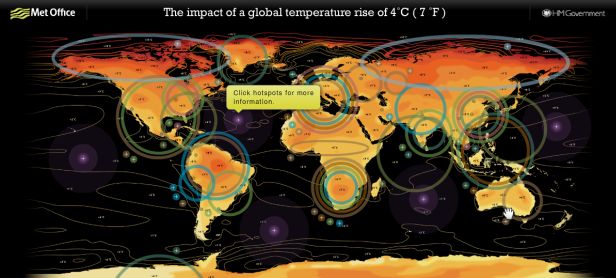
New interactive map shows devastating effects of global temperature rise
No need to waste your money on the new apocalyptic thrillers coming soon to theaters. A new world map released Thursday by the British government, and unveiled at the Science Museum in London, provides plenty of real life doom and gloom — and it’s free! The slick and colorful interactive graphic shows what a 4 […]