toxics
-
We need to stop blaming victims of breast cancer and start researching envirotoxicity
Having been touched by breast cancers in numerous women important to me, I've long been astounded by the extent to which discussions of the subject start by blaming women -- you picked the wrong parents, you didn't have your kids soon enough, you forgot to have kids, you ate too much, you ate the wrong things ... on and on and on.
Sandra Steingraber, Ph.D, an environmentalist and brilliant poet, writes about the medical-industrial complex and its instant assumption that the genesis of cancer is in the genes in her outstanding book Living Downstream. Sadly, her message seems to have been shrugged off by industry and the agencies charged with protecting public health. The media watchdog group FAIR (Fairness and Accuracy in Reporting) has a nice new piece in the February 2009 issue (alas, not yet available online) on the media's code of silence with respect to the environmental causes of cancer.
It's worth a trip to the library or magazine stand to check it out.
Meanwhile, there's a good discussion of the topic that starts at about 18:40 in this week's "CounterSpin," the FAIR radio program.
The bottom line: environmental insults are at least as significant as the usual factors discussed around incidence of breast cancer in the US -- but are studied far less, and are almost entirely absent from the wave of feel-good pink bushwa that floods the media every year during "Breast Cancer Awareness Month."
The sterling SF Bay-area group Breast Cancer Action has been a real leader in refusing to allow industry to bury the connection between their emissions and women's breast cancers. For a good example of their work, check out this factsheet on breast cancer and the environment.
-
Children are externalities
"So many people are wondering why, when our lives are supposed to be getting better, there are more and more babies born with birth defects and couples who are infertile."
-- Chinese environmental activist Huo Daishan, on the alarming rise in birth defects in his country
-
Things I don't like to see on my soap label
Warning: Trivial content ahead. Do not read if you are seeking the latest developments regarding carbon taxes, coal, or cap and trade.
My quest for a suitable hand soap has become somewhat epic in scope. Said soap must meet several criteria: a) an ingredient list that doesn't make me squirm; b) a reasonable price point; c) a scent that doesn't make my fella wince.
More often than not, my quest is shelved by the logistical hiccup known as "we ran out of soap" -- in which case I end up at the local grocery store, scouring labels and sniffing scents and getting frustrated and generally looking like a crazy old soap lady.
-
Recent food safety struggles suggest the limits of regulation
It's been a bad week for food safety. First it was the peanut butter, then it was the high fructose corn syrup, and now it's deadly antibiotic-resistant staph bacteria (MRSA) in CAFO pigs (and their minders). And of course, as Bill Marler -- litigious scourge of the food industry -- reminds us, we're continuing to lose the fight against E. coli.
Much has been written about the efforts to track down the sources of contamination. And invariably the companies involved quickly close the their doors (which is how we lost one of the largest ground beef distributors in the country virtually overnight and why the Peanut Corporation of America is no more). But what's truly worrisome is that in each case, the USDA and the FDA (who have joint responsibility for food safety) had information at hand about all of these problems.
In the case of the peanut butter outbreak, the plant in question had a long-documented history of health violations -- discovered, not by the FDA, but by local Georgia authorities to whom the FDA had contracted out inspection services. In essence, short of allowing self-regulation, the FDA managed to find an entity that enjoys even cozier relationships with industry than the FDA itself has. In theory, the Georgia Agriculture Department should have forwarded on reports of violations to federal officials. There's no word yet on where in the lines of communication the breakdown occurred.
-
![]()
![]()
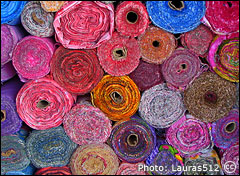
Umbra on organic fabric
Dear Umbra, First let me say that I just discovered your column and have been happily spending most of my time reading your archives. Excellent stuff! I am a total fabric geek; I love to make my own clothes and other fabric-y items, but I worry about synthetics and chemical dyes and chemically grown fibers. […]
-
![]()
![]()
Umbra on smoke detectors
Dear Umbra, How should we safely dispose of old smoke detectors? Don’t they have small amounts of radioactive material in them? We tried bringing them to our town’s recycling center, which refused them, and the board of health would not take them at the hazmat pick-up day. It seems really wrong to toss them in […]
-
Texas journalist paddles Gulf Coast to show shifty ecosystem and toxic threats
I've canoed beneath freeway overpasses in Seattle's Union Bay, but I somehow never undertook anything like this: San Antonio Express-News reporter Colin McDonald is kayaking the length of the Texas Gulf Coast, some 370 miles of alternating natural shoreline and industrialized landscape. He's blogging about the journey at Uncharted Coast, so named because the constantly shifting line between land and water has frustrated map-makers for centuries.
Having so far avoided the barges and tanker ships that ply the coastal shipping lanes, McDonald documents the unholy mix of wildlife diversity and intensive industrial use. He encounters a lot of remaining damage from Hurricane Ike and chats up locals who regale him with tales of pirates (of the insurance company variety, but still).
It's a nice bit of explanatory journalism that shows just how little separates resort-lined beaches from toxic sites like the McGinnes storage pits. McDonald also wrote an overview of the trip for the Express-News.
-
DDT, other contaminants persist in Columbia River
As the Columbia River runs its 1,200-mile course from a Canadian glacier out to the Pacific Ocean, it passes by one nuclear production complex, 13 pulp and paper mills, and countless agricultural areas, mines, and sewer outflows from major cities.
So perhaps it should be no surprise that the U.S. EPA recently found that the river -- which drains a 259,000-square-mile basin covering seven U.S. states and part of Canada -- is carrying "unacceptable" levels of contaminants like mercury, DDT, PCBs, and PBDEs.
Although other river systems like the Mississippi and the Colorado contain comparable levels of DDT, PCBs, and mercury, an EPA official said that reducing pollution in the Columbia basin would be a high priority. This is good news for many Northwest tribes who rely heavily on Columbia River fish for their diet. It's also important news for the region's salmon populations, which use the Columbia and its tributaries as spawning ground.
So how did these contaminants end up in the river? Here's a rundown, courtesy The Oregonian:
-
What's it going to take to enact proactive energy and environmental policy?
While the TVA hand-wringing went on at Senate hearings in Washington, D.C., another coal pond broke last week at the Widows Creek Fossil Plant in Jackson, Ala.
Not that we didn't know: Widow Creek was listed in a recent Environmental Integrity Project report as one of the worst 50 coal-fired power plant pollution "wet dumps" because of its toxic metals.
The "spill," this time in Alabama, according to the first reports, leaked "only gypsum."
Earlier this week, coal sludge was released into the Ocoee River Gorge in eastern Tennessee, as the TVA sought to repair a sediment dam. According to the state Department of Environment and Conservation, "Forest Service employees were walking the stream bank picking up what dead fish they could find ... No live fish were seen."
These accidents beg the question: How much longer are we going to sit back and allow crisis management to determine our energy and environmental policies?
What's it going to take? Dead bodies?
As Appalachian Voices editor Bill Kovarik pointed out, "The effusive praise in the hearing Thursday morning Jan. 8 went beyond the standard courtesies afforded witnesses in Senate hearings, perhaps because it was clear that the TVA's CEO was a relic of a bygone age who would need to be handled with respect and care as he was ushered out the door."
Instead of courtesies and crisis management, we need to:
- Phase-out all wet storage of toxic coal ash.
- Inspect all toxic coal ash storage and disposal units.
- Enact federal regulation of all toxic coal ash storage and disposal.
In the meantime, the EIP report found: