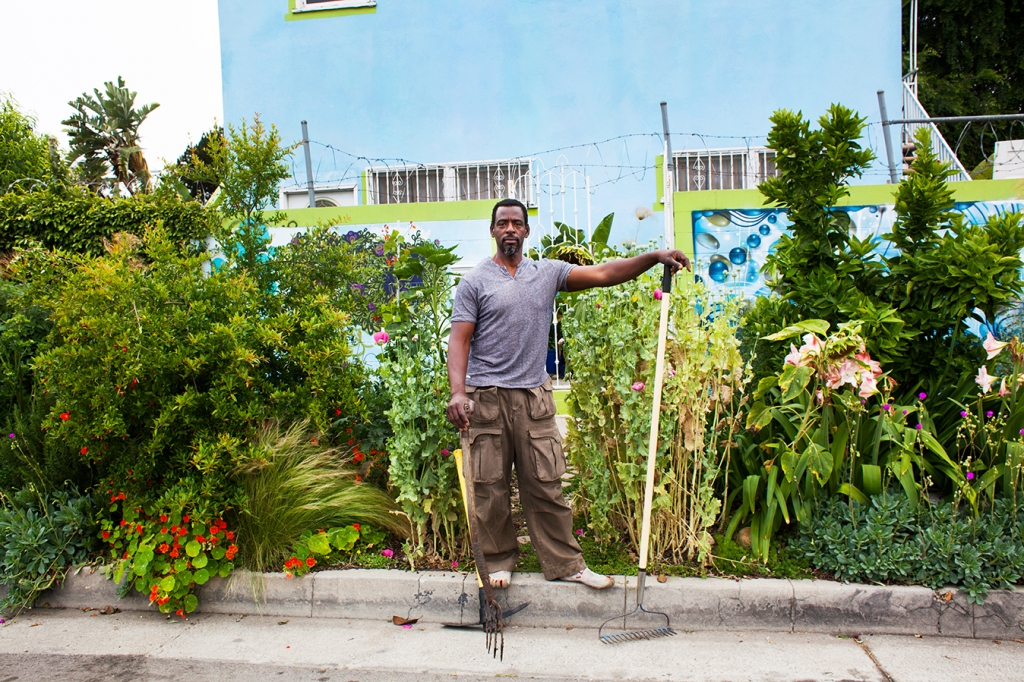
In 2010, Ron Finley planted a garden on the 150-foot-long curbside strip outside his house in South Central Los Angeles. The produce — tomatoes, kale, corn, you name it — was free for the taking, and the colorful riot of herbs and flowers and vegetables got a lot of attention. The only unwelcome scrutiny was from the city of Los Angeles, which owns the land. Finley received a citation for growing plants that exceeded height limits, and for failing to purchase a $400 permit. By circulating a petition and bending the ear of a receptive city council member, Finley convinced the city to leave his garden alone. Around the same time, he helped start an organization called L.A. Green Grounds, dedicated to installing free vegetable gardens in curbside medians, vacant lots, and other properties in blighted areas.
Susie CagleJoin Grist as we explore the wild landscape of our cities.
Then, in February of this year, the self-described “gangster gardener” — an outgoing straight-talker with a penchant for catchy one-liners — gave a TED Talk. “The drive-throughs are killing more than the drive-bys,” he said, exhorting urban dwellers to get outside and “plant some shit.” The talk instantly rocketed him to green-thumb stardom. As of this writing, the talk has attracted more than 1.3 million views, and Finley has appeared on Russell Brand’s late night talk show and been profiled by The New York Times, among many others.
This fashion designer — he’s dressed the likes of Shaquille O’Neal — and collector of black entertainment memorabilia, highlighted in a recent movie poster exhibit, now spends much of his time delivering talks and planning new urban gardening ventures. All the media attention has brought new funding, including support from the Goldhirsh Foundation. (But in Los Angeles, the bureaucratic wheels grind slowly. Planting on curbside medians remains a tricky proposition.)
Finley had just returned from a permaculture workshop in Sonoma County when we spoke. We chatted about fame, sex, and his diabolical plan to take over the world.
Q. It sounds like you’ve suddenly got a lot of people wanting to talk to you.
A. Wanting to talk to me, wanting to see me, driving from Oklahoma to meet me … It’s been a little crazy. It’s pretty miraculous how the words, the ideas, have spread. It’s just amazing to me that growing your own food is so foreign to so many people.
Q. Why do you think your message has been so powerful? Is there something intangible about gardening, beyond growing your own food?
A. It’s connection, period. To me, the garden is no more than a metaphor for life. Everything you experience in life happens in the garden. You learn patience, you learn systems, you learn biology, you learn sex. And you learn the thing we call death may not actually be death. It may just be an energy transfer. That’s what composting is. If I take this dry leaf that’s supposed to be dead and crumbly and I put it with this green leaf, why does it heat up to 200 degrees sometimes? If it was dead, how did it happen? I’m not a scholar or something, I’m as common a man as they come. But to see something like that happen, it makes you look at life differently.
Q. Gardening takes sustained work. How do you keep people motivated to do all the work that comes with creating your own food?
A. Well, you show ‘em the wheelchair or the pill that they’re gonna take for the rest of their life. To me, that’s motivation enough. You keep doing it [eating badly] and this is where you’re gonna wind up. You can’t save everybody, you know. But there’s people who want to be saved, people who want to get off these drugs these doctors are prescribing.
Q. You grew up in South Central. What did you grow up eating?
A. I mean I grew up eating the garbage that was here. You know, convenience foods. Macaroni. I never liked macaroni. Frozen spinach. We had some fresh food but at the time it was when they were changing the whole food system to be “convenient” for us. I ate McDonald’s, Burger King, coming up. All that stuff. You had no idea what this food was made of and that it would make you sick and in some cases kill you.
Q. What made you start eating differently?
A. I saw the light when there was a health food store in L.A. called Aunt Tilly’s, years and years ago. It was at the Pacific Design Center and we used to go there because there were these beautiful women there. [Laughs.] So I was exposed to some people around me at an early age. I didn’t know it would have the effect that it did.
Q. How did you begin to garden?
A. I mean a lot of the stuff I do goes all the way back to when I was in elementary school. I still start seeds the way I started them then. You know, in a petri dish with a wet brown paper towel. And you get to watch the sprouts from the seeds pop up. [I started the guerrilla garden because] work was slow or nonexistent and I took to the garden to beautify this piece of land. It became my solace. You get addicted.
Q. Tell me about your new project.
A. I’m doing what we’re calling right now the Ron Finley Project, which is the whole containment cafe concept that’s attached to a garden with a training facility. It’s a facility where we train kids how to think, not what to think. I want people trained in everything from aquaponics to woodworking to fashion to art. We want to basically put [these facilities] in what I consider food prisons, which is what a lot of us live in … We’re just trying to show people how to grow their own food, how to take your health back into your own hands. A lot of industries don’t want us to be independent. They don’t really benefit from you growing your own food.
Q. What is your typical day like now that you’re a famous man?
A. My typical day starts with me waking up. From there, I don’t have a typical day. People ask “Hey, how are you?” And I say “Hey, I woke up this morning.” And that’s real to me. I get another shot at this. Sometimes I have appointments, or I’m on the phone all day. Sometimes I’m putting in gardens. I don’t want to do the same thing every day … We all should definitely have different endeavors and different interests. All that does is increase our web, make that oneness tighter. And you realize, damn, there really ain’t no difference. We all need sex and food and sex and some water and sex. You realize that that’s your basic needs. [Laughs.]
Q. Any other projects in the works?
A. I’m gonna be working with Alice Waters. Me and Alice are putting together a diabolical plan to take over the world.
Q. Is it secret?
A. It’s a diabolical plan! Of course it’s secret.
A message from
Your support keeps our climate news free. All donations DOUBLED!
Grist is the only award-winning newsroom focused on exploring equitable solutions to climate change. It’s vital reporting made entirely possible by loyal readers like you.
At Grist, we don’t believe in paywalls. Instead, we rely on our readers to pitch in what they can so that we can continue bringing you our solution-based climate news. Donate today to keep our site free. All donations DOUBLED for a limited time.