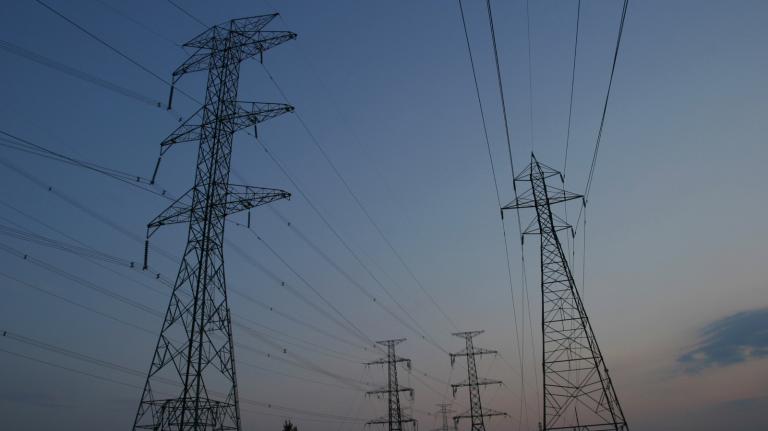
Every few months we see a spate of "news" stories warning that population growth rates are declining in the U.S. and/or the world, potentially leading to a shortage of babies and outright "demographic disaster." In an extreme (and extremely stupid) example from January of this year, one Slate writer warned that if trends continue over the long term, "we could be looking at the literal extinction of humanity."
The United Nations forecast Thursday that the world’s population will increase from 7.2 billion today to 8.1 billion in 2025, with most growth in developing countries and more than half in Africa. By 2050, it will reach 9.6 billion. ...
I would like to fly first class someday, because I’ve heard they serve you a crème brulee milkshake, give you a Swedish massage, and then cover your body in chocolate. But apparently such luxuries have a planetary price tag. Reports The Washington Post:
[F]irst-class air travel is ... ruining the environment.
Everything that ends up in our waste stream messes with fish, from the estrogen in birth control to synthetic fertilizer. That isn’t news. The new part is that seemingly inconsequential amounts of Prozac and Zoloft can interfere with fish brain development -- and instead of cheering them up, it has the effect of a Cure album on a 14-year-old. (Slipknot? Whatever the kids listen to these days.) Scientific American reports:
When fish swim in waters tainted with antidepressant drugs, they become anxious, anti-social and sometimes even homicidal ...
Male minnows exposed to a small dose of the drug in laboratories ignored females. They spent more time under a tile, so their reproduction decreased and they took more time capturing prey... [T]he doses of Prozac added to the fishes’ water were “very low concentrations,” 1 part per billion, which is found in some wastewater discharged into streams.
Hilarious yet terrifying new site Kochify the News attempts to simulate what a Koch-owned L.A. Times might look like, complete with evil cackling. The results are amazing. Here’s one story before you Kochify the news:
It is the most socialist of all energy industries, propped up by governments everywhere it exists, yet conservatives love it. It is (putting construction and materials aside) carbon-free, yet most environmentalists hate it. It hasn't grown much, or reduced costs much, or shown any signs of being anything but moribund for decades, yet it is the subject of enduring obsession in the energy world, with one wave of "nuclear renaissance" stories after another. Its most passionate supporters are propagandists, as are its most passionate opponents, and -- the weirdest part -- virtually everyone who has an opinion is either a passionate supporter or a passionate opponent, which makes for a lot of propaganda all around.
Long story short, writing about nuclear power has always been more trouble than it's worth, at least for me. No matter what you say, a bitter, endless argument ensues in which no one changes their mind. Ever. At all. There are all sorts of things happening in energy right now that are more interesting than nuclear, so I focus on those.
Regular readers will know I feel roughly the same way about the Breakthrough Institute. BTI "bad boys" Michael Shellenberger and Ted Nordhaus receive a degree of press coverage that wildly exceeds their intellectual contributions and, like nuclear power, have an ineffable power to render everyone involved an unbearable douchecanoe.
All of which suggests that the last thing I should be writing about is Pandora's Promise, a pro-nuclear propaganda film featuring the Breakthrough boys. It's like a cosmic douche vortex. No one will escape un-douched.
Nonetheless ... it's making the rounds, and people keep asking (and asking) me about it. So against my better judgment, a few general thoughts on nuke debates and the film.
At the turn of the 20th century, with the clickety-clack of hoof beats waning and the chug of the automobile fast approaching, bicycles ruled city streets. As the number of cars increased, etiquette on how to share the road began to emerge.
In some cities, “street sprinklers,” who tamped city streets with water to keep down the dust clouds kicked up by cars, left four to six feet along the curb dry so cyclists didn’t have to wheel through mud. They were the first bike lanes.
During the midst of the bicycle craze, the [Chicago] Tribune could report that "woe follows the trail of the bicycle," with 100 accidents logged by police in the course of two summer months in 1897: 10 pedestrians run down by cyclists, three caused by clothing catching in the bike, and one poor soul who rode into the river.
“Woe follows the trail of the bicycle.” Wall Street Journal editorial board member Dorothy Rabinowitz would heartily agree. While our current national love affair with hulking SUVs and tendency toward road rage present new challenges for bicyclists, as biking booms, history seems to be repeating itself, even as it pedals by on two wheels.
Luckily, a plethora of efforts aiming to keep the bicycling and car worlds from literally colliding are springing up in cities across the U.S. and Europe: bike lanes and paths, traffic-slowing devices, sharrows, and safety warnings written on crosswalks, to name a few.
One of the biggest challenges has nothing to do with infrastructure, however, and everything to do with the way we behave when we’re behind the wheel. Put another way, drivers need some education on how to coexist with all these bicyclists.
Feeling anxious today? Take a trip with us under the sea, and watch divers follow a whalesong to a mysterious and awe-inspiring close-up brush with a humpback whale.
Just wait til that new unitard isn't cool anymore.
Last week, Jezebel’s Doug Barry was all, “AAA! Throwing away clothes is shockingly bad for the environment! And 45 percent of your donated clothes are shipped overseas and sold unscrupulously. Welp, guess we better become hoarders or use Earth911!” It was very well-intentioned, but Jezebel commenters were way ahead of him (as, I'm guessing, are you, dear reader). Here are 10 of their suggestions that put Barry to shame. (For a drinking game, count how many times you say "duh.")
1. Donate to Dress for Success, a nonprofit that outfits low-income women for job interviews
“OMG! I flew down that hill on my bike!” you say, except you don’t mean LITerally, because you weren’t on this bike designed by three Czech companies. The Flying Bike, as it is aptly called, successfully took a five-minute, remote-controlled flight inside a test facility in Prague this week. With a donut-like cage housing a propeller above each tire, the Flying Bike clocks in at just over 200 pounds. (A dummy took the test flight, as ET was not available.)
The purpose of a flying bike is unclear, unless it’s to cement the fact that the Czech Republic is a cooler place to be than the U.S., which we already knew from the first Mission: Impossible movie. Hopefully it’ll at least be safer than Norah, a jet-powered bike invented by two cackling Brits and capable of hitting 50 mph:
Tip: When attempting any technically not-legal tactical endeavors, it helps to start with a checklist. For some rebels, I imagine this list would include items like spray-paint and rotten eggs, maybe an iPod stocked with mood music by the Sex Pistols. Me, I’m taking a greener approach with my list: potting soil, water bottle, trash bags, low-maintenance plants, and one classic terra-cotta planter.
I assembled these items one recent evening in preparation for my first attempt at serious guerrilla gardening (that’s reclaiming a piece of underused public land by planting it, to you). I’d dropped a few wildflower seed balls around the city, sure, but those little bombs are a bit of a crapshoot. This would be the first time I’d leave anything undoubtedly living and green in my wake. And besides, seed bombs are easy to fling unnoticed; an entire pot brimming with succulents is a bit trickier to assemble in secrecy. Better add “nerves of steel” to that checklist.
My chosen site could certainly do with a little extra love. Located along a long pedestrian staircase linking a major bus route to the neighborhoods on the top and sides of a hill, the spot was overgrown with weeds and littered with bottles and granola bar wrappers. Ugly black construction netting encircled two sinkholes next to the stairs; the only decoration was the graffiti crawling up the sidewalk and across the site’s lone bench. If there was another spot within a two-mile radius of my apartment that needed some horticultural refinement more, I sure hadn’t found it.
So I loaded up my pot, my plants, and my soil, convinced my fiancé to ride shotgun, and set out to guerrilla garden the hell out of that neglected site. Or at least, leave it a little nicer, a little greener, than it was before.