Skip to content Skip to site navigation
Gristmill: Fresh, whole-brain news.


Comments

Drought dries up wells, reveals sunken Burger Kings

See the spread of drought since June. Darker colors indicate more extreme conditions.

Bad (and weird) things happen when we run out of water. We've discussed myriad drought impacts since June, but here are more.

Wells dry up.

From the New York Times:

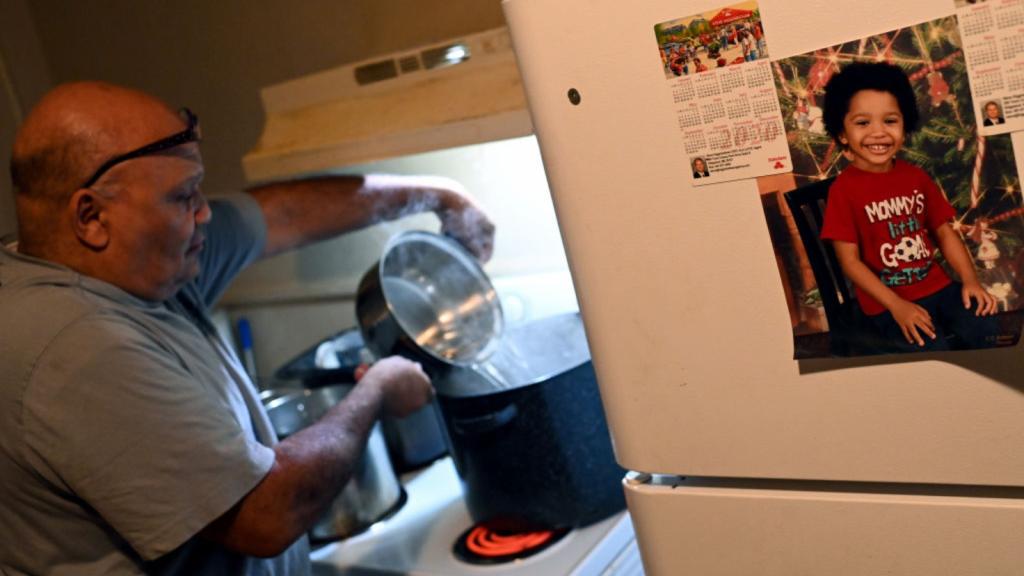
For some residents outside municipal water districts [in the Midwest], it has become a struggle to wash dishes, or fill a coffee urn, even to flush the toilet. Mike Kraus, a cattle farmer in Garden City, Kan., twisted the tap on the shower the other day after work and heard nothing but hissing.

“And that was it,” he said.

While there are no national statistics on the rate at which residential wells are drying, drilling companies and officials in states across the Midwest have said that hundreds of people who rely on wells have complained of their pipes emitting water that goes from milky to spotty to nothing. An estimated 13.2 million households nationwide use private wells.

We noted the depletion of wells around St. Louis two weeks ago. The problem has now spread significantly.

Read more: Climate & Energy

Comments

Paul Ryan: ‘Big debate about the scientific veracity’ of ‘so-called’ climate solutions

Mr. Ryan. (Photo by Toby Alter.)

Here is what Rep. Paul Ryan (R-Wis.) said to a reporter in Virginia this morning on the subject of climate change:

All the solutions that people like Barack Obama are trying to impose on the American people, cost us jobs, make us less competitive and I think there's a big debate about the scientific veracity of some of the solutions or so-called solutions.

Ryan, currently an elected official serving in the House of Representatives on behalf of more than 600,000 people, is a grown adult who graduated from Miami University. He is not known to suffer from any ailment that would impair his ability to understand scientific facts and to differentiate between speculative opinion and reasoned evidence. At no time in his career -- most of which has taken place on Capitol Hill -- is Ryan known to have himself conducted scientific studies into the efficacy of climate mitigation strategies.

Comments

Romney got his great energy policy ideas from oil execs

Photo by Gage Skidmore.

Mitt Romney's proposed energy policy, released yesterday, focuses on giving states the ability to set their own resource extraction rules and to let them drill wherever they want -- including on federal land. Even a conservative environmental organization took issue with that idea as reported by Politico: "These lands do not belong to individual states, any more than the Grand Canyon belongs to Arizona or Yosemite belongs to California."

So where'd Romney get this idea, anyway? I mean, besides how nicely it blends the common conservative arguments for neutering the federal government and drilling everywhere everywhere now now now.

According to the New York Times, the idea came from oil executives.

An individual close to the Romney campaign said that Mr. Romney’s staff drafted the proposal in consultation with industry executives, including Harold Hamm, an Oklahoma billionaire who is the chairman of the campaign’s energy advisory committee and chief executive of Continental Resources, an oil and gas driller.

Just this week, the oil and gas industry gave nearly $10 million toward the Romney election effort in two fund-raisers.

I hope you have a defibrillator nearby to restart your heart which stopped due to the surprise of that statement.

Read more: Politics

Comments

Antarctic temperature spike linked to ongoing ice loss

We've talked a lot about how quickly the Arctic ice is melting. Yesterday, ye olde Grist List shared a photo of pooled water from melted ice at the North Pole. (If you would like an up-to-the-minute view of North Pole ice, the NOAA has you covered. If the camera appears to be submerged in ocean water surrounded by ice cubes, please call 311.)

Antarctic ice loss. Red indicates more loss; green, less. (Image courtesy of NASA.)

As you may recall from school / globes / common sense, the Earth has another region of frozen desert -- and the Antarctic isn't doing much better, ice-loss-wise. From Climate Central:

Scientists are intrigued with this corner of the world because it’s warming faster than anyplace else on Earth. The planet as a whole has heated up by about 1.3°F since 1900, but on the peninsula, it has shot up by a whopping 5° in just 50 years, forcing massive ice shelves to disintegrate and penguin colonies to collapse.

Heat trapping greenhouse-gas emissions are the obvious culprit, since they’ve increased dramatically over that same 50 years, but scientists prefer hard evidence to presumption, so a team from the British Antarctic Survey has been drilling into ancient ice to see how the current warming stacks up against what happened in the ancient past. If the kind of warming happening now also happened before we started burning fossil fuels, it would cast doubt on the human contribution.

What the scientists discovered, however, removed any doubt. ...

Read more: Climate & Energy

Comments

Apocalypse or bust: How Wired’s climate optimism doesn’t add up

Good news, everyone. Wired is reporting that the world probably isn't going to end in December. The bad news is how the magazine makes that argument.

It's a clever article, this "Apocalypse Not," framing previous apocalyptic predictions about the end of the world in the context of the Four Horsemen. In lieu of famine, pestilence, war, and death, author Matt Ridley assesses the threats from chemicals, disease, people, and resources. He walks through each "horseman" in order, dispatching as best he can past theories about how they would contribute to the eradication of humanity.

In most of his examples, his point is made quickly and cleanly. There's a massive exception, however: climate change.

The fundamental problem is that Ridley's conceit makes it impossible to judge each argument entirely on its merits without hyperbole. He can't ignore climate change, given the subject of the article, but he also can't give climate change its due: He's forced to classify it as a non-apocalypse a priori and to thereby dismiss it. After all, (1) the entire article is premised on our previous errors in assessing threats, and (2) the standard to which everything is compared is the apocalypse. I mean, the Spanish flu pandemic of 1918 killed 3 percent of the world's population. But it wasn't an "Armageddon" in Ridley's formulation, an existential threat to Life As We Know It. Everything becomes an assessment on a binary scale, and one that proves his thesis before he begins: nothing before has destroyed the world; ergo, our current concerns won't either. If one had, of course, Ridley wouldn't be writing the article.

Proving that something isn't apocalyptic is not a high bar. But it leads Ridley to dismiss threats wholesale in order to defend his (easily defended) thesis.

Read more: Climate & Energy

Comments

Court: TVA at fault in massive 2008 coal-ash spill

A house surrounded by coal ash from the 2008 spill. (Photo by United Mountain Defense.)

A federal judge ruled today that the Tennessee Valley Authority is liable for the 2008 coal-ash spill that dumped thick sludge across a community in eastern Tennessee, destroying three homes. From WATE.com:

U.S. District Judge Thomas Varlan said in a ruling issued Thursday morning that "TVA is liable for the ultimate failure of North Dike which flowed, in part, from TVA's negligent nondiscretionary conduct." ...

The focus of the litigation is the spill that sent 5.4 million cubic yards of coal fly ash from TVA's Kingston Fossil Plant into nearby homes, farmland and the Emory River on December 22, 2008 after a storage dike failed.

The litigation involves more than 60 cases and more than 800 plaintiffs. They have sued over claims of damage to their property and their health. Judge Varlan heard three weeks of testimony in the case during September and October 2011.

"People have been harmed through the actions of TVA, in some cases irreparably," one of the plaintiffs' attorneys, Nashville-based Beth Alexander, said in a statement. "TVA did its best to avoid financial responsibility for the harm it has done, but there was no merit or justification for it to be given such extraordinary protection. TVA spent millions of dollars in legal fees fighting to be cleared of responsibility for what they did wrong instead of compensating the people whose property was damaged."

Comments

Disney’s pollution of America may also be literal

Here Disney's "Mickey the Mouse" promoting coal, back in the day.

Your metaphor of the day: the "vintage" air-conditioning system at Walt Disney Studios in Burbank, Calif., has apparently been leaking carcinogenic chromium 6 into the area's groundwater.

A consultant hired by the Environmental Protection Agency recently identified the Disney property among a list of facilities being "investigated as potential sources of chromium contamination in groundwater," according to an April 2012 report recently posted on the agency's website.

Authorities have long been aware of chromium 6 contamination in San Fernando Valley groundwater and have already identified a number of companies responsible for contamination, including aircraft manufacturer Lockheed Martin Corp. Lockheed paid $60 million to settle claims with roughly 1,300 residents in 1996 alleging that exposure to chromium 6 and other toxins at its former aircraft manufacturing plant left them with cancer and other maladies.

Authorities note that the levels discovered don't appear to pose a threat to public health, though surrounding cities use the aquifer to augment their water supplies.

Comments

Texas judge rules that TransCanada can seize land from a family farm

The miniature Eiffel Tower of Paris, Texas. (Photo by KB35.)

Julia Trigg Crawford manages a farm in northeast Texas that's been in her family since 1948. The 600-acre property sits on the Red River, near the city of Paris, famous for its replica Eiffel Tower topped with a red cowboy hat. It's like a Texas stereotype come to life.

Crawford’s property also sits directly between where TransCanada has some tar-sands oil and where it wants that oil to go. The southern section of the Keystone XL pipeline, which recently got a final approval, will cut through the northeastern part of Texas — as planned, through Crawford’s property. Crawford preferred that it not and rejected the company's buyout offer. So TransCanada instead sought to seize the property through eminent domain. As described on the Crawford family website:

They legally had the power to do this because -- and you’re not going to believe this -- they simply checked a box on a “T4” form for the Texas Railroad Commission (the body that regulates the oil and gas industry in Texas) that says ‘common carrier.’ Common carrier status carries with it the power of eminent domain -- the right to seize property. Meanwhile, the Railroad Commission openly states that they have no regulatory authority to make sure that a private company does not abuse the power of eminent domain.

The case went before Lamar County Court-at-Law judge Bill Harris. Yesterday, he handed down his ruling: TransCanada is a common carrier, and may therefore:

… enter on and condemn the land, rights-of-way, easements, and property of any person or corporation necessary for the construction, maintenance, or operation of the common carrier pipeline.

Comments

Peabody Coal signs sweetheart deal with government to expand existing mine

Coal trucks in the Powder River Basin. (Photo by KimonBerlin.)

Yesterday, Peabody Coal signed a deal with the Department of the Interior's Bureau of Land Management (BLM) to lease an additional 400 acres at its Twentymile Mine in northwest Colorado. Peabody will be paying 25 cents for each ton of coal; there are an estimated 3.2 million tons in the expanded tract.

Coal from the nearby Uinta Basin with similar characteristics (like energy yield and sodium content) sells for $35.60 per ton. Safe to assume that the Twentymile coal will sell at a similar price.

Which means that for each ton of coal Peabody sells, the company is netting $35.35. This isn't profit -- the company has to extract it, pay for machinery and miners, etc. But over the course of extracting that 3.2 million tons of coal, the company has $113,120,000 from which to eke out a profit.

Comments

BP, still working out the kinks in this ‘fuel distribution’ thing, recalls gasoline

On Monday, BP was forced to take an unusual step -- recalling unleaded gas in Indiana.

BP believes a 50,000 barrel batch of regular grade gasoline blended at BP’s Whiting, Indiana gasoline storage terminal between August 13th and 17th contained a higher than normal level of polymeric residue and this residue can cause hard starting and other drivability issues. The fuel may have been purchased by motorists patronizing BP and other retail outlets in Northwest Indiana during the past seven days.

Indeed, the fuel was purchased by BP customers -- some 7,000 of them, who bought the fuel at 200 stations in and around Chicago.

Don't miss a green thing!
Get Grist in your inbox every morning.