Uncategorized
All Stories
-
Confessions of a sustainable mind
Former Grist intern Jocelyn Tutak has written a short but interesting piece for the Sustainable Style Foundation's SASS Magazine in which she describes her love/hate relationship with Dansko clogs:
My paying job keeps me on my feet - literally - for eight hours a day. At about a mile an hour (oh yes, I clocked it with a pedometer), I put in forty miles a week just at work. My feet were no longer happy with me and quite vocal about it. I needed arch support, and I needed it bad.
Enter Dansko's Professional clog, the shoe of choice for doctors, nurses, chefs, and nearly anyone else whose job requires more than a bit of standing. This shoe carries the "Seal of Acceptance from the American Podiatric Medical Association." So I do a little research. My coworkers swear by them, and I even get a deal on buying them for work. The website promotes peace and earth-friendliness, and began as a mom-and-pop business. By looking at the site, the shoes, and those I know who wear them, you'd think they were helping save the world with each pair sold, with each step taken with their anti-skid tread. All is well until I check the specs on this Danish wonder-clog: The inner frame of this happy little shoe is made with PVC.
For those of you who don't know (and really, who can keep all these plastics straight), #3 PVC, or polyvinyl chloride, has been deemed the worst of the bunch. Bill Walsh, founder of the Healthy Building Network wrote in Grist that "the weight of available evidence tells us that ... it may well be the single most important source of many of the worst toxic chemicals plaguing the global environment today."I can just picture it: Umbra on one shoulder and a tired, sore Jocelyn on the other. Who won out in the end? Find out.
BTW, to all you in the Seattle area on Tuesday ... the Sustainable Style Foundation will be hosting Green Drinks. There's a rumor some Gristers will be attending.
-
Personal virtue is not enough for environmentalists
A point I try frequently to make: If you want real, substantial, lasting environmental change, it is not enough simply to recycle or drive less or shop at Whole Foods or buy organic cotton t-shirts. It is not enough to advocate that others do so. The kind of environmental change we need will never happen solely through personal virtue. There just aren't enough virtuous people.
What's needed are structural changes -- changes in gov't policy and regulation at every level, changes in the way we build and run our communities, changes in the practices of large corporations, changes in international norms and treaties. Political advocacy, in the broadest sense, is the obligation of any true environmentalist.
Now, why do I pound on this point, even at risk of being a big downer for all the chipper eco-strivers who so love Umbra?
Look no further than this headline: "Environment High in Personal Values, Low in Political Priorities for U.S. Voters"
Grrr ...
-
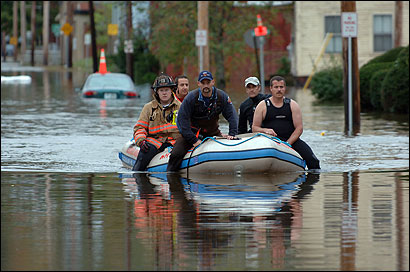
Wet
Is this image from post-Katrina New Orleans? A burly American rescue team dispatched to Mexico?
No, it's...
-
Hurricane Stan not as friendly as name might indicate
Mexico and northern Central America are still staggering from the aftermath of the latest Gulf Coast tempest, Hurricane Stan. Some are already calling Stan's impact worse than 1998's Hurricane Mitch.
Stan hit along Mexico's southern Veracruz coast on Tuesday as a Category 1 hurricane, and was downgraded to a tropical storm shortly thereafter -- but it's the landslides and flooding from the resulting rains that have been devastating. In Guatemala, storm-induced rains only ended on Sunday, and the army began evacuating people stranded in remote towns and villages. As many as 1,400 are feared to have died in villages inundated by mudslides; the government says it will declare them hallowed ground, as mass graves. Thousands are displaced and many fear their livelihoods have been destroyed.
In Mexico, Costa Rica, El Salvador, Honduras, and Nicaragua, more than 100 have been reported killed and thousands displaced from flooded areas. In Mexico, the storm destroyed key crops including coffee, and about 300,000 people -- primarily in the country's poorest regions -- were evacuated to shelters. About $1.85 billion will be needed to rebuild the hardest-hit areas, according to President Vincente Fox.
The Grist staff are taking the rest of the day off to go home and hug their kids and puppies.
-
Slam debunk
So, there's a buzzed-about new book called The Weather Makers: The History and Future Impact of Climate Change, by Aussie scientist Tim Flannery.
Naturally, it's brought the flat-earthers out of the woodwork.
And when the flat-earthers come out, Tim Lambert follows. Read his delightfully compact, action-packed festival of debunkery, in which he makes typically quick work of the skeptics. Like skeet shooting ...
-
Running out of things to blame Katrina on? Here’s a new one
I'll admit I didn't listen to this entire Oct. 5 NPR broadcast on "Environmental Politics after Katrina and Rita" -- probably worth a listen if you have 53 minutes. I tuned out after the first five minutes, following this ludicrous quote o' the week from Fred Smith, President of the Competitive Enterprise Institute:
It would also of course be useful if we allow people to, encourage people to, develop their own mechanisms of defense. One of the great tragedies and something that showed quite clearly in Katrina is that poverty is a form of vulnerability, poverty is a form of pollution. The inability of people in New Orleans to get out of town, the reliance on mass transit, illustrates just how dangerous a world is without mobility, without the automobile and the ability to use it freely. And the war on the automobile, the war on the energy policy, have had consequences, and one of those consequences is an America that is more vulnerable, especially if you're poor.
But don't just read -- listen, so you can hear host Steve Scher's throat-clearing as Smith says "mechanisms of defense" (got a cold, there, Steve?) and the snarl in Smith's voice as he pronounces the detestable words "mass transit."
-
opposes it in a speech to businessfolk
Thanks to reader EM for drawing our attention to a speech given by Canadian Prime Minister Paul Martin to the Economic Club in New York on Oct. 6.
He begins with lots of happy talk about the many shared interests of Canada and the U.S., and concludes by raising two problems. The first is familiar to devotees of Canadian politics: trade disputes, namely over softwood lumber and beef.
The second -- and this, I must admit, came as a surprise to me -- is U.S. desire to drill in the Arctic National Wildlife Refuge. Martin objects on environmental grounds. The cynic in me assumes there must be some other angle here. Perhaps he's maneuvering on behalf of Canadian energy producers. I'm not sure. Maybe someone more familiar with Canadian politics can educate us in comments.
Anyway, here's the relevant passage from the speech:
-
A small farmer ruminates on consolidation in the global seed market.
According to a recent study by ETC Group, the world's ten largest seed vendors control about half the global seed market.
By current standards, that's a modest concentration level. In the U.S., for example, the top four beef packers pack more than 80 percent of the nation's beef. Microsoft famously owns more than 90 percent of the world's computer operating system market. Consolidation of markets is as American as the SUV and the Apache helicopter.
Nevertheless, seeds lie at the heart of all organized food production, and thus at the heart of human culture for the past 10,000 years. Perhaps the seed trade deserves a closer look.
-
Sheri Speede, chimpanzee champion, answers questions
Sheri Speede. With what environmental organization are you affiliated? I’m a veterinarian who directs a conservation project in Cameroon, in west-central Africa — In Defense of Animals – Africa. At the Sanaga-Yong Chimpanzee Rescue Center in the Mbargue forest of central Cameroon, we provide sanctuary to 48 chimpanzee orphans of the bushmeat trade, ranging in […]
-
System of a Drown
The long history of political bungling that sank New Orleans In “The Slow Drowning of New Orleans,” The Washington Post‘s Michael Grunwald and Susan B. Glasser trace the centuries-long history of shortsighted greed and political expediency that left the Crescent City vulnerable to disaster. In recent decades, Louisiana has received more Army Corps of Engineers […]