Uncategorized
All Stories
-
More on sprawl
Pop quiz: Where are the most densely populated cities in the U.S.?
If you conjured up visions of the artificial canyons of Manhattan or the rowhouses of most older Eastern cities, you would be wrong. As the Washington Post reports this morning, it turns out that only 3 of the top 15 most densely populated cities are east of (or on) the Mississippi River. Talk about myth-busting over the morning OJ!
LA tops the list, followed closely by San Fran. San Jose comes in third and New York shows up in the number four slot. New Orleans is fifth, but then you have to go all the way to 13 before you get another Eastern city -- Miami! California is home to 9 of the 15 most densely populated cities in America.
Update [2005-8-11 8:30:16 by Ana Unruh Cohen]: Kudos to Andy on his analysis on this morning's Washington Post story. But in our initial posts neither of us mentioned this dark side of LA's density, which is also worth pondering over your ice tea at lunch. From the story:
There is another kind of infill. It occurs -- without planning, rubbish removal or construction -- when poor people pack into old houses and apartments. This is the single most important reason Los Angeles has become the nation's densest urban area, housing experts say.
-
Density and walkability
Just below the fold on the front page of today's Washington Post lies a very interesting article on sprawl in the West, particularly in Los Angeles. Turns out it's much more dense than typically pictured in the public's mind.
Citing the US Census Bureau, the article notes that the metropolitan Los Angeles area has density 25 percent higher than New York's. Despite the "unforgiving restraints" the area is subject to (like, for instance, the fact that the whole place is a desert), residents just keep pouring in. It was necessity that led to the density.
The article is another lesson that "there's more to density than meets the eye."
There is also mention of a place made infamous by teens and their problems: the Newport Coast. Built at the high density of seven units per acre, the development leaves about 80 percent of its land as open space.
Some of the more traditional conceptions of suburbia return though.
A six-lane road feeds cars in and out of the development so efficiently, DeSantis said, that in the past nine years she has never seen it clogged with traffic....Distances here are measured by time in a car.
However, one gets the sense that even if gas were $15 a gallon, these suburbs would still have developed in more or less the same way. The median priced home in Orange County is $702,000. -
Men
I have long had a pet theory. It goes like this: Many if not most of the world's troubles can be traced to men -- specifically, men overcompensating in response to perceived threats to their masculinity. (There are addendums; for instance: many men have absent or emotionally distant fathers, and thus either receive a warped picture of what masculinity is or have to forge one of their own, or get it from their peers.)
Traditionally -- and, arguably, in nature -- masculinity means strength, assertiveness, bravado, willingness to take risks and adventure and defend home and hearth and blah blah and so on. In the kind of hunter/gatherer societies where humankind evolved for millions of years, this worked out OK. But in a highly complex, densely populated, interdependent world, it doesn't always go so great.
Evidence for my pet theory just emerged in the form of a new study:
"I found that if you made men more insecure about their masculinity, they displayed more homophobic attitudes, tended to support the Iraq War more and would be more willing to purchase an SUV over another type of vehicle," said Robb Willer, a sociology doctoral candidate at Cornell. ...
Willer administered a gender identity survey to a sample of male and female Cornell undergraduates in the fall of 2004. Participants were randomly assigned to receive feedback that their responses indicated either a masculine or a feminine identity. While women's responses were unchanged regardless of the feedback they received, men's reactions "were strongly affected by this feedback," Willer said.
" Masculinity-threatened men also reported feeling more ashamed, guilty, upset and hostile than did masculinity-confirmed men," states Willer's report, "Overdoing Gender: Testing the Masculine Overcompensation Thesis."Peace. Cooperation. Compromise. Voluntarily buying a smaller car. Burning less fossil fuel. Listening to treehuggers. These things are for chicks.
Masculinity-threatened participants also showed more interest in buying an SUV. "There were no increases for other types of cars," Willer said.
What? No hybrids?
-
Discuss the ‘Soul of Environmentalism’
In May we reprinted "The Soul of Environmentalism" on Grist. It didn't get quite the response "Death of Environmentalism" got, but it was an important contribution to the discussion.
Tomorrow, Moving Ideas is hosting an online discussion with the authors. Head on over and ask them a question.
-
Franzen in The New Yorker
This week The New Yorker is home to a piece by noted author Jonathan Franzen on birdwatching, environmentalism, global warming, and, um, his love life. No description can do it justice -- it really is an extraordinary piece of writing, weaving together personal history, acute political and sociological observation, ornithological detail, and an elegiac tone, with effortless grace.
As usual when I encounter stuff like this, I feel admiration and naked envy in roughly equal measure.
It isn't available online yet -- not sure if it will be -- but it's worth buying the magazine to read it. If I can track down an electronic copy, I'll paste some excerpts.
-
![]()
![]()
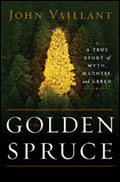
Forest meets felon in John Vaillant’s The Golden Spruce
The old riddle goes: If a tree falls in a forest and no one’s there to hear it, does it make a sound? The new one might go: If a tree falls in a forest and no one’s there to hear it, is it worth writing a book about? The Golden Spruce by John Vaillant, […]
-
Apotcalypse
Armed pot growers invade public lands When we say “growing pot in national parks,” what do you think of? Aging hippie, beat-up VW minibus, little dope field a few yards up the hill from the camp site? Yeah, those were good times … but where were we? Oh yes. Well, times change: California’s Sequoia National […]
-
Hairy Otters Are Now Half-Gone (Wince)
Alaskan sea otters being added to endangered species list Suffering population declines that are baffling scientists, the sea otters of southwest Alaska are being designated a threatened species under the Endangered Species Act, which entitles the furry marine mammals to stronger federal protections. Government biologists plan to investigate why their numbers have plummeted from tens […]