Uncategorized
All Stories
-
Because we've always needed reasons to kill each other
Canada's public broadcaster, CBC, has just finished airing the three-part series Climate Wars, based on the Gwynne Dyer book of the same name. I haven't yet finished reading the book, but the thesis is easily summarized: If you thought that the effects of climate change only included withering droughts, torrential storms, and general freaky-deakiness, you've missed one of the big ones: anthropogenic mass death, or as the political scientists call it, "war."
Yup, on top of all the other things we'll have to worry about in a melting world, there's the sad fact that we'll have more and more reasons to kill each other over dwindling water and food supplies. When you consider that the 20th century was bloody enough as economic and industrial opportunities were expanding, the 21st century is looking mighty depressing if you believe that wars can start over resource scarcity.
You can download the podcasts of Parts I, II, and III of Climate Wars here, though I can't testify as to how long they'll stay up there. So give it a listen soon. And do check out the book -- like I said, haven't finished it, but it's excellent so far.
-
Win an eco-Valentine's Day package valued over $400

Subscribe to our weekly Seattle email -- a guide to the green scene in our hometown -- for your chance to win dinner for two at Stumbling Goat Bistro, an organic bouquet from TerraBella Flowers, the organic Aphrodisiac Collection from Theo Chocolate, and a private tour of the Theo Chocolate factory.
 It's everything you need for the perfect green Valentine's Day ... except for an actual valentine, of course. (Good luck with that!)
Plus, by signing up for the Grist Local email, you'll learn about upcoming events, sustainable businesses in the area, and important political goings-on -- all zapped straight to your inbox every week. Each email also features an interactive event map, local green job listings, and news links that will keep you informed about eco-issues throughout the Puget Sound region.
Already a Grist Local subscriber? Invite a few friends to sign up, and you'll be entered, too.
The deadline is 3 p.m. next Tuesday, Feb. 10, so sign up now!
-
CO2 and the Clean Air Act
We are rapidly approaching national greenhouse gas legislation, either through a congressionally-led cap-and-trade bill or an EPA-led amendment to the Clean Air Act. However passed, these regulations will then immediately face a practical problem: how do you enforce a law that is in conflict with itself?
This problem arises because of the Clean Air Act's core failing: It compels businesses to increase their CO2 emissions. The moment we compel businesses to reduce those same emissions is the moment we expose this flaw and invite waves of litigation that will not only delay the implementation of CO2 policy, but also invite compromise and negotiation that will likely be forced to sacrifice some of the Act's environmental intent. How on earth did we get here? And what are we to do about it?
The clean air act mandates greenhouse gas pollution
Broadly characterized, the Clean Air Act does three things:
- It sets limits on the concentration of regulated pollutants at regulated point sources;
- It steadily tightens those limits over time, and;
- It requires any new pollution sources to meet the most current (stringent) pollution standards.
By any measure, the act has done a commendable job of reducing non-CO2 air pollution. But it has unwittingly increased CO2 pollution as well.
-
Scientists find source of gregarious behavior (in grasshoppers)

This week's edition of Science has an interesting paper on the swarming behavior of desert locusts. It's initiated by high levels of serotonin. I'll wager E. O. Wilson is very excited about this.
From an informative article in the BBC News:
"Serotonin profoundly influences how we humans behave and interact," said co-author Dr Swidbert Ott, from Cambridge University.
"So to find that the same chemical is what causes a normally shy, antisocial insect to gang up in huge groups is amazing."Indeed. Got me to wondering about other examples of swarming behavior. I'm thinking Super Bowl. Which got me to wondering about the Super Bowl ads mentioned by Kate Sheppard.
The Ecomagination ads made me smile. They made me feel good inside. Given the opportunity, I may find a way to thank GE for making me feel good. Drinkability made me laugh. I may subconsciously decide to buy a Bud Light the next time I'm at a bar just to rekindle that feeling.
-
James Hansen apologizes to U.K. environmentalists
This is a guest post by noted NASA climate scientist James Hansen.
-----
I have relearned a basic lesson re interviews -- which will have to be fewer and more guarded. I recall giving only one interview to U.K. media this year, but perhaps it was two. One resulting story was that I said the climate problem must be solved in four years -- of course, what I meant to say was that we needed to start moving in a fundamentally different direction during President Obama's first term. CO2 in the air will continue to increase in those four years -- we are not going to take the vehicles off the roads or shut down commerce.
I must have said something dumber in response to a question about air travel. Special apologies to people working in opposition to expansion of Heathrow Airport -- I had no intention of damaging their case. All I intended to say was that aviation fuel is not a killer for the climate problem -- at worst case we can use carbon-neutral biofuels (not current biofuels -- there are ways to do biofuels right, for the fuel volume needed for global air traffic -- ground transport will need a different energy source). When asked about the proposed added runway at Heathrow, I apparently said, in effect, that coal is the (climate) problem, not an added runway -- in any case, what was reported angered a huge number of people, as indicated by my full e-mail inbox. I should have deferred questions on Heathrow to local experts -- I am sure there are many good environmental reasons to oppose airport expansion. I am very sorry that I was not more guarded. You can be sure that in the future I will be more careful to avoid making comments that can be used against good causes. Telling President Obama About Coal River Mountain and the Heathrow Airport runway reminds me how important it is to keep our eye on the ball.
Coal River Mountain is the site of an absurdity. I learned about Coal River Mountain from students at Virginia Tech last fall. They were concerned about Coal River Mountain, but at that time most of them were working to support Barack Obama. They assumed Barack Obama would not allow such outrages to continue.
The issue at Coal River Mountain is whether the top of the mountain will be blown up, so that coal can be dredged out of it, or whether the mountain will be allowed to stand. It has been shown that more energy can be obtained from a proposed wind farm, if Coal River Mountain continues to stand. More jobs would be created. More tax revenue would flow, locally and to the state, and the revenue flow would continue indefinitely. Clean water and the environment would be preserved. But if planned mountaintop removal proceeds, the mountain loses its potential to be a useful wind source.
There are two major requirements for solving the global warming problem:
-
How the U.S. can stay the global wind leader

The Global Wind Energy Council reported Monday:
The United States passed Germany to become world #1 in wind power installations, and China's total capacity doubled for the fourth year in a row. Total worldwide installations in 2008 were more than 27,000 MW ... 36% more than in 2007 ...
Global wind energy capacity grew by 28.8% last year, even higher than the average over the past decade, to reach total global installations of more than 120.8 GW at the end of 2008.It just goes to show what this country can do with intelligent and (somewhat) consistent government policies -- state-based renewable electricity standards and a federal tax credit (see "U.S. wind energy grows by record 8,300 MW").
But the race is on for global leadership, and China is poised to be our major contender, as it "once again doubled its installed capacity by adding about 6.3 GW, reaching a total of 12.2 GW":
-
Nuclear meltdown in Finland
This is the radioactivity-free kind of meltdown, as Helsingin Sanomat reported:
The Finnish nuclear power company Teollisuuden Voima (TVO) is seeking damages of EUR 2,400 million from the consortium of Areva and Siemens for delays in the construction of Finland's fifth nuclear reactor in Olkiluoto.
Makes one look forward to what might happen if a truly litigous country had a major nuclear Renaissance fueled by, say, taxpayer money (see The nuclear bomb in the Senate stimulus plan).
The Finnish newspaper has a great photo of "The Olkiluoto III nuclear reactor construction site in December 2008."

Here are more details on the meltdown between the partners in this debacle:
-
Dirty water and clean transit in the Mountain State
Sometimes the news is random, and sometimes it aligns itself into tidy patterns and themes. Today is West Virginia day!
To wit:
• A group of residents in Boone County, W. Va., has sued coal giant Massey Energy and several subsidiaries for polluting their groundwater. The suit asks for replacement water supplies and compensation for personal and property damages. Meanwhile, a sympathetic group has raised enough funds to begin delivering clean water to the residents. (See their lurid toilet tank photos.)
-
Does anyone think battery swap-out is useful or even needed for electric vehicles?
The Washington Post ran a very good article on electric vehicles Saturday. I recommend it to anyone who wants an overview of the important issue of where American companies will source their batteries. The article notes:
GM plans on a battery pack big enough to last 40 miles, at which point a small gasoline engine will take over. Some rival companies are considering a smaller battery pack that might go only 20 miles, still enough to serve the needs of many local commuters without adding as much weight and cost.
That was my point in the post, "Has GM overdesigned the Volt: Is a 40-mile all electric range too much?"
Like pretty much all recent articles on EVs, this one highlighted the uber-marketers of the EV world:
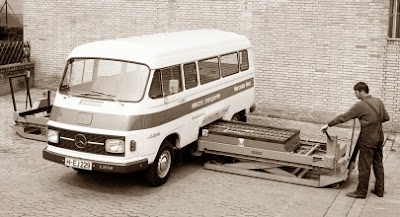
Shai Agassi, the chief executive of Better Place, which is building electric car infrastructure in Israel, Hawaii, Northern California and several other places, thinks electric cars should have batteries only. He proposes setting up swap stations where motorists on long trips could exchange a depleted battery for one fully charged.
"We just don't think that the answer to how to extend the battery is to put a power plant in our trunks," he said.You can see a computer simulation of the Project Better Place battery exchange station here.
I recently asked my EV wonk friends what they thought of the battery swap-out model, and I will reprint some of their answers below. I have never actually found anyone who thought it was a viable idea. Where, for instance, would it be done? Sunday's New York Times asserts:
-
The World Bank offers to loan developing countries the funds to pay for climate change adaptation
What would you say if someone drove a truck into your house, then jumped out and offered you a loan to help rebuild?
After you stopped screaming at them, which might take a while, you'd demand that they pay for damages that they caused, of course. Over time though, if no one forced the truck driver to pay for the damages, you might be tempted to take the loan. Sure, its a rip-off, but at least you get the money you need to rebuild.
This is exactly what's happening today with much needed funding for adaptation to climate change impacts in the developing world. The World Bank, backed by Northern taxpayers, is "offering" to loan the developing world the money needed to adapt to climate change impacts.
Ethically, this is abhorrent.
