Uncategorized
All Stories
-
Massive flooding in western Washington linked to man-made causes
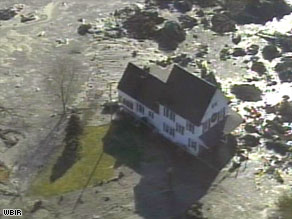
After digging itself out of "Snowmageddon" over the holidays, western Washington was hit with heavy rainfall this week, causing massive flooding. Roads, including major arteries like I-5 (pictured above), are closed and entire neighborhoods evacuated.
Sure, Seattle's known for its rain, but this is ridiculous! So who's responsible? Well, us, it turns out.
Scientists say a man-made triple whammy of logging, development, and climate change are to blame. And we shouldn't be surprised ...
A year ago (almost to the day), University of Washington geologist David Montgomery issued a warning to state legislators about the flooding that ravaged the region in 2007:
-
Question of the day
Why does Rex Tillerson, CEO of Exxon-Mobil, want a carbon tax?
Raise your hand if your answer is: because he sincerely thinks that is a more effective way to achieve the substantial emission reductions required to forestall catastrophic climate change.
-
TVA says leak has stopped but 'some materials flowed into Widows Creek'
You can't out-irony real life. The Tennessean has the story:
TVA is investigating a leak from a gypsum pond at its Widows Creek coal-burning power plant in northeastern Alabama ...
Seriously, Widows Creek coal plant? What PR guy thought that up? The same genius behind Frosty the Coalman, Clean Coal Night, and Deck the Halls with Clean Coal?
TVA says the leak has stopped, but not before "some materials flowed into Widows Creek." At least they won't have to change the creek's name. The story continues:
Gypsum is a byproduct of coal-burning power plants when "scrubbers" are added that use limestone spray to clean air emissions. This pulls sulfur dioxide from the emissions ...
Tighter air emissions controls result in additional waste byproducts. Gypsum can be used in building materials.As always, the enviros are really to blame. If it weren't for their pesky laws, the pollutants would be in the air where they belong:
-
Oil giant forecasts continued rise in emissions through 2050
Exxon-Mobil believes the world is doomed to drought, floods, massive refugee crises, disease, and rising sea levels. According to its "outlook for energy: a view to 2030," global CO2 emissions will rise 30 percent by 2030. That will effectively make holding global average temperatures to 2 degrees over pre-industrial levels -- what the IPCC says is necessary to avoid catastrophe -- impossible. To hit that target, global emissions must peak by 2015.
Of course Exxon doesn't put it that way. They just cheerfully chatter on about all the great energy they're going to sell to meet all that demand -- that is, the role they're going to play in rendering the earth hostile to their grandchildren.
-
The real cost is the cost of doing nothing
That's always the mantra: Serious climate policy is too pricey, especially in this economy.
To that I say: Watch this excellent video from King 5 News. (It's almost 16 minutes long, but well worth it.) The impacts of climate change, such as flooding, carry a very steep cost. And judging by the video, the costs aren't mostly borne by the rich -- they're paid for by those who can least afford it.
I want to be perfectly clear.The floods in Western Washington -- this year and in several recent years -- are completely consistent with what the climate science has been predicting for the Northwest. It doesn't really matter whether these particular floods are the direct result of global warming (that's an untestable hypothesis),what matters is that this is exactly what we should expect in the future. If the scientists are right, get ready for more.
So if you think carbon pricing is too expensive, just wait until you see the bill for failing to put a price on carbon.
-
![]()
![]()
Consumer Reports knocks plug-in hybrid Hymotion L5 conversion kit on efficiency, value
Is a product doomed if the highest praise its evaluators can offer is "viable"?

In the February issue of Consumer Reports, CR editors tested a 2008 Toyota Prius equipped with a Hymotion L5 conversion kit sold by A123 systems of Watertown, Mass. The conversion kit failed to deliver its promised 100 mpg, but did spike the prius' average efficiency of 42-mpg up to 67 mpg for the first 35 miles of driving. But at a $11,000 a pop, CR concluded that the kit "won't save the consumer money overall."
For the truly plugged-in, however, Hymotion's lithium-ion battery conversion kit is only one of the first forays into the world of commercial plug-ins. Here in the states, 3Prong Power of Berkeley, Calif. offers a conversion with old-fashioned lead-acid batteries that promises a 10-mile all-electric range for a more affordable $6,700. And around the Pacific Rim, Chinese automaker BYD Auto presented the world's first mass-produced plug-in hybrid in December of 2008.
(h/t: autobloggreen)
-
Wherein I praise the mainstream media from the back of an airborne porcine vehicle
I was bashing on Newsweek the other day, and in general that magazine really is weak on climate/energy issues.
Lest you think I'm just a hater of old media, however, I should point out that Newsweek competitor Time has been doing fantastic stuff on green issues lately, mainly thanks to the tag team of Michael Grunwald and Bryan Walsh.
-
Black lung is back!
"After a couple of years, something changed. I began to see the type of disease that was only in the textbooks -- this massive fibrosis, where the lung is basically destroyed. It's nothing but black scar tissue. I was incredulous. And it was young people. It wasn't the older miners. I thought, something is wrong here. We decided we'd better do some research."
-- Dr. Edward L. Petsonk, head of the black lung program for the National Institute of Occupational Safety and Health, on the recent resurgence of the disease, once a scourge among coal miners but virtually eliminated in the 1970s
-
Green jobs: Boon for Native America
A network of over 250 Native American organizations recently issued an important challenge to the Obama administration for any green recovery plan: Look to the First Nations.
The reality is that the most efficient, green economy will need the vast wind and solar resources that lie on Native American lands. This provides the foundation of not only a green low carbon economy but also catalyzes development of tremendous human and economic potential in the poorest community in the United States -- Native America.
As the recent scandalous decision to expand coal strip mining on Black Mesa in northern Arizona revealed, Native Americans have been saddled with a toxic legacy of fossil fuel and uranium development.
According to the statement released by the Native organizations, including Honor the Earth, Intertribal Council On Utility Policy, International Indian Treaty Council, and Indigenous Environmental Network:
-
On the challenge of cellulosic ethanol
"There is only one problem: the United States is not producing any second-generation non-corn ethanol in significant quantities at the moment. So a whole new industry will have to be brought into existence within less than four years and become one of the largest industries in the United States within the next 10 years."
-- Reuters columnist John Kemp, "Obama's Biofuel Challenge"