Uncategorized
All Stories
-
How do we reduce long-distance shipping?
Random factoid from a recent New Yorker article (not online, unfortunately) on, among other topics, the international shipping business:
For a pair of shoes made in China and sold in this country for fifty dollars, only about seventy-five cents of the retail cost derives from transportation. And the main costs in international shipping come from friction in the pipeline, particularly at the points of ship loading and unloading. [Emphasis added.]
Wow: shipping shoes all the way across the Pacific accounts for well under 2 percent of their retail price. And most of the transportation costs cover things other than fuel: labor, capital, financing, etc.
So for finished goods shipped over long distances, the fuel costs of transportation are probably not much more than a rounding error.
-
The big-box plot thickens
Was watching TV last night, and half paying attention during the commercials, when I heard something like this: "High gas prices got you down? Do all your shopping in one place: Wal-Mart."
Oh, Wal-Mart. What to make of your ongoing evolution? Way back when, you were an in-town store. Then you became the hated icon of big-box suburbia, and a huge contributor to people driving more as part of their daily routines. Now you're twisting the driving thing to make it seem like a benefit -- but at the same time, you're sending a subtle message to conserve! Which can't be a coincidence, considering the shift to selling organics and such! Is it time to return to your roots, open a few downtown locations, experiment with the notion of community again? Stranger things have happened.
-
Oceana names names as part of seafood contamination campaign
 Along with your omegas, you've been getting a dose of mercury in some of your seafood. In fact, the amount of mercury in some seafood has risen to dangerously high levels, putting children at risk for neurological problems. In an effort to combat the growing number of contamination cases, the Food and Drug Administration issued an advisory in 2004 warning women of child-bearing age and children to avoid certain types of fish and limit their consumption of albacore tuna, for example, to six ounces a week. That's about one sandwich. Grist readers undoubtedly know this, but what about those that don't check the FDA website on a daily basis?
 Oceana has been pressuring supermarkets for nearly a year to post this warning at their seafood counters. Yesterday, we held press conferences in eight cities across the nation, revealing which supermarkets are stepping up to the plate and outing supermarkets that aren't. On Monday, I got word that Whole Foods joined Safeway, Dominicks, Carrs, Genuardi's, Tom Thumb, Vons, Wild Oats and some others as members of the Green List by agreeing to post the signs.
Check out our new website to see if your store is on the "Green" list or the "Red."
-
![]()
![]()
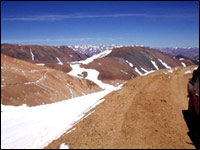
A proposed gold mine in Chile and Argentina has emails flying
Last week, Chile’s government green-lighted a controversial mining project known as Pascua-Lama. If the name rings a bell, odds are a chain email has found its way to your inbox, an appeal to “friends who care about our earth.” Activists hoped Chile’s new president, Michelle Bachelet, would stop the mine. Photo: Queen/ WireImage.com. The far-reaching […]
-
Refining Fault
Green groups sue EPA over refinery emissions rules Yet again, environmental groups are suing the U.S. EPA for issuing rules the enviros say will increase pollution. In the old days, refineries and other industrial plants were required to submit a malfunction contingency plan to the EPA; under a rule that went into effect in April, […]
-
All the Right Moves
Grist needs more help getting a move on If you’ve been following our saga over the last week or so, you know that Grist is about to make two big moves: the physical kind, which will land us in a new office space, and the, uh, metaphysical kind, which will lead to all kinds of […]
-
CFLs
Leonard Lin crunches the numbers and finds that if the government started a program to replace every lightbulb in every household with a CFL bulb, the American people would save $4.1 billion in electrical bills and enough power to replace a nuclear power plant. (via kottke)
In other news, Mr. Luna is still plugging away at his bright idea.
-
Nature and allergies
Want to make sure your kids don't have bad allergies? Take them out into messy, dirty nature.
-
Disposable everything. Really. Everything.
A few days ago, Stephen Hawking declared that the only hope for future human survival is space colonies. Specifically, Hawking said:
It is important for the human race to spread out into space for the survival of the species ... Life on Earth is at the ever-increasing risk of being wiped out by a disaster, such as sudden global warming, nuclear war, a genetically engineered virus or other dangers we have not yet thought of.
Now, I'm glad to add Hawking to the list of geniuses (genii?) who are scared witless about global warming. But is this how desperate we are, that the only choice is a reverse-Battlestar Galactica?
-
Energy bills proliferating (and sucking)
I can't decide whether to be heartened or depressed beyond reason by this NYT story on the recent flurry of energy-related bills in Congress. I'm leaning toward the latter.
Since Hurricanes Katrina and Rita shut down refineries in the Gulf of Mexico region last summer, speeding the rise of gasoline costs, House members have introduced 267 energy-related bills and senators have introduced 210, according to an analysis by the Senate energy committee.
On one hand, it's nice that the energy issue is rising in importance and that legislators are paying attention.
On the other, the vast majority of the proposed bills are awful. Worse yet, the few that actually have a chance of passing are among the worst: