Latest Articles
-
Congress takes a step toward regulating coal waste, but what about the EPA?
A bill aimed at reining in mountaintop-removal coal mining has been reintroduced in the House. The Clean Water Protection Act, sponsored by Reps. Frank Pallone Jr. (D-N.J.), Dave Reichert (R-Wash.), and John Yarmuth (D-Ky.), would outlaw the dumping of mining waste into streams, which would make it significantly more difficult for mining companies to blast […]
-
Sheer number of solar advancements suggests that cheap solar electricity is coming soon
Concentrating solar power is a well-known approach to lowering the cost of solar electricity. You focus sunlight from a large area onto a small one, the same way a magnifying glass can set a piece of newspaper on fire, using one small, high-quality solar cell and a concentrator for a lower total cost than hundreds of slightly cheaper cells. (Or you can use the concentrated heat to drive a heat engine, but not in the example we are about to discuss.)
Morgan Solar has a smart variation on this under development. They start with a clever acrylic concentrator that uses pure optical guiding to concentrate solar energy about 50 times, around the same results as a Fresnel lens, but without the need for curves or a non-zero focus. This already moderately concentrated solar is then concentrated further by a much smaller glass concentrator that also needs no air gap. Because neither concentrator requires an air gap, a tiny solar cell is attached directly to the glass.
So you have an eight-inch acrylic concentrator, a glass concentrator the size of an American nickel, and a solar cell the size of a baby's thumbnail.
-
![]()
![]()
Umbra on incendiary topics
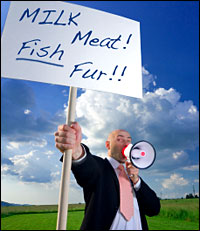
Dear Umbra, Your investigation for the raw milk advice apparently didn’t trip over the Real Milk Campaign of the Weston A. Price Foundation. I hope you can remedy the oversight in a future column. Stephen Guesman Alabama Dearest Stephen, Thank you for your kindly upbraiding and the opportunity to further discuss the problem of incendiary […]
-
A smart grid, yes. A new national grid, no.
The new mantra in energy circles is "national smart grid."
In the New York Times, Al Gore insists the new president should give the highest priority to "the planning and construction of a unified national smart grid." President Barack Obama, responding to a question by MSNBC's Rachel Maddow, declares that one of "the most important infrastructure projects that we need is a whole new electricity grid ... a smart grid."
We lump together the two words, "national" and "smart" as if they were joined at the hip, but in fact each describes and enables a very different electricity future. The word "national" in these discussions refers to the construction of tens of thousands of miles of new national ultra-high-voltage transmission lines, an initiative that would further separate power plants from consumers, and those who make the electricity decisions from those who feel the impact of those decisions.
The word "smart," on the other hand, refers to upgrading the existing network to make it more resilient and efficient. A smart grid can decentralize both generation and authority. Sophisticated electronic sensors, wireless communication, software and ever-more powerful computers will connect electricity customers and suppliers in real time, making possible a future in which tens of millions of households and businesses actively interact with the electricity network as both consumers and producers.
Advocates of a new national ultra-high-voltage transmission network offer three main arguments:
1. New high-voltage transmission lines are needed to decrease electric grid congestion and therefore increase reliability and security.
There is indeed congestion on some parts of our distribution and transmission networks. Congestion reveals a problem; it doesn't demand a specific solution. It can be addressed by reducing demand through increasing energy efficiency or by increasing on-site or local energy production. Both strategies are often less costly and quicker to implement than building new transmission lines. An analogy from the solid-waste sector may be appropriate. Exhausting nearby landfills does not inevitably require us to send our garbage to new and more distant landfills. We can emphasize recycling, composting, scrap-based manufacturing and reuse.
2. A new national high-voltage transmission network is necessary to dramatically increase renewable energy.
President Obama wants to build new transmission lines because, "I want to be able to get wind power from North Dakota to population centers, like Chicago." Writing in Vanity Fair, Robert F. Kennedy Jr. wants a new high-voltage transmission system to "deliver solar, wind, geothermal and other renewable energy across the country."
But do we really need to deliver renewable energy across the country? The distinguishing characteristic of renewable energy is its availability in abundant quantities virtually everywhere.
-
Washington new center of global warming battle
WASHINGTON — European ministers are flocking to Washington drawn by the new administration’s pledge to help lead the fight against climate change, an issue largely put on ice for eight years here. Ministers from across Europe as well as Canada are taking part in a whirl of meetings here this week to gauge prospects of […]
-
What's the alternative?
Fossil fuel energy prices are down right now due to the recession suppressing demand, but the mid- and long-term trend is up. Coal, oil, natural gas -- all up. If we do nothing, energy will keep getting more expensive for Americans, and it will impact the poor disproportionately.
The progressive proposal is to price carbon, strengthen efficiency regulations, and invest in green energy and infrastructure. This will produce a short-term rise in energy prices followed by a mid- and long-term stabilization and reduction as renewables and efficiency scale up.
Conservatives react with outrage to the notion of policy that will produce an increase in energy prices, of any duration.
But ... what's their alternative? Energy prices are going up regardless. What's their solution to that problem?
I sincerely don't understand. Someone explain it to me.
-
Los Angelenos narrowly reject city-wide solar plan
Los Angeles voters yesterday rejected the Green Energy Good Jobs ballot initiative (AKA Measure B), according unofficial results from the city clerk’s office. The plan, which failed by about 1,000 votes, would have led to the installation of thousands of solar panels on rooftops and parking lots throughout the city. It would have required the […]
-
Greenhouse-gas emissions continue to grow in the U.S.
Shocker! In the absence of a national program to cap and reduce the amount of planet-warming gases we’re pumping into the atmosphere, U.S. emissions continued to grow in 2007. The country’s overall emissions increased 1.4 percent that year, with the majority of that increase coming from fuel and electricity consumption, according to a new draft […]
-
As reservoirs fall, water prices should rise
Last week, California Governor Arnold Schwarzenegger declared a state of emergency and warned of possible mandatory water rationing as the state struggled through its third consecutive year of drought. This well-intentioned response to the latest water crisis should not come as a surprise.
Whenever prolonged droughts take place -- anywhere in the United States -- public officials can be expected to give impassioned speeches, declare emergencies, and impose mandatory restrictions on water use. Citizens are frequently prohibited from watering lawns, and businesses are told to prepare emergency plans to cut their usage. A day after the restrictions are announced, the granting of special exemptions typically begins (as in Maryland a few years ago, when car washes were allowed to remain open even if they were not meeting conservation requirements).
The droughts eventually pass, and when they do, water users go back to business as usual, treating water as if it were not a scarce resource. Water conservation efforts become a thing of the past, until the next drought, until the next unnecessary crisis. Isn't there a better way?
-
There are two ways of improving the electrical grid, each with its own politics and challenges
Two years ago, nobody was talking about the nation's electricity grid; today it's so prominent in the national conversation that Barack Obama mentioned it in his inauguration speech. For energy wonk types, it's pretty amazing.
Lots of politicians and pundits are sort of waving their hands toward the grid as an energy solution, without being very specific about their goals or the policies needed to get there. To add some clarity, it's worth distinguishing two distinct grid issues, each with its own technological challenges, regulatory issues, and political implications.
To simplify matters, think of the grid like the nation's waterways. There are a few big, primary rivers -- the high-voltage, long-distance lines that compose the transmission system. Then there are thousands and thousands of smaller tributaries -- the lower voltage lines that carry electricity from the transmission system to individual homes and businesses, called the distribution system. (I guess the homes and businesses are ... lakes? Ponds? Frankly I haven't thought the metaphor through that far.)
With that distinction in mind, we can discern two grid-related subjects of interest to energy/enviro types:
The National Grid
This has to do with extending the transmission system to address two problems:
• First, there aren't many high-voltage lines that go to the places where renewable energy is most abundant (e.g., the Southwest for solar, the Midwest for wind).
• Second, right now there are (depending on how you count) anywhere from three to seven distinct regional grids that make up the national grid, and they aren't very well connected. While juice circulates relatively freely within these grids, it's difficult to get juice from one grid to another.
The wide grid refers to the effort to build a truly national transmission system: a new high-voltage backbone, with lines spanning the length and breadth of the country, able to carry electricity from anywhere it's generated to anywhere it's needed. Wide grid advocates argue that linking the entire nation together would mitigate the problem of intermittency -- the fact that sun and wind are variable (as opposed to baseload sources that can be turned on and off at will). The more intermittent energy sources are linked together, the more stable and reliable the whole system becomes.