Latest Articles
-
Colorado official with green chops is tapped for White House post
The Obama team circulated another list of hires at the White House on Wednesday. Apparently, the new president has scooped up Shaun McGrath, the green mayor of Boulder, Colo., as a deputy director of intergovernmental affairs.
McGrath began serving on the Boulder city council in November 2003 and was elected mayor in 2007. He has worked for the Western Governors' Association since 1995, where he is the program director for water and drought policy, climate change adaptation, and the Wildlife Corridors Initiative. He was previously a legislative assistant to Rep. Jim Slattery (D-Kansas), working on environmental issues, and the executive director of the Kansas Natural Resource Council.
Here's his official bio:
Prior to joining the White House, McGrath was Program Director for the Western Governors Association, an independent, non-profit organization representing the governors of the 19 western states and three U.S. flag islands in the Pacific, where he managed programs on wildlife corridors, sustainable water, renewable energy, and climate adaptation. McGrath is also the Mayor of Boulder, Colorado, a progressive city of 100,000, named the "smartest city in America" by Forbes magazine in 2006 and 2008. As Mayor, he led efforts to establish Boulder as the first smart-grid city in the country, pass a climate action plan for which voters approved country's first carbon tax, and become only the third city in the country to receive the platinum level "bicycle friendly community" award from the League of American Bicyclists.
-
Musings from an L.A. green-biz conference
This article is part of a collaboration with Planetizen, the web’s leading resource for the urban planning, design, and development community. <p>The green marketplace is the marketplace of the future. From Wal-Mart to Toyota to the neighborhood dry cleaner, it seems like every business is going out of its way to tell us how green […]
-
As meaningful as his presidency is, Obama will not act fast enough on the climate crisis
Now is the winter of our discontent
Made glorious summer by this sun of York;
And all the clouds that lowered about our house
In the deep bosom of the ocean buried.-- William Shakespeare, King Richard the Third
To complain that President Barack Obama is not serious enough about climate strikes most U.S. environmentalists as strange, almost incomprehensible behavior. This is a time for celebration and new beginnings and any small doubts we harbor are easily assuaged by our confidence in the man who is president. Those who are not swept up in the new optimism seem small -- either nit-pickers of detail who miss the big picture (what did he mean by "harness the sun and the winds and the soil"?) or the Gloster's of our victory -- cramped and parsimonious in spirit, prone to petty grievance.
Our feelings now are in accord with our conduct over the last decade and more. We are always optimistic, it is our nature. When politicians send mixed signals we embrace the positive and accept the troubling as pragmatic, necessary concessions. When offered half a loaf we take it and proclaim ourselves full.
But this is no compromise to be swallowed, is it? After eight years in the wilderness, we look out onto a playing field dominated by President Obama, House Speaker Pelosi, Senator Boxer, and Congressman Markey, and we see immense promise. In Obama's majestic inaugural address we heard climate mentioned, then mentioned again, and again, and, "he gets it!" we thought. This is what we endured for, this is what we campaigned hard for, and the sweetness in the D.C. air is more glorious than we had imagined.
Except for three things:
- The time-line for climate action has been cut to four years.
- The Democratic plan of action is utterly inadequate.
- Climate is a second-tier problem for President Obama.
-
More on the FDA's bumbling role in the peanut-butter salmonella outbreak
As a writer whose beat includes the food-safety system, I sometimes feel like political satirists must have felt in the Bush II era: unable to keep up with the extreme buffoonery of the ruling "elite," always one beat behind reality.
The nationwide peanut-butter salmonella outbreak, caused by a single factory in Georgia run by Peanut Corporation of America, is a case in point. In a previous post, I tried to come to grips with it. The New York Times had revealed that Georgia officials, working on behalf of the FDA, had repeatedly cited the company for dire sanitary conditions -- and let it continue operating. I was stunned that a company with such a vast range and reach into the Americans' grocery bags would be allowed to continue after repeatedly demonstrating reckless practices.
Now the FDA reveals during 2007 and 2008, the company found salmonella in its own products through in-house testing no fewer than 12 times -- and sent the paste out anyway.
A lot of folks are seeing this episode as a case of corporate malfeasance. It is that, to be sure.
But I want to look back to those Georgia health officials, working on behalf of the FDA, who were inspecting the plant in '07 and '08, diligently recording an epic series of sanitary misdeeds. What was done with their reports? Now we know that the company was actively testing the peanut butter for pathogens. Was the FDA? If not -- given the mounting evidence of reckless practices -- why not?
For those who can stomach it, here is the FDA's official report [PDF] of what it found at the plant starting Jan. 9, when it finally began to move to close the plant -- after hundreds had gotten sick (mainly children) and several had died. Some highlights below the fold.
-
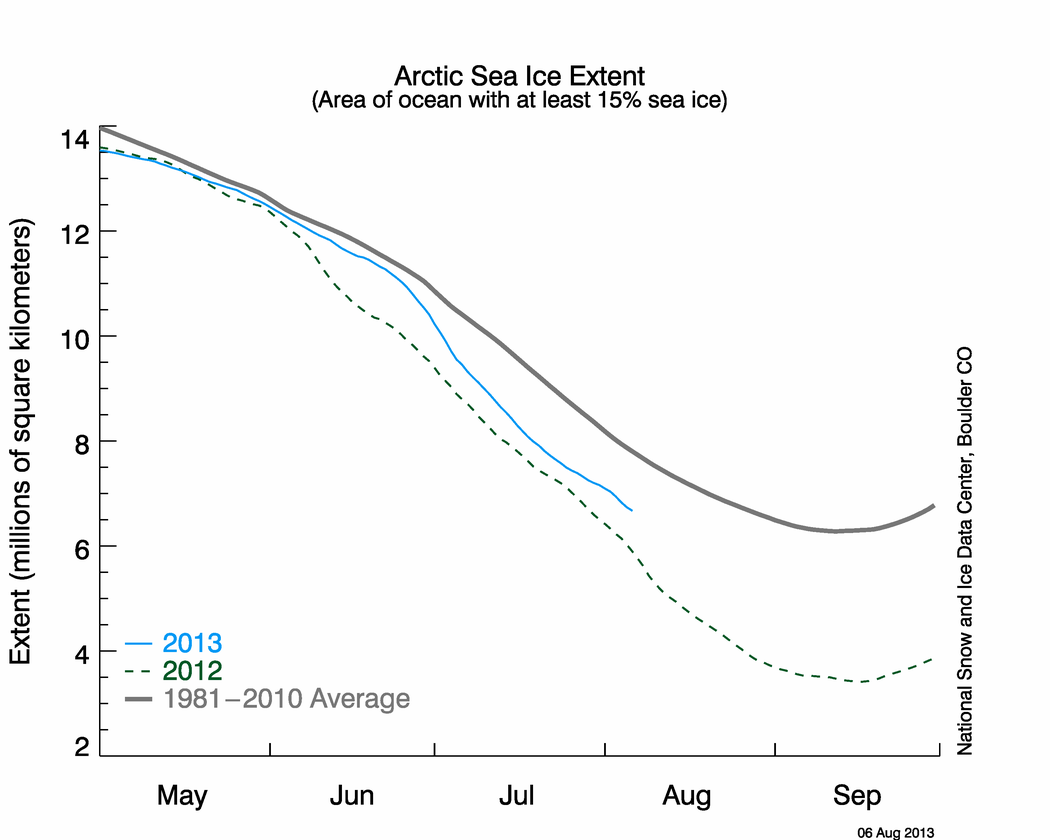
Arctic sea ice drops below 2007 levels
Arctic sea ice extent just dipped below January 2007 levels in the last few days, according to the daily time series from the National Snow and Ice Data Center:

The NSIDC notes that they are showing the data from 2007 on this figure since that year "went on to reach the lowest summer minimum in the satellite record."
The NSIDC also has an interesting 2008 Year-in-Review for cryosphere buffs. It explains why the ice stopped growing for a week in mid-December. It also has an interesting graphic comparing the Arctic sea ice extent in 2008 with 2007:
-
Are the Big Three just ghostwriting WaPo editorials now?
The Washington Post editorial board, drifting ever farther right, covers its Auto Alliance position on CAFE with a shiny, self-righteous veneer of Krauthammerian posturing on gas taxes.
-
Beef has 13 times more climate impact than chicken, 57 times more than potatoes

SciAm reports:
- Pound for pound, beef production generates greenhouse gases that contribute more than 13 times as much to global warming as do the gases emitted from producing chicken. For potatoes, the multiplier is 57.
- Beef consumption is rising rapidly, both as population increases and as people eat more meat.
- Producing the annual beef diet of the average American emits as much greenhouse gas as a car driven more than 1,800 miles.
I primarily focus on technology-based solutions since they can be the basis of government policy and since many websites are devoted to personal behavior choices, like No Impact Man.
Behavior-based strategies really only work on a large scale when societal values change (and/or prices jump) sharply, which is certainly inevitable in the coming years as more and more people come to grips with the increasingly painful reality of human-caused global warming (see "What are the near-term climate Pearl Harbors?") and realize just how immoral it is to maintain current levels of GHG emissions per capita at the expense of the next 50 generations to walk the earth (NOAA stunner: Climate change "largely irreversible for 1000 years," with permanent Dust Bowls in Southwest and around the globe).
For a good article on how one meat-loving environmentalist has changed his behavior, see Mike Tidwell's "The Low-Carbon Diet."
This post was created for ClimateProgress.org, a project of the Center for American Progress Action Fund.
-
Beef has 13 times more climate impact than chicken, 57 times more than potatoes
SciAm reports:
- Pound for pound, beef production generates greenhouse gases that contribute more than 13 times as much to global warming as do the gases emitted from producing chicken. For potatoes, the multiplier is 57.
- Beef consumption is rising rapidly, both as population increases and as people eat more meat.
- Producing the annual beef diet of the average American emits as much greenhouse gas as a car driven more than 1,800 miles.
I primarily focus on technology-based solutions since they can be the basis of government policy and since many websites are devoted to personal behavior choices, like No Impact Man.
Behavior-based strategies really only work on a large scale when societal values change (and/or prices jump) sharply, which is certainly inevitable in the coming years as more and more people come to grips with the increasingly painful reality of human-caused global warming (see "What are the near-term climate Pearl Harbors?") and realize just how immoral it is to maintain current levels of GHG emissions per capita at the expense of the next 50 generations to walk the earth (NOAA stunner: Climate change "largely irreversible for 1000 years," with permanent Dust Bowls in Southwest and around the globe).
For a good article on how one meat-loving environmentalist has changed his behavior, see Mike Tidwell's "The Low-Carbon Diet."
This post was created for ClimateProgress.org, a project of the Center for American Progress Action Fund.
-
Creating transit-oriented communities addresses many different issues
 Photo: Seattle Municipal Archives
Last November, Seattle-area voters gave a resounding shout-out to mass transit. Building on that support, a new bill in Washington state focuses on sustainable development near transit stations. This "Creating Transit Communities" legislation calls for dense, walkable communities in transit hot-spots.
It would provide local jurisdictions with resources and incentives for sustainable growth and strengthen existing provisions about making low-income housing available near transit centers.
Think those are unrelated issues? No way, say bill supporters from Futurewise, Washington Low Income Housing Alliance, and Transportation Choices Coalition. "Our state may face no challenge greater than the threat of global warming and the lack of sufficient affordable housing," they argue in a recent Seattle P-I editorial, "and we can't solve either unless we solve both."
They go on to illuminate the connections:
-
You can't violate the laws of physics
"The erroneous belief that stabilizing emissions would quickly stabilize the climate supports wait-and-see policies but violates basic laws of physics."
-- Dr. John Sterman, risk analyst at the Sloan School of Business, M.I.T.