Latest Articles
-
Agrifuels creating insecurity of demand for their oil
According to an article by Javier Blas and Ed Crooks in the Financial Times (London), the Secretary-General of the Organisation of the Petroleum Exporting Countries (OPEC), Abdalla El-Badri, warned Western countries yesterday that their efforts to develop biofuels as an alternative energy source risked driving the price of oil "through the roof".
Oh, the irony of it all.
-
Tim Lambert …
… dismantles NYT columnist John Tierney’s latest attack on Rachel Carson.
-
The Musing Environmentalist highlights a keeper
Karen Street, who comments here regularly, runs an interesting blog of her own called Musing Environmentalist.
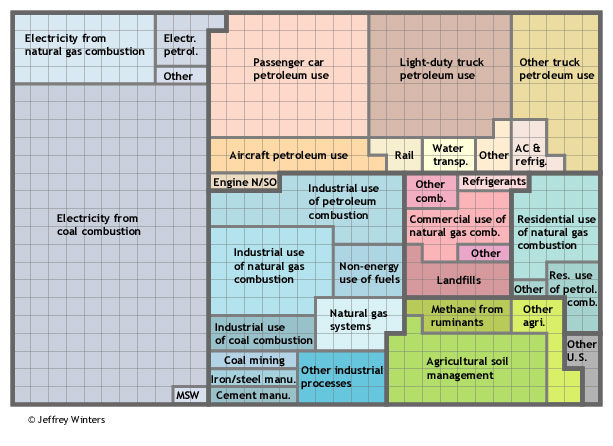
I was taken with a graphic she highlighted from an article in Mechanical Engineering magazine, representing the GHG emissions from various sources. Check it out (click for larger version):

-
That’s It, We’re Not Washing Our Undies Anymore
Groups ask U.S. EPA to ban chemical in detergent that feminizes fish Your detergent gets your clothes clean, sure — but does it feminize your trout? Five green groups and a labor union are petitioning the U.S. EPA to ban a family of chemicals used in cleaning products that have been linked to gender changes […]
-
Well, Uh, At Least No One Got Zero?
California, Vermont, Connecticut top ranking of energy-efficient states Less than a week after California Gov. Arnold Schwarzenegger (R) declared at an economic summit in Canada that clean energy is becoming the basis for “a new gold rush,” his all-star state has topped an energy-efficiency ranking issued by the American Council for an Energy-Efficient Economy. Looking […]
-
Or is that geoengineering at work?
A new study shows that geoengineering should work. Just not exactly how we imagined:
Geoengineering could indeed cool the atmosphere, ecologist Ken Caldeira of the Carnegie Institution in Stanford, California, and colleagues conclude in their new analysis. The team examined the impact of 11 possible projects over the next century using computer simulations and assuming trends in greenhouse-gas emissions will continue unchecked.
The good news is such measures would be effective even if undertaken decades from now, the researchers report online this week in the Proceedings of the National Academy of Sciences. The bad news is that in all cases studied, reducing solar radiation would also shift global rainfall patterns, potentially drenching some areas and parching formerly productive agricultural land. Worse, the simulations predict that if the atmospheric fiddling suddenly stopped, the warming would accelerate dramatically -- possibly to 20 times the current rate -- because CO2 would still be accumulating. -
Credits will be auctioned and limits tightened
This is extremely heartening: Europe is moving toward making significant changes to its emissions-trading system that could force large polluters to pay for most, if not all, permits to produce climate-changing gases, European officials said Monday. Although the European carbon-trading arrangement is considered to be among the world’s most functional, the countries that administer it […]
-
A couple of podcasts for your commuting pleasure
I've run across these shows in the past couple days, and thought fellow Gristmill readers might like to hear them too. The first is Science Friday's "Hour One" from last week. There is a segment on carbon sequestration, which I have yet to form an opinion on, and also one on generating hydrogen. The second, which I'm actually listening to as we speak, is about the economic benefits of "going green." Apparently being environmentally conscious is a smart business move! Go figure. The podcast comes from a series called "TED Talks" and the show can be downloaded here.
Enjoy!
-
Why we gotta knock solar?
Can we please, once and for all, stop decrying solar energy for being too area-intensive? See, for example, the oft-cited statistic that to power its economy, the U.S. would need "10 billion meters, squared, of land." America isn't exactly short on square meters, and awfully sunny ones at that. But 10 billion square meters sounds a lot bigger than it really is.
10,000 square kilometers (100km x 100km) form a square you could drive around entirely, at legal highway speeds, in four hours. (Less if you speed.) 10,000 square kilometers is also roughly one-fortieth the area that the human species has already occupied for hydroelectric reservoirs -- all to produce, according to the IEA, 15 percent of current global electricity demand. (This certainly overstates the efficiency of large dams, which do not produce 100 percent of the world's hydroelectric power.)
Get that? For vastly less space than we already consume for the pittance we get from hydroelectric dams, we could power the world. Space is not the limiting factor -- and soon enough, cost won't be either. Which will leave mulish stupidity the remaining roadblock.
-
Conservatives like Bush’s climate plan because greens don’t
The conservative National Review likes the president’s new climate change strategy. Not because it will work to reduce emissions, mind you. Because it irritates environmentalists and Europeans.