Latest Articles
-
Sometimes you have to take risks to save endangered species
I received an irate email the other day from Luke Hunter, who is the (taking a deep breath) Global Carnivore Program Coordinator for the Wildlife Conservation Society and an Associate Conservation Scientist in the Science and Exploration Program.
Apparently, somebody ratted me out and sent him a copy of one of my posts where I made a passing comment about the absurd amount of darting and radio collaring that is now going on in this human-dominated world:
Here is another article where two proud researchers first trapped, then darted, then radio collared cheetahs in Iran. The process will of course be repeated over and over again until their grant money runs out.
-
-
When people ask silly questions

"If fossil fuels are the problem, wouldn't running out of them be good?"
There's an old joke about economists and other Panglossians that bears on this question:
A man leaps off the top of a skyscraper and, as he passes by each floor, true to his optimistic tendencies, he says, "Well, so far, so good."
Running out of fossil fuels is like this man running out of floors. The critical thing is not to jump ... i.e., not to commit all that carbon to the atmosphere in the first place.
-
Canucks 1, US 0
Turns out that springing forward a month early didn’t save any electricity at all in the U.S. From Reuters: But other than forcing millions of drowsy American workers and school children into the dark, wintry weather three weeks early, the move appears to have had little impact on power usage. “We haven’t seen any measurable […]
-
![]()
![]()
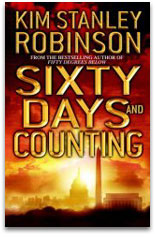
A review of Kim Stanley Robinson’s Sixty Days and Counting
Sixty Days and Counting, by Kim Stanley Robinson. I waited for the release of Kim Stanley Robinson’s new book, Sixty Days and Counting, like a computer geek awaiting the release of the PS3: standing outside the door of the store, in the snow, having cleared my calendar for a few days so I could dive […]
-
Organic coffee deep-sixed
Due a recent decision over at the USDA's National Organic Program, organic coffee, in the U.S. at least, may be a thing of the past. I wrote about this decision on Salon and did not shout it out to Gristies right away (mea culpa), but I am now.
The USDA decision, which affects the way small farmer cooperatives in the Third World are certified, will also dry up supplies of organic cocoa and curtail bananas. So eat your organic Dagoba bars now while they're still available.
It doesn't look like there's a solution right away, though a friend over at PCC -- in Grist's backyard of Seattle -- tells me the solution might be to build certification organizations in local markets. In the meantime, however, certifiers, coffee farmers and NGOs that work in the Third World are perplexed and upset.
I'll be updating over at Chews Wise blog and post any big moves here.
-
Good new blog on climate science and communication
Climate scientist Michael Tobis has started a blog, not so much about climate science itself as about the challenges of communicating about it and the bizarre notions about it that remain puzzlingly persistent. Off to a good start.
-
Bipartisan bill calls for intelligence assessment of climate impacts
How might U.S. national security be threatened by mega-droughts, coastal flooding, killer hurricanes, food scarcity, and the other ecological calamities scientists widely predict will occur if global warming continues apace? Is climate change the real ticking bomb? Photo: iStockphoto No one knows, but Sens. Chuck Hagel (R-Neb.) and Dick Durbin (D-Ill.) think it’s time to […]
-
Crafting a culture of change
Yale University students, staff, and other community members crowded a university conference room yesterday to watch Erika Lesser, director of Slow Food USA, give a talk on the Slow Food movement in America. Lesser spoke pretty generally about Slow Food USA's goals, philosophy, and achievements. The talk was interesting in itself, but there were two aspects that I found particularly significant:
- Lesser made some very interesting connections between Slow Food and American environmentalism (more on this below).
- It was a horribly cold, rainy, awful day, the talk was located in an incredibly out-of-the-way part of campus, yet nonetheless the room was packed.
-
The ubiquitous Richard Heinberg talks with Acres USA
Interesting interview with Richard Heinberg about the effects of peak oil on U.S. agriculture, in Acres USA, "A voice for Eco Agriculture."