Climate Climate & Energy
All Stories
-
Geek bleg
Not to out myself as a total geek (or has that boat sailed?), but I’d really love to read this report: "Lights Out: The Electricity Crisis, the Global Economy, and What It Means To You." My geekdom has limits, though, and I’m not about to pay for it. Any chance a Gristmill reader has a […]
-
(Or take the bus)
From Wired: How much are you paying for gas? Depends on where in the world you’re parked. In oil-producing nations like Venezuela and Iran, you can fill up for as little as 17 cents a gallon. But in tax-happy Germany and South Korea, you’ll pay more than six bucks. So even when prices hit near-record […]
-
California takes the lead
California is once again taking the lead: California Attorney General Jerry Brown has sued San Bernardino County, the largest in area in the contiguous USA and one of the fastest growing, for failing to account for greenhouse gases when updating its 25-year blueprint for growth. “It’s groundbreaking. California is just leading the way for other […]
-
Great idea or load of crap?

In Minnesota, a state that produces more turkeys than any other (some 44.5 million birds per year), a new power plant that burns turkey litter just began operations. According to the article in today's NYT, operators of the plant, which is the first in the country to run on animal waste, is environmentally friendly. But critics say the manure is more valuable "just as it is, useful as a rich, organic fertilizer at a time when demand is growing for all things organic."
They also say the electricity is expensive -- that it requires a lot of energy for a relatively small output. It would take 10 turkey-powered plants, they say, to churn out the juice of one medium-sized coal fired operation.
Though it does mention particulate matter, sulfur dioxide, carbon monoxide, nitrogen oxides, and hydrogen sulfide as some nasty fallout of biomass burning, the Times article offers no hard numbers on the energy balance that poultry-power yields. Since know too well by now that all biomass is not created equal, that would have been some helpful info.
Perhaps you Gristmillers know some stats?
-
A man ahead of his times
I've always thought that Edison's notion of using DC instead of AC would've resulted in a better energy situation -- more locally produced power through cogeneration and other sources, and better storage capability. But this New York Times piece on how he worked to build an electric car, and his dream of powering every house with its own wind generator, puts him squarely ahead of his time.
-
Umbra on thin-film solar panels
Dear Umbra, I read that thin-film solar panels are now being produced on a wider scale. I always hear that they can be sandwiched into window glass, but are there any companies that are actually using the technology in architectural products? How does thin film compare to the traditional PV panel? Jen Oakland, Calif. Dearest […]
-
Glade Runners
Florida utilities commission rejects Everglades-area coal plant The Florida utilities commission voted unanimously yesterday to reject a proposal for building the nation’s largest coal-burning power plant there. The $5.7 billion project, put forth by Florida Power & Light Co., was booted primarily on economic grounds. But since it would have been located near the Everglades, […]
-
Agrifuels creating insecurity of demand for their oil
According to an article by Javier Blas and Ed Crooks in the Financial Times (London), the Secretary-General of the Organisation of the Petroleum Exporting Countries (OPEC), Abdalla El-Badri, warned Western countries yesterday that their efforts to develop biofuels as an alternative energy source risked driving the price of oil "through the roof".
Oh, the irony of it all.
-
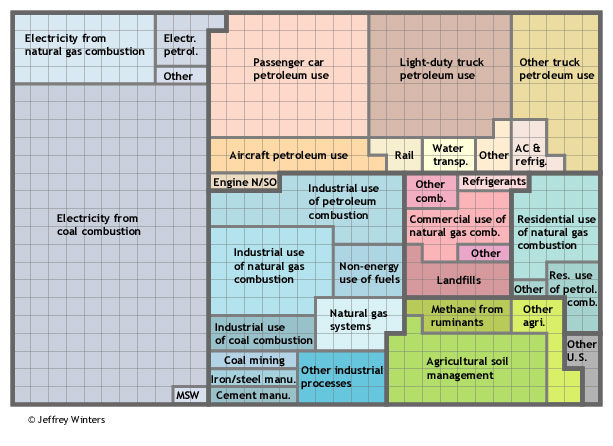
The Musing Environmentalist highlights a keeper
Karen Street, who comments here regularly, runs an interesting blog of her own called Musing Environmentalist.
I was taken with a graphic she highlighted from an article in Mechanical Engineering magazine, representing the GHG emissions from various sources. Check it out (click for larger version):

-
Well, Uh, At Least No One Got Zero?
California, Vermont, Connecticut top ranking of energy-efficient states Less than a week after California Gov. Arnold Schwarzenegger (R) declared at an economic summit in Canada that clean energy is becoming the basis for “a new gold rush,” his all-star state has topped an energy-efficiency ranking issued by the American Council for an Energy-Efficient Economy. Looking […]