On the empty 47th floor of the downtown San Francisco headquarters of the social media company Ur, gazing down upon the sea of tents that crowded Sitlintac Park, stood the third-to-last employed user experience writer in all of Greater Silicon Valley.
Morgan Bernd didn’t know he was the third-to-last, but figured it was something around that since everyone else he knew had been laid off years prior and Ur had only kept him on to train the AI on the finer nuances of ensuring Ur users felt a sense of agency as they navigated the latest update to the legacy mobile platform.
He was like the mobile platform — useful only for the profits it brought in from retiring millennials, long isolated from the younger generation of novelty-obsessed Urverse vibe coders who saw it only as an embarrassing necessity in the age of personal drones — and he knew his time was near. News of the upcoming layoffs had already leaked to the press, as it always did, and by the end of the week he would no doubt join the millions of former creative professionals who now lived on California Basic Income.
His city had been a hundred different cities since he’d moved into his first apartment at Ellis and Jones, the summer between high school and art school. Ramen shops came and went like the fog, encampments sprouted on the sidewalks like delicate mushrooms in the first week of fall rain. Skyscrapers rose like the wild fennel in the empty lots, fenced high to make sure no one slept in them. And so Bernd had walked, from his home office in Mid-Market, all the way to the skyscraper he had never actually worked in, past the single desk attendant and her hovering drone, to get one last glimpse of this San Francisco, from the 47th floor.
There was no one up there. No one leaning against the rail of the open-air deck to gaze out at the Bay Bridge with a joint between meetings. No one at their desk with headphones bashing out last-minute code, no one twirling their hair and planning drinks with No One From Marketing, and no one biting their lip as they shuffled to the bathroom to cry.
He’d only worked for Ur six — no, seven — years, and there had been people in the office for big meetings, planning sprints, and crunches, but he’d heard stories of the pre-remote days, imagined that top floor when it was new, bustling with blandly-enthusiastic naivete, the old famous CEO who was three days younger than him strutting around in a hoodie, giving an awkward thumbs up to the old famous COO in her tailored navy suit as she made an important presentation to an important investor or some shit.
He’d never met them. He’d never wanted to.
He’d always — and only — wanted to make the lives of users just a little easier.
He pressed his hand against the wall of cool glass that stretched between his aging body and the crowded skyline. How many towers had stood this empty this long?
Far below his toes, in the long, floating quasi-rectangle of Sitlintac Park, were a thousand brightly-colored tents, and underneath the park, around the edges of the transit center, were a thousand more, and the edges of that blurred with the line for the East Cut Refugee Resource Center.
This was one of the better San Franciscos. Perhaps the best since the Spanish got here.
In this San Francisco, the haze that lounged across the hills was from prescribed burns. The farmers markets sold less almonds, more nopales. The new seawall was still under construction, but at least it was under construction, and the industrial shorelines of the East Bay were in carefully managed retreat. In this San Francisco, the revolution, if not televised, had been livestreamed in a series of melodramatic public comment sessions on the city government website. Most of Bernd’s coworkers were now as ignorant about it as he had been about the assassinations of Harvey Milk and Mayor Moscone when he first moved here for art school.
And in this San Francisco, the people who had been displaced by the Colorado River Moratorium and the Gulf Coast Inundation and the Appalachian Fires and the extremists were all welcome — as strangers have always been in San Francisco, even when the government claimed otherwise — but now with intentionality and exhausted kindness and, eventually, a meal card and a tent. Homes were no easier to come by, but at least they weren’t arresting people for not having one anymore.
And the skyscraper headquarters of the Ur corporation — named out of cynical hubris — stood yet above it all, smirking and hollow and blue.

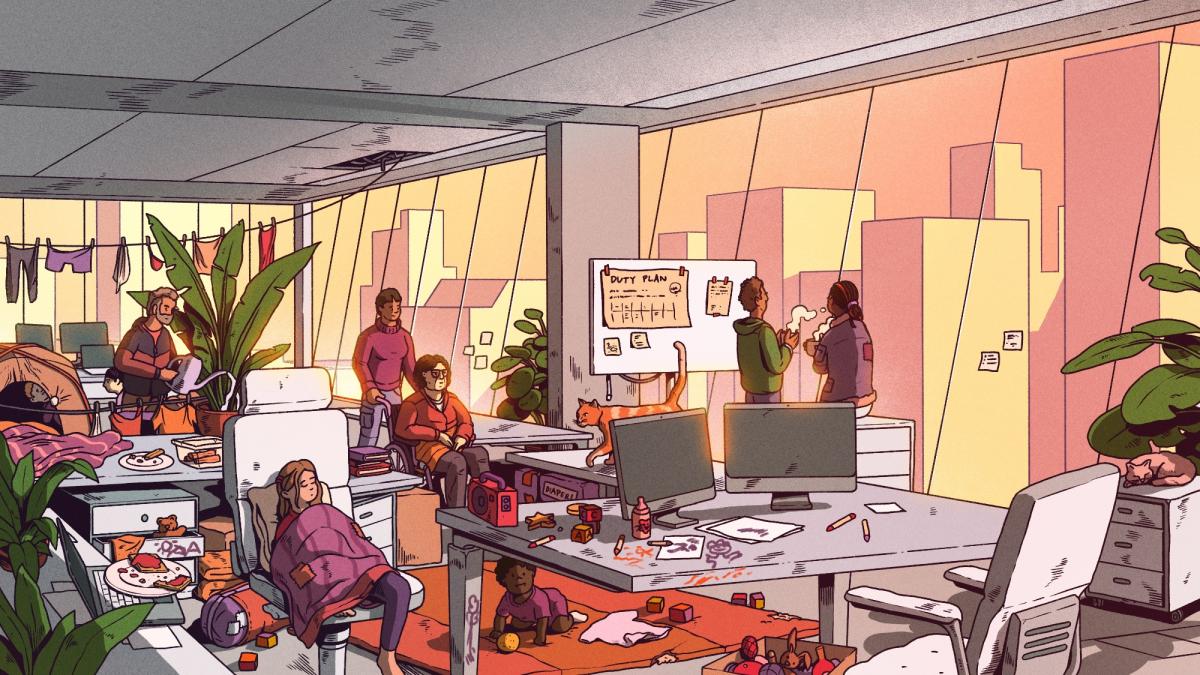
Morgan Bernd walked back to the elevators past the vacant conference rooms with their expressionless whiteboards, and the silent kitchenette that had once been stocked with endless plastic-packaged snacks, and the rows of yellowed-vinyl desks attended to by empty ergonomic Aerons, and he took the elevator in the only direction it could go from here, which was down.
All the way down. Down to the nineteenth floor where he got out, crossed the hallway, called the next elevator and took it in the only direction that it, too, would go from here, which was also down. And he stepped out into the cavernous stone and wood lobby, and approached the lone attendant at the long front desk who was watching videos on her drone’s display. She shooed it to the side and smiled at him. She had paisley eyeshadow, bright gold and violet popping across cool, dark brown.
“What’s the guest policy?” he asked her.
She smirked and nodded knowingly. “Fourteen. Sixteen if you want a camera malfunction.” And she winked.
“Oh, it’s not —”
She cocked her head at him, twirling a braid while he stammered. “Whatever.”
Sixteen hundred cals was probably a week’s pay for her. But right now, while Bernd was still on payroll, it was something he could do. He transferred 1,600 to her drone and stepped outside, where the air had warmed by 10 degrees. There was music wafting through the streets from Sitlintac Park. He followed it.
One thing you should know about Morgan Bernd is that when he was 5 years old and his parents were both between jobs, they had all slept in the living room of a friend’s trailer in the Mojave Desert for three months, and it was there that his parents’ relationship ended. He used to walk through the desert with his dad picking up pink rocks and watching the quick, quiet water flow through the aqueduct and lap haphazardly against its concrete prison walls.
Another thing you should know about Morgan Bernd is that when he was 7 there had been a fire in the Oakland Hills, and he could still remember how the sky looked, glowing orange at night, through the attic window of the tiny carriage house his mother rented from a friend. And he still remembered how they couldn’t afford carriers for their two calico kittens and there wasn’t time to try and borrow one because the fire was so close, so they put the kittens in their backpacks, carefully, so carefully, and the little cats were quiet for once, as if they knew.
And a third thing you should know about Morgan Bernd is that he chose a career as a user experience writer instead of something he was probably better suited for, like writing science fiction, in part because when he was in his early 20s, working retail jobs on Union Square, he could feel how thin the margin was between himself and everybody living on the street, and he knew one thing for certain: He did not want to be one of them.
And there are more things you should know, a dozen more, and they’re all tedious, because the stories of how people lost or almost lost their homes are dreary Rube Goldberg machines of broken-down cars and failed marriages and lost parents and bad policy and disorders no one diagnosed in time and none of them — none of them — are cut and dry, even for the climate refugees, because if only they’d bought the place inland when the interest rates were low, if only they’d finished that other degree, if only they’d had a savings, had a wealthy relative, had a wealthy relative who kept them in their will after an unsanctioned marriage, or, god forbid, a mistake.
And so as Morgan Bernd walked to the end of the long, long line that led to the East Cut Refugee Resource Center, he passed versions of himself, 5 and ignorant and holding his father’s hand; 18 with no way home; and countless versions of his parents who’d evacuated floods and fires, but these parents’ homes were one foot lower on the hill, one block closer to the forest’s edge.
At the end of the line was a gray-haired, pink-skinned man his age, with a backpack and a cigarette and nothing else, and Bernd said to him, “There’s a place you can crash for a while a couple blocks from here.”
The man looked him up and down and said, “I don’t suck dick.”
And Bernd said, to the whole line who could hear him from here, “There’s room for everyone, no strings, just not strictly above board. But if you want a clean bathroom and roof for a few hours, maybe longer, we’re two blocks over.”
The man at the end of the line tried to gauge how many people were in front of him, stamped out his cigarette and said, “Fuck it, let’s see what you got.”
Two teens in front of the smoker followed, and a woman in front of them pulled on the sleeve of the woman in front of her and gestured with her head and they both joined, and the family in front of them with two small kids who both had to pee came also. And seeing that there was another place to go, fifteen or so others followed, some with carts or luggage, and a few others joined on the way, so that when he came back to the cavernous stone and wood lobby, they filled it like commuters waiting for the 6 p.m. train.
The lone attendant with the paisley eyeshadow shook her head at him continuously as the refugees poured in. “Oh, hell no. Nope. Nope. No, fuck no. This was not the deal, you’re gonna get both our butts fired.”
“My butt’s already on the list,” Bernd said. “What do you want?”
She didn’t have to think. “Three K. Six if you don’t want me to call the cops in 15 minutes.”
That would set him back. Would there be enough severance to make up for it? Would they fire him before the layoffs and not give him any severance? Would firing or legal charges disqualify him for the basic income program?
Would he end up one of them after all, after everything, after selling his soul for an entire career, wasting his life turning billionaires into trillionaires just to flee the gnashing jaws of homelessness that had come so close to devouring him in his youth?
He wished he could convince her with words. But he’d always been better at writing them than speaking them.
The guy his age with the backpack tapped his arm. “Hey, isn’t this the Ur building?”
Bernd turned and nodded, and behind the man was the crowd, and the kids who had to pee, and a teenage girl running her hand along the edge of one of the 10 black leather sofas that no one had sat in for years. She looked around to see if anyone was going to stop her, then she set her purple backpack on the floor and slumped into the leather with an outburst of appreciative slang he didn’t know the precise meaning of, but could hear from all the way across the cavern of the lobby.
And two elderly men sat across the polished marble coffee table from her, one apologizing to the other, the other insisting he rest.
“We should still be in line, what if we don’t get a tent?”
The other countered, “Your ankle isn’t healed yet, babe. You have to take it easy.”
At the far wall by the floor-to-ceiling windows, a toddler no taller than a flower pot reached up on tippy toes to touch the lowest leaf of a fiddle-leaf fig that was probably real. The leaf was wider than their head. A young man nearby pulled the child back with an urgent, “Aaaaye, no touching, you little raccoon!” Then he kissed the child’s forehead, gathered them up in his arms and pointed to the leaves, one by one, muttering botanical descriptions as the child giggled and squirmed.
Something moved in the backpack of the man who stood next to Bernd, and a black, whiskered nose pushed its way through the zipper. “Hey, buddy,” the man said, and shifted the bag around to his chest so he could rub the cat’s head. Two triangle ears popped up, and the whole fluffy black face fit cupped in the man’s sunburned hand. He looked at Bernd and said apologetically, “He’s probably thirsty.”
Bernd transferred six thousand dollars to the desk attendant’s drone.
And he said to her, “If you get fired, come upstairs.”
Her arched eyebrow leveled into genuine concern. “You know I’m sympathetic, but this is a stupid fucking idea on so many levels.”
“I know,” he said. “It’s a stupid fucking idea on all 47 empty fucking levels.”
And she nodded, and laughed a small, sad laugh, and said, “Hold on a sec.”
She reached under her desk and pulled out a basket of blank badges. She ran one through a machine and handed it to the man with the cat in his backpack. And then another, and another, until everyone in the lobby was a guest of Ur.
Bernd entered the elevator with as many people as would fit. They were tired, every one of them, and they smelled like the street and like stress and like they all needed a shower, and they were nervous about what would happen next, how long they’d be able to stay here, where food would come from, how many cops would show up and would they all lose, somehow, even more for the crime of trying to find a bathroom and a bit of air conditioning — or for the crime of trying to make the lives of the city’s users just a little easier.
The elevator doors closed, and they went in the only direction they could go.
“Forty-Seven Vacant Floors of Ur” appears in T. K. Rex’s debut collection, The Wildcraft Drones, available May 21, 2026. Order it from your local independent bookstore, or through the publisher’s website.
T. K. Rex is a science fiction and fantasy author whose stories can be read in numerous publications, including The Wildcraft Drones, their debut collection on shelves May 21, 2026, from Stelliform Press. The Wildcraft Drones begins in the near future of “Forty-Seven Vacant Floors of Ur” and follows the evolving relationship between humanity, nature, and technology into the far future. T. K.’s stories, socials, and newsletter can be found at tkrex.wtf. They live in San Francisco.
Stefan Große Halbuer is a digital artist from Münster, Germany, who has worked for brands like Adidas, Need for Speed, Samsung, Star Wars, Sony, and Universal Music, as well as for magazines, NGOs, and startups. Recently, he released his first solo book, Lines, a coloring book with a selection of his art from the last years.
Read more from Imagine 2200
-
![Stylized illustration depicts a silhouette wearing headphones with sound waves radiating around. Below their feet is a bright world of mushrooms and fungi.]()
The Case of the Missing Lake
Lake Ballona goes missing, and only the mushrooms can help.
-
![Illustration portrays two young women riding on a motorcycle through a field of flowers]()
The Sunflower Covenant
When Dee is transferred to the swanky Wicker school, their education in conformity is quickly derailed by another misfit willing to fight for a different world.
-
![Illustration of an elderly woman sitting on a mechanical dugong in the water. She wears elaborate armor and holds a spear, waiting to attack a large trawler ship.]()
Mousedeer Versus the Ghost Ships
When automated ships threaten their recovering ecosystem, it falls to Ah Ma and the crew of the Mousedeer to fight back.