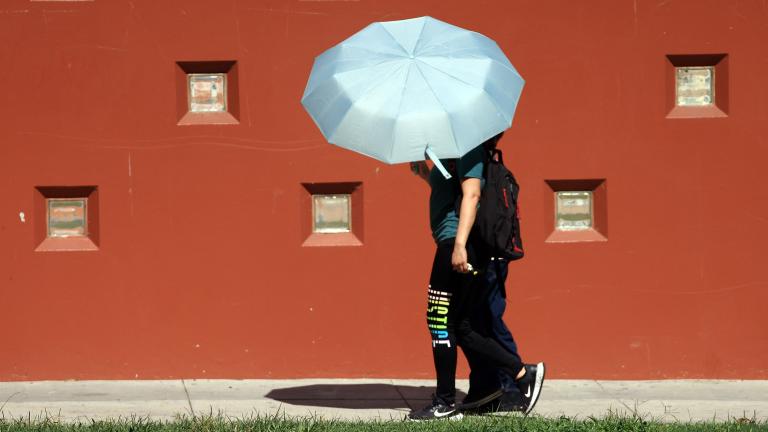
France has been preparing for climate-fueled heat waves for more than two decades. In 2003, more than 14,800 people died as summer temperatures hovered above 95 degrees Fahrenheit for two weeks. The devastating event led French policymakers to build one of the world’s most comprehensive heat-resilience programs.
The following year, the French government unveiled a national heat plan that included a four-tiered alert system. When temperatures rise and trigger the highest alert level, authorities establish a crisis center to coordinate a national response. Local officials are required to implement their heat plans, which include providing access to cool spaces, ensuring access to water, and checking in on heat-vulnerable residents. France’s meteorological and health agencies jointly monitor weather forecasts and health risks, alerting residents when dangerous conditions arise.
In the years since, France has taken additional measures to adapt to hotter summers: Cities have planted trees to reduce the urban heat island effect, built shaded walkways and biking paths, and converted public spaces into cooling centers that residents without air conditioning can use on the hottest days. (Only about 25 percent of French households have air conditioning.) In Paris, policymakers have conducted drills and tabletop exercises, rehearsing what it might be like to live in the future when temperatures are projected to hit 122 degrees Fahrenheit.
Those strategies are now being put to one of their biggest tests. Over the past week, cities across Europe have experienced soaring temperatures, with many breaking all-time heat records. More than a dozen countries across Europe, including France, issued heat alerts over the past week, warning their residents to stay indoors during the hottest hours, keep homes cool by drawing shutters and curtains, and avoid strenuous physical activity. It’s the continent’s second heat wave in two months, both of which began even before the official start of summer. In Paris, temperatures topped 103 degrees Fahrenheit, and average temperatures across France were at their highest level ever last week.
The heat has already proven deadly. More than 40 people seeking respite from the heat drowned while swimming in France, many of them teenagers. Spanish officials also warned of heat-related deaths: A local monitoring agency estimated that more than 200 deaths in the past week could be attributed to high temperatures. The elderly, children, and the unhoused are among the most vulnerable populations.
Researchers have found that as climate change drives warming, cities will increasingly have to grapple with longer summers and hotter temperatures. Europe, the world’s fastest-warming continent, is in many ways at the forefront of this challenge. For much of 2024, temperatures were 1.5 degrees Celsius (2.7 degrees Fahrenheit) higher than preindustrial averages. On the current trajectory, temperatures in Europe are expected to rise by 5.6 degrees Fahrenheit by the end of the century.

“Cities across the world — even the ones that are doing the best that they can — are still preparing for the heat that we’re experiencing today,” said Ladd Keith, an associate professor of planning and director of the Heat Resilience Initiative at the University of Arizona. “They’re not doing a great job of really aggressively planning for the heat that we’re going to experience tomorrow.”
For years, extreme heat received far less attention and resources than disasters such as hurricanes and wildfires. But as heat waves have become more extreme — and the consequences increasingly deadly — policymakers have begun to treat them with greater urgency. Early generations of heat plans primarily focused on protecting public health and emergency response. But recent heat plans have taken a broader approach, including urban greening efforts and reducing waste heat from vehicles and air conditioning.
Cities tend to be 5 to 10 degrees F hotter than surrounding areas due both to heat generated by cars and heavy industry as well as heat trapped by asphalt and other synthetic materials. Cities have been tackling this phenomenon, which is called the urban heat island effect, by planting trees, building parks, and investing in other greening initiatives. Such efforts require multiple departments across government — including urban planners, public health officials, and disaster response teams — to work together.
Some cities have even been hiring so-called chief heat officers to take ownership over managing the problem, or else explicitly tasking their climate resiliency officials with heat adaptation efforts. In 2021, Florida’s Miami-Dade County hired the world’s first-ever dedicated chief heat officer. According to Keith, who has been studying how governments are responding to rising heat, there are roughly 15 analogous officials worldwide. Similar roles exist in Los Angeles and Phoenix, as well as in Greece and Australia.
Keith said that Arizona, in particular, has been ahead of the curve in its response to extreme heat. About a thousand people died from heat-related illnesses in 2023, more than any other U.S. state. But in the following years, those numbers came down even as the state experienced more punishing heat. For one, the governor began declaring official heat emergencies during extreme heat waves. The state also appointed a chief heat officer and statewide cooling center coordinator. Cities like Tucson also adopted their own heat action plans. During the cooler months, officials now meet to discuss the lessons learned from the previous year’s summer.
“A lot of efforts that have been building over the last decade came together that crisis year,” said Keith. “We’re addressing the summer’s heat in a much more coordinated way than we’ve ever addressed it before.”
Such efforts will only become more important as regions with historically temperate climates — like parts of Europe — experience hotter, more frequent heat waves. Climatologists have been forecasting that the summer of 2027 will likely be the hottest in recorded history, thanks in part to a “super El Niño,” the periodic shift in warm waters across the Pacific Ocean that exerts tremendous influence on global weather patterns.
“This is just classically in line with what we are expecting with climate change,” said Keith. “Any lessons that we learn from this specific event, we need to rapidly turn around and put those into place.”