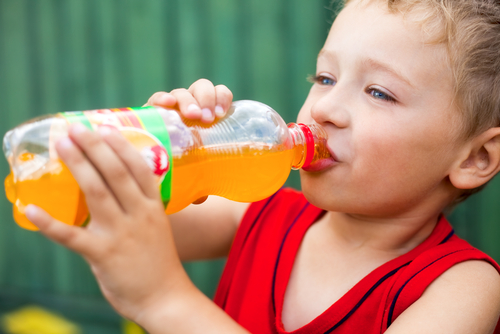

Photo by Shutterstock.
In the Great Soda Wars, it often seems that beverage companies have the upper hand. Critics of restricting access to soda and other sweetened beverages have the rhetoric of freedom and liberty — or rather Freedom! and Liberty! — to draw on as well as the whole history of failed government attempts to restrict stuff people like that’s bad for you. But now we have the latest entry in the Soda Wars saga; what I’d call: The Researchers Strike Back.
The New England Journal of Medicine (NEJM) has published a series of articles dedicated to research and commentary on the health effects of sugar-sweetened beverages (soda, yes, but also 100 percent fruit juice). The conclusions are striking. As The New York Times put it, the articles offered critics of soda consumption “a potent weapon: strong evidence that replacing sugared drinks with sugar-free substitutes or water really can slow weight gain in children.”
Two of the studies in the series stood out for me. The first was an 18-month double-blind trial (i.e. neither the researchers nor the subjects knew which group was being experimented on) performed by a team from the University of Amsterdam. The goal of the study was to compare weight gain from sugar-sweetened versus diet drinks in children.
Interestingly, the researchers only selected kids who were already regular soda drinkers. As they said, they “considered it unethical to provide sugary beverages to children who did not habitually consume such beverages.” They also contracted with a beverage maker to create a custom-made canned drink so that there was no difference in appearance or taste between the two versions. Clever!
The researchers found that kids who drank the diet drinks gained “significantly” less weight and had less body fat than the kids who drank the sugar-sweetened ones. The exact mechanism is unknown, but it lends credence to the theory that sugary drinks represent “extra” calories that don’t make us feel full the way other kinds of calories do. Of course, before you get excited about the idea of expanding diet soda consumption among kids, it’s worth quoting another study I recently wrote about that found diet soda consumption up among American kids:
The effects of these sugar alternatives have not been well studied, and both short- and long-term effects have yet to be determined …
… Recent human and animal studies have shown that [low-calorie sweeteners] may affect glucose metabolism, satiety, and vascular function, despite their inherent lack of energy. A growing body of evidence suggests that repeated exposure to sweet substances may lead to the development of preferences for highly sweet foods and beverages. This is particularly concerning in young children, among whom early exposure to highly sweet substances can lead to the development of dietary patterns replete with highly caloric foods, typically lacking in nutritional value.
That bit about “vascular function” refers to other research that found an association between diet soda consumption and stroke and heart attack risk. Thus, while switching kids to diet soda might help prevent weight gain, it could open them up to other risks that we don’t know much about.
In fact, the Dutch researchers pointed out that they likely would have gotten the same results, in terms of weight loss, had they used water instead of a diet drink. But that would “break the blind,” i.e. subjects given water would know it wasn’t the sweet drink and thus might adjust their behavior. The point of the study was not actually to demonstrate the effectiveness of diet drinks, of course. It was to show that the calories in sugar-sweetened drinks have a direct effect on weight gain.
The other NEJM study that I found noteworthy was by researchers from Harvard University. It found a link between sweet drink consumption (including soda, diet drinks, and fruit juices) and a genetic predisposition to obesity. Researchers examined data from several sources — the Nurses’ Health Study and the Health Professionals Follow-up Study, as well as from the Women’s Genome Health Study.
They discovered that for any given subject, the greater the genetic predisposition to obesity — as measured by a set of genetic markers associated with obesity — the higher that subject’s intake of sweetened beverages turned out to be. And the greater the weight gain, as well.
This study puts some science behind the problematic politics of restricting access to soda. Like liquor, sweetened drinks may be something that a large chunk of the population can enjoy with minimal ill effects. But similarly, there may also be a significant chunk of the population with a predisposition to health problems from consuming them. Creating policies that help the latter without infuriating the former is the great challenge for government.
The good news is, despite the rhetoric from critics, no one is talking about banning soda. Even in New York City — where sodas larger than 16 ounces are now unavailable at most fast food restaurant chains — you’ll be able to buy as many smaller sodas, not to mention two-liter bottles, or even Big Gulps, as you like.
Since taxing foods like soda has proved problematic for all sorts of reasons, Bloomberg-style bans may be one of the best ways to attack the problem. And yet, they risk driving even non-soda drinkers a bit batty. But perhaps it would help if more people understood that the health risk from soda consumption may not be universal. It’s not a revelation to declare that sugar isn’t good for you. But, as with alcohol, many people can consume it without suffering long-term negative health effects. So perhaps we need to recognize that there are some small sacrifices we need to make in order to reduce the health risks for others.
Yes, the uneven effect on populations makes finding evidence of damage difficult; it’s why researchers are only now coming up with ways to tease out the effects of soda consumption on weight gain. But it also makes addressing the problem unpalatable, to say the least. Just ask Michael Bloomberg.
A message from
Your support keeps our climate news free.
Grist is the only award-winning newsroom focused on exploring equitable solutions to climate change. It’s vital reporting made entirely possible by loyal readers like you.
At Grist, we don’t believe in paywalls. Instead, we rely on our readers to pitch in what they can so that we can continue bringing you our solution-based climate news. Donate today to keep our site free.