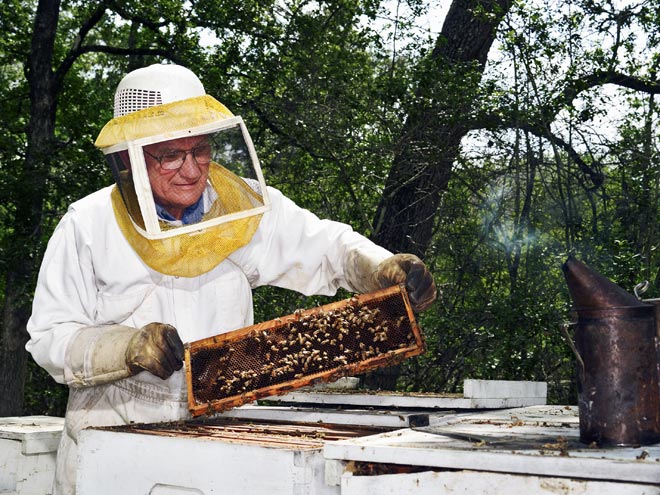
Don’t even try to lie to me about honey, son. (Photo by Jay B. Sauceda.)
Did you know that people sell fake honey? They take supermarket honey and try to pass it off as fancy stuff you get for $30 at a farmers market. Is nothing sacred anymore?
Luckily they don’t always get away with it, thanks to honey detective Vaughn Bryant. By day, he’s an anthropologist, and a regular user of honey. By night, or maybe just some other days, he’s a melissopalynologist — an expert on pollen.
Bryant can ID a honey’s origin by analyzing pollen traces — flowering plants have different genetic information depending on where they grow, so each batch of honey has a genetic signature that can tell you where it was gathered. At his Texas lab, Bryant tests hundreds of samples each year, and when he finds, say, Texas pollen in “California” honey, he’s pretty sure he’s looking at honey fraud. Bryant is in high demand as a honey detective; his customers include importers, exporters, and state agricultural agencies. He even verified that the White House honey came from White House bees.
We figure the life of a honey detective is not unlike the life of a regular detective — gunplay, dangerous dames, trenchcoats with mesh face-coverings attached. But instead of sending you Gwyneth Paltrow’s head in a box, the perps mail you a plastic thing shaped like a bear.
A message from
Your support keeps our climate news free.
Grist is the only award-winning newsroom focused on exploring equitable solutions to climate change. It’s vital reporting made entirely possible by loyal readers like you.
At Grist, we don’t believe in paywalls. Instead, we rely on our readers to pitch in what they can so that we can continue bringing you our solution-based climate news. Donate today to keep our site free.