👋 Hi, everybody! Last week, we had our book club gathering to discuss Climate Wayfinding by Katharine K. Wilkinson. As always, it was beyond lovely to be in the Zoom room with y’all, and with Katharine. We even departed from our usual format to do a guided meditation together. If you missed out, you can find that and more activities and resources on the book’s companion website. In today’s newsletter, explore some highlights from our Q&A with Katharine on what it means to bring our full selves into climate work and to operate from a place of love.
We’ve also got news about the EV transition, solar power, and the weather on Sesame Street.
This post originally appeared in Grist’s weekly solutions newsletter, Looking Forward. Not on our list yet? Subscribe here to get it in your inbox every Friday.
Loving our planet and our whole selves: A conversation with Katharine K. Wilkinson
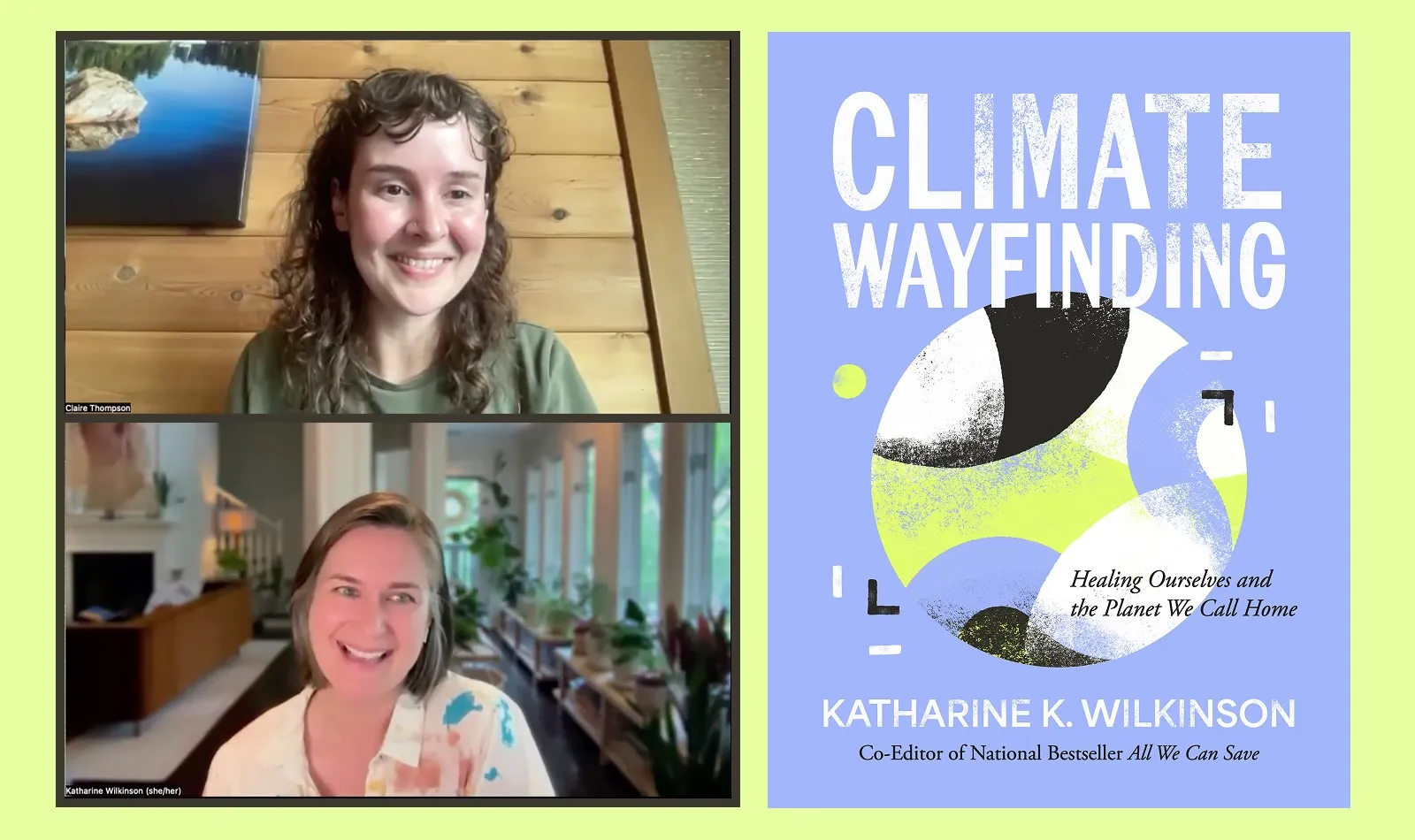
When we started the Looking Forward book club back in 2022, the very first book we read and discussed together — by popular demand — was All We Can Save, a collection of essays, poems, and other creative works by 60 women in the climate movement, co-edited by Ayana Elizabeth Johnson and Katharine K. Wilkinson. Katharine joined us as a special guest at that inaugural 2022 gathering. So it was a special treat to see her at the book club again, this time to discuss her newest offering: Climate Wayfinding.
Climate Wayfinding in itself is a kind of full-circle moment. The book grew directly from programmatic work that Katharine led with the All We Can Save Project, the organization that she and Ayana co-founded after putting All We Can Save out into the world and discovering that “the book wanted to be more than a book,” as they put it on the organization’s website. Their mission was to cultivate and grow a “leaderful climate community,” which they did by designing programs that took the essence of All We Can Save off the page.
Facilitating in-person retreats with their small nonprofit has been wonderful, Katharine told us at the book club discussion. “But it’s like a drop in the bucket for providing the support that I think folks need — both those who are in this work and burning out, and for the many, many, many more who are kind of sitting on the sidelines still asking, ‘What can I do? How can I help? Is there a role for me in this?’”
The chapters of Climate Wayfinding — peppered with personal reflections, playlists, poems, and prompts to put the book down and do some journaling, meditating, or thinking — guide a reader through answering those questions. At our gathering, Katharine told us what it was like to translate that work back into book form, and the parts of her own journey that informed the writing. Some highlights from our conversation are below, edited and condensed for clarity.
* * *
Q. Katharine and I got to meet face-to-face just ever so briefly in Seattle when she was on her book tour. I’d love it if you could start by telling us a bit about how the tour went and any highlights from your journey.
A. A book tour is a beautiful and exhausting thing, I’ll say. Some real highlights for me: We integrated a lot of the arts into the book events wherever we could. We had a big event at the Carter Presidential Library in Atlanta, and this amazing cellist, Okorie Johnson, played and integrated looping cello in the book event. It went a little church, which frankly felt right for Jimmy Carter. We did some events with poets as well — poets who contributed to Climate Wayfinding — Jane Hirshfield, Ellen Bass, Tamiko Beyer.
I think it was also, quite frankly, a bit of a harrowing pulse check on how the community’s doing, how the movement’s doing. Lots of folks — you can imagine, particularly in D.C. — lots of people who have lost jobs in the federal government, people whose organizations have lost funding or certainly lost momentum. There was a lot of community and a lot of joy and laughter, but also there were a lot of tears. And I think just feeling how much the heart of it all needs support and tending in this time.
Q. Let’s get into the book a little bit more. I’ll ask the super basic intro question. Having done this work for a while, in various parts of the country with people in person, how did you decide to turn it into a book?
A. Yeah, this is sort of an unusual book, in the sense that it has lived in the world in other forms for the last four years now.
The first wave of helping this program grow and reach more people was through facilitator training. It’s running now on something like 50 college and university campuses. But of course, people of all ages need this support. And I had kind of a hand-to-the-forehead moment of, like, “Oh, yeah. One of the things that I do is make books, and we could take the content of this program and bring it onto the page.”
Ultimately, it was so exciting to imagine that so much of the program could find a home in the book and then could come to life for individual readers, for reading groups, and in classrooms, and in all sorts of ways that kind of liberates the program from needing to be directly delivered by our team.
Q. Something else that this book includes quite a lot of is your own personal memories, reflections, experiences. Which I imagine captures some of the personal connection and bonding that would happen IRL. I really loved sort of getting to know you through what you shared in the book. I’m wondering if you could talk about the importance of bringing your whole self into climate work in that way.
A. That was a very different aspect of this book for me. My first book in 2012 was an academic book, so you can imagine the trajectory from there to here. And I appreciate that, Claire, because I was a little nervous actually — so I appreciate that reinforcement for what’s in there. And I do hope that in some way it models the bringing of the fullness of ourselves into this work and the evolution of that. At 43 now, I’m bringing more of myself into this work than I did at 33 and than I did at 23.
There were messages that I got early on about how one is supposed to be in the climate space. My first boss out of undergrad was at NRDC, and he was like, “You’ve gotta go get a Ph.D. Doesn’t really matter what it’s in, but you have to have that for credibility.” So it was this message of, like, you need to show up with your big brain and with your facts in hand and please keep the poetry and the tears for another space. And ultimately, I think it’s just not really possible to do this work for the long haul without having the fullness of ourselves come in.
But I also think it’s not effective. The depth of what needs to be done is too much for just the prefrontal cortex. It’s too much for just our emotional, spiritual roots in this work. It’s too much for just capable hands. We need all of us. This is a question from the last page of the book: Can you feel a magnetic pull for the gifts you are here — in this time, in this place — to bring?
And I think that is about coming with the bigness of ourselves, the depth of ourselves, the wholeness of ourselves.
Q. I think about this quote in the book: “There must be those among whom we can sit down and weep, and still be counted as warriors.”
A. Adrienne Rich. Totally.
Q. One of the final ideas you leave us with toward the end of the book is about operating from a place of love. Not just a desire to fix something that’s broken, but a real love for our planet and life on it. Tell us a bit more about that and what that means for you.
A. For anyone who maybe hasn’t gotten to the last chapter, I ended up writing a bit about my dad’s passing. I took three months off to focus on writing this book — or three months away from the typical fray, it was very much three months on — and exactly one month into that, my dad died. And that was the end of a 10-year journey with Alzheimer’s, which is a tough road. My heart was just kind of blown open in a different way than I think it otherwise might have been. And I think the book is better for it. I found myself holding just a whole raft of new wonderings about home, about meaning, about what is worth doing with this incredibly fleeting time that we have in these strong but fragile bodies of ours.
I was also thinking about, just the sheer math doesn’t add up sometimes for what needs to be done and how quickly we need to do it — and feeling like we have to tap into energy, power, courage from some other place. And I don’t think it comes from that sort of bureaucratic fixing mentality. It comes from something else, and it has to hold both the possibility that we have the outcome that we want and that we don’t, right?
I think when we are coming from a place of love, we expand our capacity to hold the potential futures that may be ahead. Certainly that was my experience of journeying through hospice with my dad. There was no optimal healed in some conventional sense, but there was the capacity to do deep loving and, I hope, some spiritual healing along the way.
I’ll also say, my dad was a sports journalist. He was really not a nature guy. So I also think he would have found it so fricking funny that he had found his way into a climate book posthumously. I can just hear his sort of roaring laughter. But like, “That’s great!”
More from Grist
🚙 Upgrade you
Thinking of switching to an EV? For a long time, the prevailing wisdom was that keeping your clunker for as long as possible was the most sustainable choice. New research has found the opposite. Trading in even a relatively new gas car for an electric one leads to clear emissions savings in a surprisingly short time. Read more
📄 Not permitted
The controversial Line 5 pipeline just suffered a legal blow from Michigan’s Supreme Court. In a 6-1 decision, the justices vacated a permit for work to replace an underground segment of the pipeline, writing that the potential for environmental harm needed to be more thoroughly considered. Read more
☀️ Sunny state
A decade ago, Utah was getting the majority of its energy from coal. But steady investment in renewables is bucking that trend. In May, the state got nearly a third of its electricity from solar — surpassing all other sources for the first time ever. Read more
In other news
- An appeals court ruled against the Trump administration’s termination of ‘green bank’ funds. The issue may go all the way to the Supreme Court. (Canary Media)
- Sesame Street takes on the topic of extreme weather, teaching kids about preparation, camaraderie, and recovery (The New York Times)
- Land defenders are setting up tents on logging roads to try to save old-growth rainforests on Canada’s Vancouver Island (The Associated Press)
- A study mapped Europe’s most critical, carbon-storing wetlands, helping to direct restoration efforts (Inside Climate News)
- She spent years pushing for representation in the climate movement. Now, she’s created the world’s first environmental justice encyclopedia. (The 19th)
And finally, looking forward to …
… YOUR visions for meaningful climate action. In lieu of a drabble today, I’ve got a prompt for you all. I mentioned we took a moment to do a guided meditation together at our book club gathering last week — specifically this meditation on vision from Chapter 7. On the book’s website, you can hear a recording of Katharine reading it (you can also find it on page 173 of the book, if you have it). The exercise prompts you to envision a day, three years from now, when you are immersed in climate engagement. It nudges you to reflect on several questions as you move throughout this future day. And of course, I saw a ripe opportunity for drabbling!
I encourage all of you to take nine minutes to do the meditation. And then, if you feel moved to turn a piece of your vision into a written drabble, I would love to read it. Reply to this email, or share with me anytime at [email protected].
🌱
A drabble is a 100-word piece of fiction — in this case, offering a tiny glimpse of what a clean, green, just future might look like. Want to try writing your own (and see it featured in a future newsletter)? We would love to hear from you! Please send us your visions for our climate future, in drabble form, at [email protected]
👋 See you next week!