One of the hottest, most fascinating new fields in science doesn’t sound particularly exciting: distributed acoustic sensing, aka DAS. It involves using fiber optic cables to spy on the environment, and is proving to be enormously powerful. By analyzing the way that vibrations scatter light through the wires, scientists can detect volcanic eruptions, earthquakes, and even footsteps above. Last year, researchers laid a cable on the seafloor near a Greenland glacier, providing unprecedented insight into how the ice is rapidly deteriorating.
Now a team working in the mountains of Switzerland has used DAS to expose another troubling trend in ice, known as hydrofracturing, in which meltwater seeps deep down and creates pressure. By studying the phenomenon, scientists can get a better idea of how ice the world over will decline, and therefore better predict consequent problems like sea level rise.
“It’s hypothesized to be a mechanism that can cause mass disintegration of ice shelves and ice sheets in the Antarctic, Greenland, et cetera,” said Thomas Hudson, a seismologist at ETH Zurich in Switzerland and lead author of a recent paper describing the work. “But no one’s really observed the mechanism in any detail.”
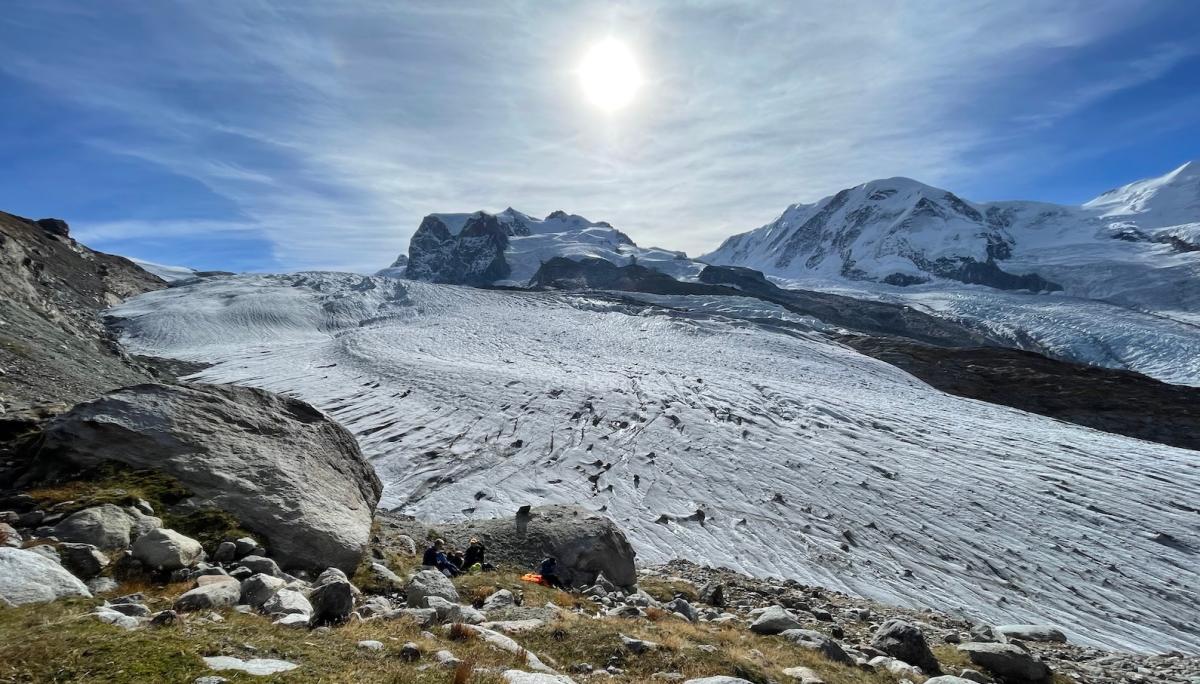
For all its simplicity, DAS provides incredible amounts of data. On a Swiss alpine glacier, Hudson and his colleagues laid out fiber optic cables in a grid pattern. Then, using a device called an interrogator, they fired laser pulses through the cable. Even the tiniest of disturbances along the cable sent the tiniest bits of light back to the device, where they were logged.
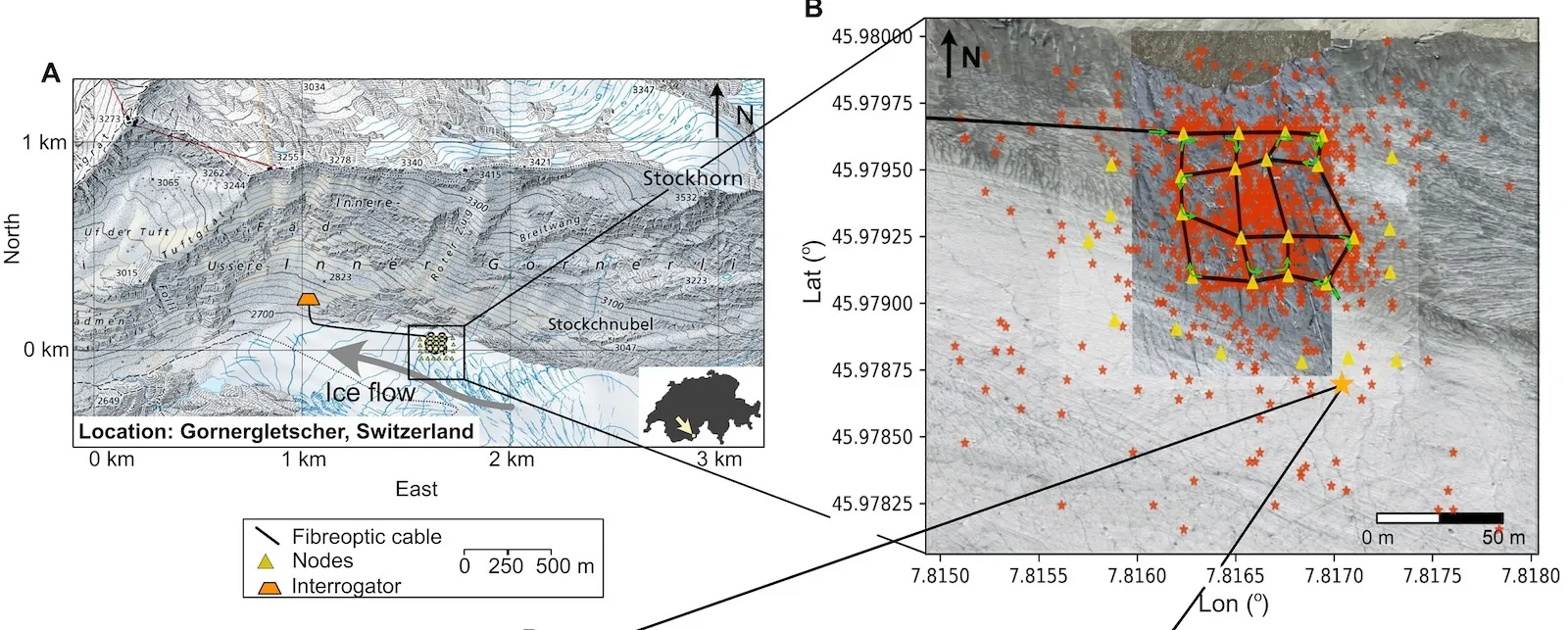
Using calculations based on the speed of light, the researchers could pinpoint an “icequake” — a fracture that generates seismic activity, similar to an earthquake — at different distances along the cable, since farther ones take ever so slightly longer to travel back. With an extensive grid pattern of cable, they detected vibrations in extreme detail. Compare this to a traditional seismometer, which detects shaking at a single point. “We can break that fiber optic cable into thousands of strain sensors,” Hudson said. “So, effectively equivalent to thousands of seismometers.”
In addition, fiber optic cables are relatively cheap, so if something catastrophic happened to the glacier, the researchers wouldn’t take as big of a financial hit. With all these crevasses around, glaciers can be extremely dangerous places for scientists to work. With DAS, though, they can lay the cable, leave the site, and get a constant stream of real-time data beamed from the interrogator.
“Whereas streaming data back from seismometers is not trivial, and then you have to process all the data back in your lab,” Hudson said. “DAS is actually more promising as a monitoring method, just purely from a data logistics point of view.”
Indeed, using DAS, the team found that this alpine glacier isn’t just threatened with melting from rising air temperatures. Because liquid water is denser than solid water, it flows deep down into cracks and forces the ice apart, creating crevasses that compromise the overall structural integrity. “How deep these cracks go, and how many cracks there are, really matter for the stability of the glacier,” Hudson said. “These glaciers overhang critical infrastructure like train lines or villages, and so it’s really important in the future to potentially apply this technology.”
Theoretically, a long-term DAS deployment could provide early warning of changes in stability. In just a week of this fieldwork, Hudson and his team detected more than a thousand icequakes. Furthermore, the resulting fractures allow meltwater to get deep into the glacier, which likely holds true for others beyond Switzerland.
One goal would be to develop DAS into an early-warning system for the kinds of catastrophic glacial collapses like what recently happened in Nepal. “I would be 99.999 percent certain that there were signals that you could pick up,” Hudson said of the disaster, though there would still be several steps to getting that information out in a way that would help protect people. “It’s still challenging, right? Our research still doesn’t address the question of how you turn the signals into an accurate early-warning system.”
DAS could also help monitor the ice in Greenland and Antarctica that is already collapsing into the world’s oceans. The issue isn’t so simple as the sun beating down on these ice sheets. In Antarctica especially, warming waters are eating at the undersides of ice shelves (the bits that float on the ocean), as underwater “storms” add more destructive turbulence. That other recent DAS study in Greenland found another dynamic: As ice violently calves, it stirs the water and breaks up an insulating layer of cold water resting against the ice, leading to still more melting — a sort of self-perpetuating cycle.
With DAS, scientists get an unprecedented look inside the ice, as seismic waves propagate and betray the destabilizing cracks. “If we can use this technology to understand how deep those cracks go,” Hudson said, “and how many cracks there are in the subsurface, then we will get a better idea of how stable those bigger glaciers are. And obviously that has implications for how fast these glaciers might break up and cause sea level rise.”