Several hundred scientists, government officials, and environmentalists gathered for an unusual two-day conference in Newport, Oregon, last week, entirely focused on a single species: gray whales.
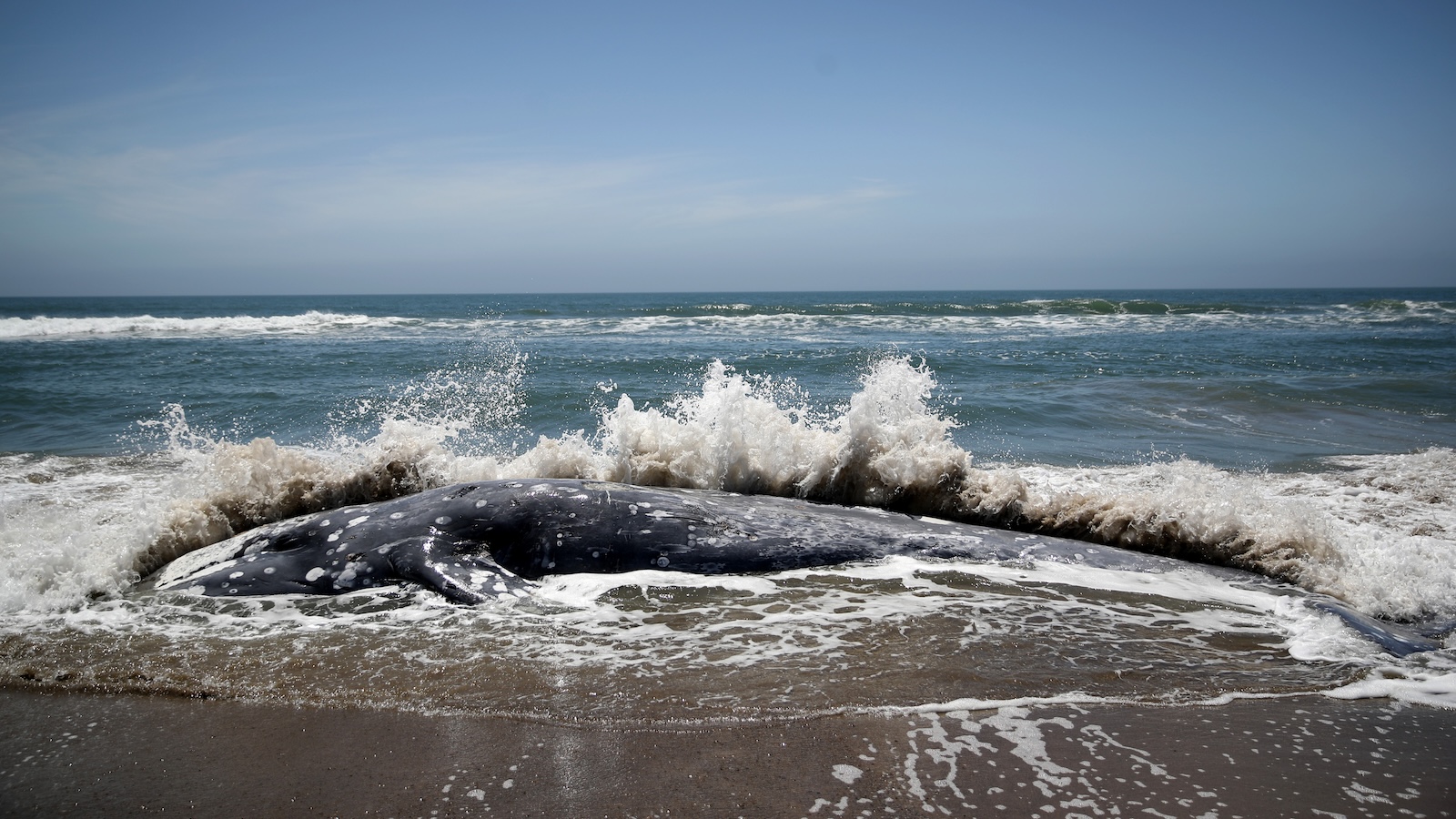
It was an urgent meeting. The number of gray whales along the U.S. West Coast has recently plummeted by the thousands, falling by half in the last decade. The leading theory is that climate change has been causing the whales’ food source in the Arctic to dwindle. And the situation seems to be getting worse. This past summer, 187 gray whales washed up dead on beaches across the region. So far, the Trump administration has largely ignored the problem.
The attendees at the conference, who came from across North America, were there to share as much as they knew about the animals. Bill Keener, a researcher at the Marine Mammal Center, a nonprofit in California, said it was inspiring to see so many scientists come together to tackle the issue.
But the atmosphere in the rooms was tense, others said. Gray whales have been off the list of animals protected by the Endangered Species Act for decades. And the National Oceanic and Atmospheric Administration — whose scientists participated in the meetings — recently missed the legal deadline to respond to a petition to relist them. At the end of August, three conservation groups filed a notice of their intent to sue, which would kick off a lawsuit if the Trump administration doesn’t respond to the petition within two months.
“People were walking on eggshells there,” said Mark Palmer, who helps lead a project protecting marine mammals at the Earth Island Institute, one of the groups behind the potential lawsuit. Presenters at the conference were careful to focus on science and avoid politics, he said, adding that the event organizers “made it very clear from the beginning that they would not discuss policy issues.”
That’s likely because many of the attendees were scientists who work in the government, or depend on federal funding in some way, Palmer said. Since taking office in 2025, the Trump administration has made sweeping cuts to staff and funding at the National Oceanic and Atmospheric Administration, or NOAA, to better align with partisan beliefs. It has also proposed eliminating the Marine Mammal Commission, which helps other parts of the government protect animals like whales, and it recently rolled back habitat protections from the Endangered Species Act. There is a backlog of some 400 species currently awaiting a federal listing decision.
“Obviously they are very nervous about what the administration could do to them,” Palmer said. In addition to failing to respond to the petition, NOAA is several months late in releasing the count of gray whale births this year. “Yes, they’ve been dragging their feet, but also the administration has been targeting this funding,” he said. The agency declined to comment in response to Grist’s request.
In many ways, gray whales’ fortunes have long been decided by humans. Starting in the 19th century, commercial whaling drove their numbers to historic lows, but bans on the practice, along with federal endangered species protections beginning in the 1970s, helped the population along the U.S. West Coast more than double. Their recovery was so strong that, in 1994, U.S. officials decided to remove them from the endangered species list.
Now, sharing a planet with humans appears to have reversed their fortunes again. Those found on the U.S. side of the Pacific are known as eastern gray whales, and they are distinct from the western population, found near East Asia and Russia. They feed on small crustaceans in the Arctic waters near Alaska in the summer, and then swim down to Mexico to give birth in the winter — one of the longest migrations of any mammal. But climate change is heating up the Arctic nearly four times faster than the rest of the planet, and the melting ice has led to a number of cascading changes that have caused the whales’ prey to sharply decline. Scientists think hungry gray whales are beginning their migrations with too little energy in reserve, leading to fewer births and more deaths.
“The science on this is perfectly clear,” said Richard Steiner, a marine conservation biologist who initially submitted the petition to relist gray whales. “As goes Arctic sea ice, so goes the gray whale population. And Arctic sea ice will continue its decline throughout this century.” If humans don’t reduce greenhouse gas emissions that warm the planet, he said, the consequences could be “apocalyptic” for gray whales, as well as many other species on Earth.
Gray whales on the other side of the Pacific are struggling too, with only a few hundred remaining. And the Atlantic gray whale disappeared centuries ago, likely due to whaling. The loss was “the only extinction of a whale in human history,” Steiner said. “Thus, we know this particular whale population is extremely vulnerable to anthropogenic impact.”
Clara Field / San Francisco Chronicle via Getty Images
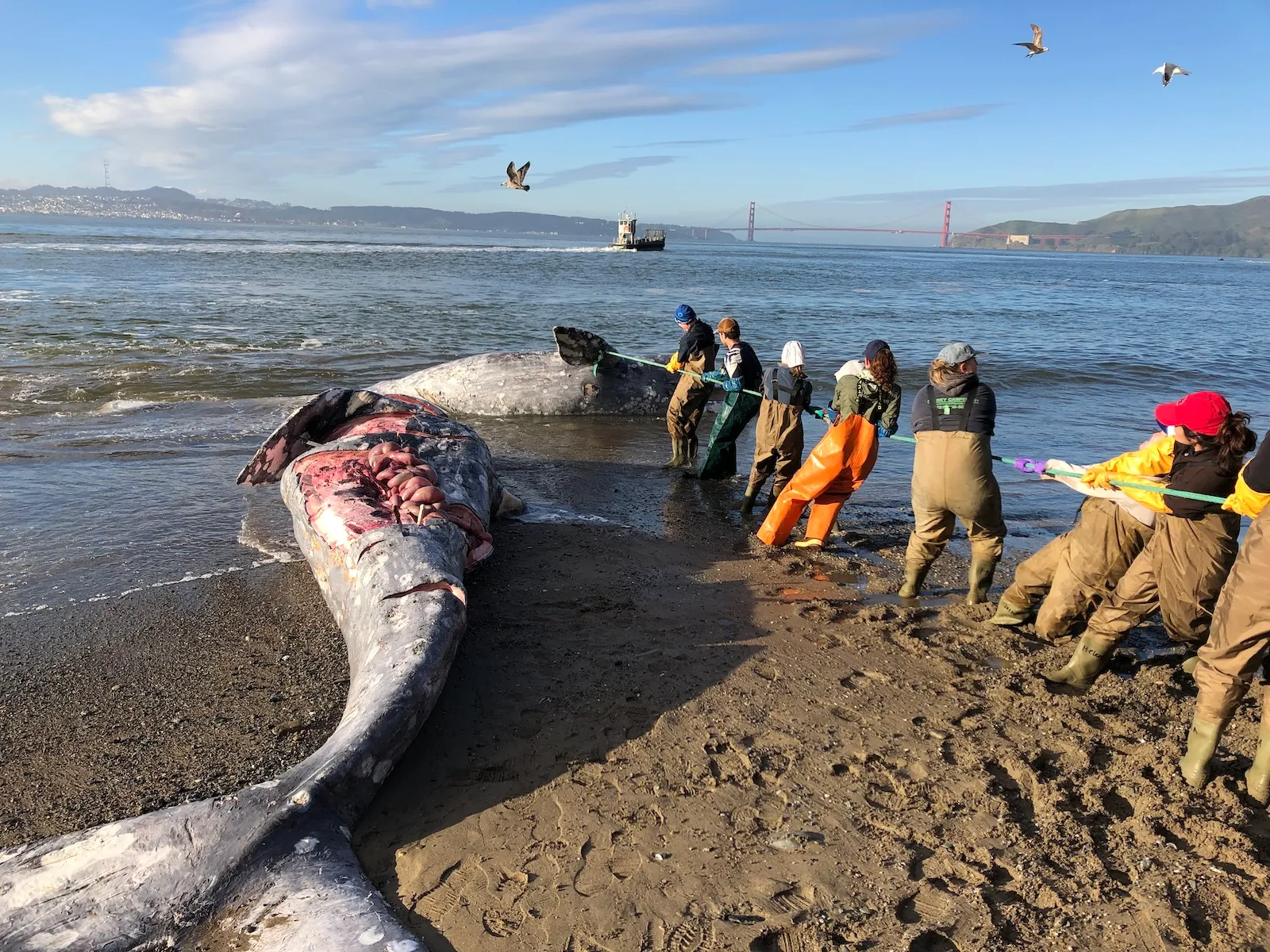
Malnutrition may be making it harder for whales to withstand threats along their routes, like collisions with ships or getting tangled in fishing gear. It may also be pushing more whales to forage for food in dangerous stretches of their route — like the San Francisco Bay Area, where scientists have been tracking an increased number of whale strandings in recent years. At least a fifth — and possibly up to half — of all whales that enter the San Francisco Bay end up being killed by ships. This summer, 13 were discovered dead in the area, but scientists say many more are sinking before they can be counted.
U.S. government scientists estimate that eastern gray whales peaked in 2016 with some 25,000 to 30,000 individuals. But in the last decade, the population crashed to about half that, with estimates ranging from 11,700 to 17,000. Normally, a thousand calves are born each year. But last year, scientists estimated just 85 births — a record low.
Relisting gray whales as an endangered species is an important first step, said Miyoko Sakashita, an attorney at the Center for Biological Diversity, an environmental nonprofit, who is leading the impending lawsuit against the Trump administration. Once a species is formally protected, federal agencies are generally required to develop a recovery plan. Listing also opens the door to federal funding for monitoring, research, and efforts to protect or restore habitat. That could “buy us some time for us to solve that bigger climate change problem,” Sakashita said.
If the Trump administration decides not to relist the whales, Sakashita said, the plaintiffs would file another lawsuit and probably end up in court anyway. “The law says they have to use the best available science,” when deciding which species are endangered, she said. “When we look at this terrible population decline, it seems like there cannot be any other answer than to proceed forward with a threatened or endangered listing.”
NOAA has released estimates indicating that whale populations rebounded by roughly 5,000 whales in the last year. Palmer, of Earth Island Institute, is among those who are skeptical of these numbers. Especially considering the low number of calves born last year, “it’s just physically impossible for gray whales to produce that many animals in such a short time,” he said.
Many groups are racing to protect whales, even without an endangered species listing. One promising approach starts with asking ships to slow down near hotspots of whale activity — a step that can significantly increase the odds that a whale will survive a collision, said Rachel Rhodes, a scientist with the Benioff Ocean Science Laboratory at the University of California in Santa Barbara. She leads Whale Safe, a large project that has been mapping whales in shipping lanes by using sonar, thermal cameras, and satellite tags.
In an ideal world, ships would be able to avoid whales entirely. But waterways are often too busy and confined for that to be possible, she said. “So the next best thing is to ask ships to slow down to 10 knots or less.”
Similar speed limits are mandatory for large vessels on the East Coast, but remain voluntary on the West Coast. Another California project, Blue Whales Blue Skies, has had success in paying and publicly praising shipping companies whose ships slow down. But some vessels, particularly cruise ships, continue to speed through these areas.
“The scientists have done their job in reporting the dire situation for gray whales,” said Steiner. “Now it’s time for the policymakers to put that science to work in protecting them as much as possible.”