
👋 Hi! I’m Claire Elise Thompson, an associate editor at Grist and the writer of the Looking Forward newsletter. Every week, Looking Forward brings you stories of what’s happening in the world of climate solutions, and how you can be a part of it.

No doom and gloom. No rose-colored glasses, either. Just reasons to believe that change is possible — and already underway.
Come join us!
Free. Weekly. From reporters you trust.
What you’ll get every week
Stories like this one:
- 📰 Reporting on climate action that’s already making a difference
- 🧠 Cultural insights that help explain how change happens
- ✨ Moments of imagination and creativity, including original fiction and reflections on the future
Plus:
- 🔗 Curated solutions news from Grist and the broader climate media ecosystem
- 🫂 And a community of other people who care about the planet and are grappling with how to take personal action (we even have a book club!)
Scroll to read Friday’s email:
👋 Hi, everybody! This week, we’ve got a story about how scientists are trying to bring back an iconic, and endangered, species — the American elm — through a somewhat scattershot approach to breeding disease resilience. It’s a gamble that just might be the best shot in a century of restoring the once prolific trees, and the shade and flood mitigation they once provided.
We’ve also got news for you about Indigenous justice, climate lawsuits, and an exciting development for the future of reusables in Hawai‘i.
This post originally appeared in Grist’s weekly solutions newsletter, Looking Forward. Not on our list yet? Subscribe here to get it in your inbox every Friday.
Saving the forest for the trees
The Nature Conservancy
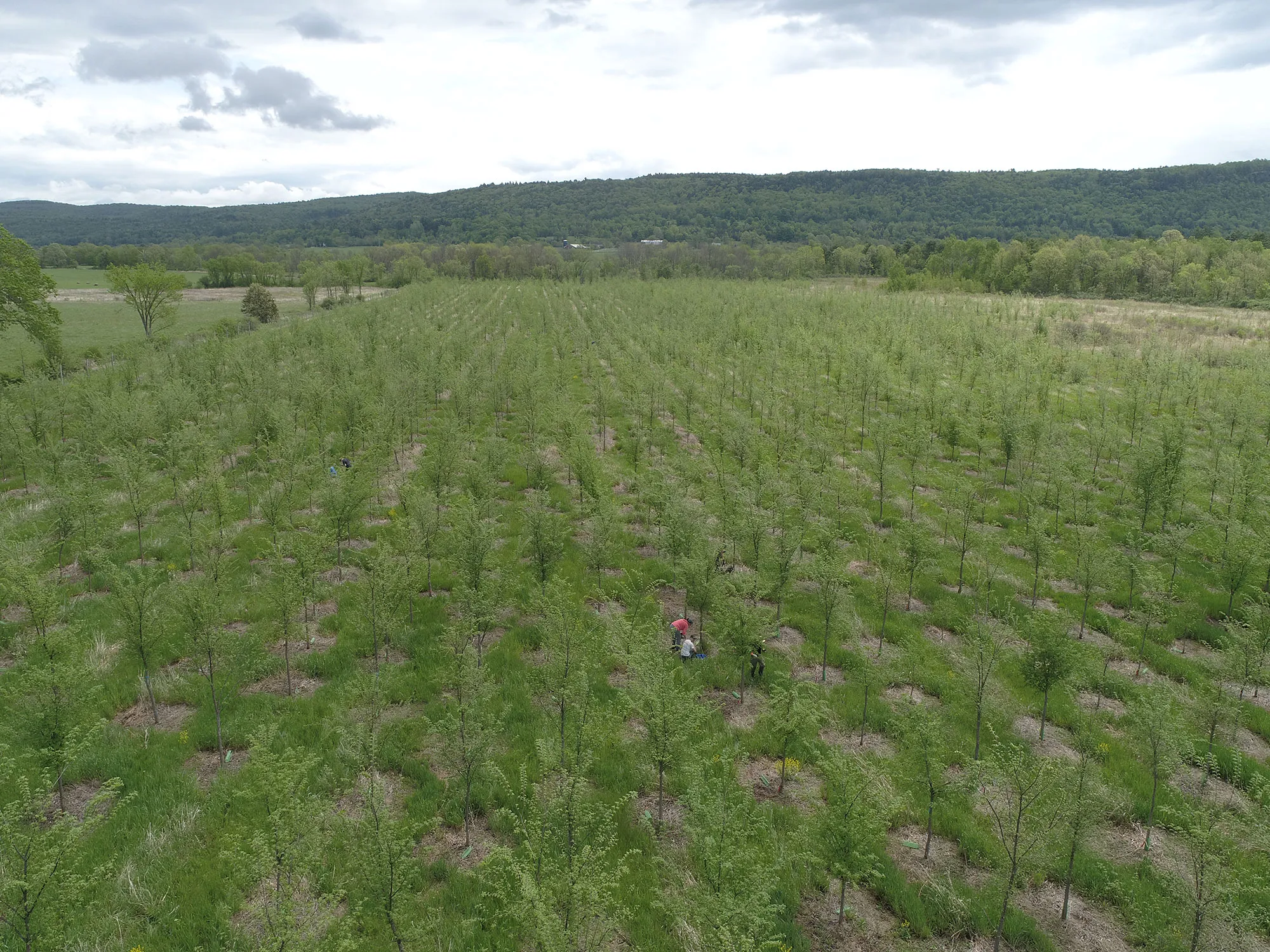
About two months ago, my colleague Tik Root visited a sprawling 28-acre research plot in Benson, Vermont, where scientists are growing more than 5,000 elm trees. He watched as the researchers set about drilling small holes in the young trees and then injecting them with a couple teaspoons of liquid that contained spores of the deadly fungus known as Dutch elm disease.
Over the last 100 years or so, this disease has all but wiped out elm populations. The tall, elegant trees once dominated the American landscape, serving as landmarks and meeting places for Indigenous peoples and as iconic anchors of communities. Many individual trees are — or were — named for the cities in which they stood (like the Benson tree, a mature elm that stands near the research plot). But the species is now listed as endangered.
Why, then, are scientists infecting trees on purpose? The idea, which Tik explored in a feature story this week, is pretty simple and builds on decades of previous research. Although there’s no clear genetic marker for resistance to the disease, scientists are trying to home in on genetic combinations that might yield trees able to withstand it.
Tik compared the endeavor to Gregor Mendel’s famous homegrown experiments crossbreeding pea plants (which takes me right back to high school biology).
“It was crazy how primitive the science is,” Tik said. “I find myself reading about, you know, CRISPR, and these crazy new techniques. And then there’s this, which is basically throwing educated darts at a dartboard and then seeing what’s best.”
Tik isn’t much of a science nerd, he said. But he found this story fascinating for its simplicity. The scientists have identified about 50 parent trees — some from the wild, some from previous nursery strains selected for disease resilience — and bred them in various combinations represented in the thousands of trees now growing in the Benson plot, to see which of their offspring might carry on that heartiness.
Only time will tell if these new cultivated generations can yield stronger defenses. And, somewhat perversely, that involves killing quite a few trees in the meantime, as most of the saplings will succumb to the disease. One scientist admitted to Tik that she cringed at each injection — “I feel like we should warn them and apologize to them … but they’re serving the greater good,” she said.
That greater good includes efforts like revitalizing floodplains, where elms are one of just a handful of key species needed to soak up excess water during storms. “New England has seen a lot of flooding in recent years,” Tik said. “It’s pretty clear that better floodplains, or more robust, healthy, long-living floodplains could absorb a lot of the blows that flooding has brought.”
Another key thing that elms provide, he said, is shade — of particular note in hot cities, where trees can help reduce the urban heat island effect. Elms are tall, with large canopies. “And they’re particularly fast-growing,” Tik added. “I mean, not in human terms, but in tree terms. They can get pretty big pretty fast.”
In human terms, it will take another 10 to 15 years before these experimental trees bear seeds of their own. So far, about 800 trees in the Benson plot appear healthy. The researchers will monitor them for another two years before deciding which varieties to clone and plant in another orchard of suspected “super trees.”
Tik is curious to see what the next steps will bring. “The multi-decade commitment is pretty remarkable,” he said. Some of the scientists working on Dutch elm disease have done so for a majority of their careers. “I would be so impatient,” Tik admitted. But the researchers are working at the pace of the elms, and hoping their efforts will help give birth to the resilient trees of the future.
Dive deeper:
- Killing trees to save the forest
- To prepare for the climate of tomorrow, foresters are branching out
More from Grist
🌏 A global push for Indigenous rights
The 19th session of the Expert Mechanism on the Rights of Indigenous Peoples, or EMRIP, took place last week in Switzerland, and participants finalized a set of a dozen recommendations for the U.N. Human Rights Council. They include measures like protecting Indigenous land defenders from violence and ensuring they’ll have a greater voice in global affairs. Read more
⚖️ Panic mode for fossil fuels
There are nearly 40 lawsuits against fossil fuel companies currently pending across the country, seeking legal accountability for their undeniable role in causing climate change. But as these litigation efforts push the industry into “panic mode,” companies are launching a counterattack by lobbying for legal measures that would grant them immunity. Read more
🔌 EVs as batteries
Critics may say that electric vehicle adoption will put too much strain on the grid. But EVs actually have the power to shore it up by sharing their batteries as a backup power source during peak times — a technology known as V2G. This week, a coalition of companies launched a test initiative in Massachusetts. Read more
In other news
- Hilo, Hawai‘i, is preparing to launch the first citywide system for reusable foodware in the US (Honolulu Civil Beat)
- Big Oil has profited from high prices caused by the Iran War. Some US lawmakers want to tax that windfall. (NPR)
- This free app is helping people get crucial information about disasters (The New York Times)
- In 2026, fewer states are passing laws restricting clean energy and more are simplifying their permitting processes (Canary Media)
- Scientists have mapped the Great Barrier Reef’s microbiome, discovering viruses and bacteria previously unknown to science (The Guardian)
And finally, looking forward to …
… a future where humans work with and respect the natural world, to everyone’s benefit. As everybody in my city and beyond goes crazy for a raccoon (yes, I would also die for Jimothy, don’t @ me), I’ve been appreciating posts like this one that remind us it’s best to let wild things be wild. This drabble, submitted by reader Jillian Scott, captures that sentiment — while also playing around the edges of what a more harmonious future could look like.
🐳🐳🐳
The splash of the cold water brought goosebumps. As I sat on the edge of my paddleboard, I watched my daughter enjoy her playdate with her unexpected friends. We were just past the break, and I could feel the joyful song through the water swirling around my ankles. While she played freely with the whales, I still couldn’t bring myself to jump in. I was taught to keep a distance. We couldn’t risk a mother losing her calf. Working with the wild, we altered the flow, and the whales came home. Today, laughter rang louder than the waves hitting the shore.
— a drabble by Jillian Scott
🐳🐳🐳
A drabble is a 100-word piece of fiction — in this case, offering a tiny glimpse of what a clean, green, just future might look like. Want to try writing your own (and see it featured in a future newsletter)? We would love to hear from you! Please send us your visions for our climate future, in drabble form, at [email protected]
👋 See you next week!
From Grist
Looking Forward is produced by Grist Magazine, an award-winning, independent nonprofit newsroom that’s been on the climate beat for over 25 years.
Our reporters bring deep expertise across science, policy, culture, and community — and a shared belief that journalism should help people understand not just what’s going wrong, but what’s possible.
Ready to look forward?
Join thousands of readers who want climate news without despair, and inspiration grounded in reality.
