agriculture
-
It may not be as eco as you think
 The Cornucopia Institute, an organic watchdog organization, has released a report (PDF) on the "organic-ness" of 68 dairy name brands and private labels. While cow-conscious consumers might assume that the word "organic" on the label means that their milk mustache comes from a happy cow grazing in non-pesticide-laden pastures, that's not always the case; guidelines for organic certification can be variously interpreted, and the USDA is lax on enforcing regulations. Says the Cornucopia press release:
 [The report] profiles the growth and commercialization of organic dairying and looks at the handful of firms that now seem intent upon taking over the organic dairy industry by producing all or some of their milk on 2000- to 6000-cow industrial-style confinement dairies.
The report finds that while the majority of name-brand organic producers do hold to high legal and ethical standards, 20 percent garnered a "one-cow" substandard rating (out of a possible five).
A booming, lucrative $15 billion market for organic food and a severe national shortage of organic milk are two factors that industry observers mention as driving the "get organic milk from any source" philosophy.
The top companies -- Aurora Organic Dairy and Dean Foods, which owns Horizon Organic, Organic Cow of Vermont and Alta Dena -- did not respond to the survey that Cornucopia sent out, for which they received a score of no cows. The two producers control 60-70 percent of the organic dairy market.
Read a New York Times article on the report or search for your favorite organic dairy provider on this alphabetical list.
-
A food-politics writer expresses angst at the obscurity of his topic

The other day, a prominent Canadian journalist paid me a visit to interview me for his book on building a sustainable future. At one point, I expounded on the closed-nutrient cycle of old-school organic farming, contrasting it with what writer Michael Pollan deemed the "industrial-organic" way. In the old-school organic style, which relies on animals, farm wastes are recycled into the soil, providing all the nutrients necessary for the next harvest. The industrial-organic farmer, by contrast, imports his or her soil fertility -- just like the conventional farmer. The difference is that the organic farmer is likely shipping in composted manure from far-flung places, while the conventional grower is hauling in a processed petroleum product.
"The problem," I continued -- my interlocutor's eyes may well have been glazing over -- "is that most small vegetable farms these days, including my own, don't have enough animals to produce the nitrogen we need. So our transition to real organic farming is ongoing."
The journalist then asked me a question that stopped me short: "Do you think real organic farming could feed the world?" I stammered something like "I hope so," and had him jot down a couple of books to look up. It wasn't until after he left that I realized why his question made me so uneasy.
-
Tirso Moreno, farmworker organizer, answers questions
Tirso Moreno. What’s your job title? General coordinator for the Farmworker Association of Florida. What does your organization do? We work to empower communities of farmworkers and the rural poor, focusing on a wide range of issues, from workplace and community organizing to disaster preparedness and response, from vocational rehabilitation to immigrants’ rights advocacy for […]
-
USDA ID-tag plan for farm animals has some small-scale farmers unhappy
If only Orwell could get a load of this. The U.S. Department of Agriculture is promoting a system that would have farm-animal owners and livestock handlers attach microchips or other ID tags to their furry and feathered charges so they could be monitored throughout their lifetimes by a centralized computer network. The National Animal Identification […]
-
Once the global capital of bad food, London shows the way forward.
Since I started writing for Gristmill, I've tried to make the point that our food system amounts to an ongoing environmental disaster, and deserves much more attention from greens.
Over in London, Mayor Ken Livingstone is putting that idea into action. As the Guardian reports, Livingstone recently declared that "The energy and emissions involved in producing food account for 22% of the UK's greenhouse gas emissions."
Ponder that number for a minute. Rather than obsess about hybrids and switchgrass and CAFE standards -- worthy topics, to be sure -- it might make sense to push for policies that make food production more eco-friendly. And Livingstone is doing just that.
"I want London to set a standard for other cities around the world to follow in reducing its own contribution to climate change. How we deal with food will play an important role in this," he told the Guardian.
(Thanks to the Organic Consumers Association for bringing this story, which came out way back on Jan. 7, to my attention.)
-
In the heartland of industrial agriculture, a county goes local and organic

Nestled in the heartland of globally oriented commodity-food production, Woodbury County in Iowa has made a bold move away from industrial agriculture.
Last summer, the Kellogg Foundation's Food and Society (FAS) website reports, "the County passed an 'Organics Conversion Policy,' offering up to $50,000 annually in property tax rebates for those who convert from conventional to organic farming practices."
And then in January 2006, FAS continues, the county ...
... became the first in the United States to mandate the purchase of locally grown, organic food. The "Local Food Purchase Policy" requires Woodbury County departments to purchase locally grown, organic food from within a 100 mile radius for regular city use. The policy has the potential to shift $281,000 in annual food purchases to a local farmer-operated cooperative, increasing local demand and spurring increased production and processing.
Why would a county in Iowa, of all places, implement what amounts to a rejection of industrial agriculture?
-
Why the heavily subsidized corn harvest amounts to an annual environmental calamity
While researching my Poverty & the Environment piece on the food system, I had occasion to look closely at the corn harvest, source of so much of our cheap food.
As bad as the annual flood of cheap corn is for our health -- nutritionally worthless high-fructose corn syrup, cheap feed for confined animals pumped full of antibiotics and hormones -- it may be even worse for the environment.
-
![]()
![]()
How poultry producers are ravaging the rural South
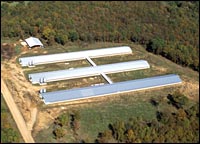
A person driving through the South might notice the chicken houses dotting the hills and flatlands. He might marvel at the larger ones, as long as a football field. He might react to their gagging stench for a moment, and then forget as he travels on. But those who live near the structures — stuffed […]
-
A positive environmental program that can (almost) fit on an index card
Without further ado, here's the first draft of my index-card manifesto. It turned out to be two index-card manifestos, with five points each: one for stuff I consider immediately urgent, and a second for what I consider longer-term goals. Feedback is welcome -- nay, requested. (I'll discuss the whole project more in a subsequent post.)
WHAT A GREEN WANTS: IMMEDIATE PRIORITIES
Energy efficiency: Proven techniques can get the same amount of work with 50% of the oil.
Tax/subsidy shifts: Markets should tell the ecological truth. That means shifting subsidies from industries and practices that harm us to those that help us -- and doing the reverse with taxes.
Diverse clean energy: Our economy must move from reliance on a single concentrated source of energy (oil) to reliance on a distributed array of small-scale, renewable energy sources appropriate to local conditions. That means staying within our solar budget, using wind, solar, biothermal, and hydrodynamic energy.
Electric vehicles: Flex-fuel and plug-in hybrid automobiles are necessary transition technologies, but in the long-term we need vehicles that run purely on electricity, stored either in hydrogen fuel cells or advanced batteries.
Smart grid: The electric grid should be agnostic (accepting inputs from any source of any size), intelligent (able to apportion based on shifting demand and supply), transparent (providing data on price and supply to all consumers), and scaleable (capable of building out, or degrading, gracefully).