aquaculture
-
Umbra on pearl production
Dear Umbra, I’m nearly drowning in jewelry ideas for my valentine, but wary of mined gemstones. Do you know anything about the ecological impact of cultured pearls, or the faux “shell pearls”? Swimming to the Surface Slowly Portland, Ore. Dearest SSS, I apologize for missing your Valentine’s window, but you may have seen my wee […]
-
A lighthearted look at biosequestration
A semi-recent issue of High Country News carried a feature on the deep-rock carbon sequestration potential in the northwestern U.S.: it's maybe possible to inject CO2 captured from power plants into the basalt that underlies the region, producing inert calcium carbonate. If so, there's apparently enough basalt to capture centuries of the region's carbon emissions.
It's safe to say the research has its doubters. And carbon sequestration in general deserves the hairy eyeball: even if proven both ecologically and geologically viable and economically feasible, if it leads to the continued destruction of Appalachia and vast tracts of the West for coal, count me out.
Elsewhere, a study's findings added to the body of evidence that shellfish, like clams, oysters, and mussels (oh, and plankton, crustaceans, and corals), will start growing more slowly or dissolving altogether due to anthropogenic ocean acidification (from all of the excess CO2 we produce that goes into oceanic solution), which would dissolve their shells. Fewer/smaller/weaker shellfish would have economic effects, but also much greater impacts on marine life: they're an important food source for everything from fish to whales and birds.
My point? These critters fix carbon ("biosequestration") in their shells, so we could start losing an important piece of the ocean's ability to maintain its natural alkalinity, plus its tendency to sequester carbon, just when they're most needed.
My disinterested and clear-eyed proposal, then, is increased aquaculture of mollusks in bays, sounds, estuaries, sloughs, etc. We're already growing tens of millions of pounds of clams alone each year in the U.S., and unlike most other forms of aquaculture, you don't get the massive energetic losses like with the feeding of fish meal to top-of-the-food-chain finfish.
-
New studies show salmon farms destroy wild stocks
Responding to collapsing wild-fish stocks worldwide, the World Bank has hotly promoted "aquaculture" — essentially, large-scale, industrial fish farms. Photo: Simon Bisson The Bank has directed serious resources at promoting fish farming. Such projects make up a significant chunk of its "portfolio of over US$1.2 billion in fisheries, aquaculture, coastal and aquatic environmental management and […]
-
Ecosystems are nonlinear
Here's a disturbing study that seems to mimic nothing so much as my mother-in-law's theory that small brownie pieces cut from the edge of the remaining mass of brownies left in the pan ("the efficient frontier," an economist might call it) don't have calories, because each little tiny mini-slice hardly changes the amount of brownie left at all.
On the one hand, the example cited is not particularly objectionable: Researchers claim to have found a mangrove where you can remove 20% of it with little reduction in flood control capacity -- meaning you can use that 20% for factory farmed shrimp and such.
The attitude of this article is in sharp contrast with that of Aldo Leopold and others, who would suggest that recognizing nonlinearity is a good first step, but that wisdom, or even an approximation of it, doesn't begin until you recognize that this ...
-
Killer farmed salmon and non-deadly sharks
More than 10,000 people worked to clean up the worst oil spill in South Korean history after a crane punched a hole in an oil tanker, releasing 2.7 million gallons of crude. A 63-year-old shellfish farmer wept as she showed dead tar-coated oysters to a reporter ...
... a study published in Science suggested that leaving more fish in the sea leads to higher profits than the traditional target known as maximum sustainable yield. "We like to say it's a win-win," said one of the study's authors ...
... a detailed new study of salmon farming found that farmed fish spread sea lice, which killed juvenile wild salmon ...
-
An influx of jellies in strange places is not so hard to explain
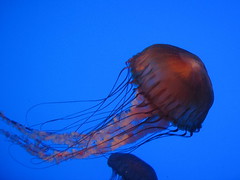 Over Thanksgiving, I came across a news story that may represent the perfect storm of issues plaguing the oceans. A salmon farm in Northern Ireland was wiped out by a huge swarm of mauve stingers (Pelagia noctiluca), a jelly usually found in the warm Mediterranean sea.
In a 35-foot-deep, 10-square-mile swath, the jellies stung and killed 100,000 salmon before workers could reach the pens. It must have been quite a sight. The jelly's scientific name means "light of the sea," and the creatures give off an eerie, purple-red glow. I can only imagine that, at that scale, the sea looked possessed.
The incident may seem strange and isolated, but it touches on three major issues facing the oceans.
-
A bottom trawler scores underwater pot, and it’s open season for Japanese whalers
... a study found that just 79 percent of known fish species has been formally described, and that the largest gaps in knowledge centered on the oceans' most diverse habitats ...
... California governor Arnold Schwarzenegger suspended all fishing in the San Francisco Bay after the area's worst oil spill in two decades. The governor called the 58,000 gallon spill, which occured after a cargo ship collided with the San Francisco-Oakland Bay Bridge, an "unbelievable human failure" ...
... German scientists developed LOKI, a device that can recognize and count organisms as small as 0.2 millimeters across. It will be used to study zooplankton, a critical food source for juvenile fish ...
-
Understatement of the week
A federal judge tells the Bush administration that, yes, there is a difference between wild fish and farmed fish.
"A healthy hatchery population is not necessarily an indication of a healthy natural population," [Judge Coughenour] said.
Insert your insult here ...
-

