environmental justice
-
![]()
![]()
Ecuadorian government shuts down leading environmental group
Ecuadorian President Rafael Correa Last Monday, environmentalists were shocked to learn that the Ecuadorian government had shut down Acción Ecológica (Environmental Action), withdrawing the legal status of one of South America’s best-known environmental groups. Acción Ecológica has in recent months supported indigenous-led, mass protests and highway blockades against President Rafael Correa’s support for large-scale mining. […]
-
In industrial-tomato country, workers suffer squalid living conditions and even slavery
Note: Last week, I visited Immokalee, Fla., with nine other food-politics writers and activists. We were there to check out conditions in the area where 90 percent of winter tomatoes consumed in the U.S. originate. Part I of my diary is here. ——— Update [2009-3-13 15:3:13 by Tom Philpott]: After refusing for two years, Florida […]
-
Rumor has it Obama will tap Van Jones as his green jobs czar
Word around the blogs is that Van Jones has been tapped to serve as a “green jobs czar” in the Obama administration. We’re still trying to confirm, and we’ll have more soon on this potential new role for someone who’s been a household name here at Grist. [UPDATE: A well-placed source confirms that Jones has […]
-
![]()
![]()
The human cost of industrial tomatoes
Do you know who picks your tomatoes? As Tom Philpott discovers during a trip to Florida tomato country, farmworkers suffer low wages, squalid living conditions, and even slavery.
-
Checking out the scene in the nation's industrial-tomato capital
Tomorrow, I'm heading down to Immokalee, Florida, to check out conditions in our nation's tomato basket. During the growing season -- between December and May -- something like 90 percent of tomatoes consumed in the U.S. come from the area in south Florida anchored by Immokalee.
I'm going as part of a delegation of food-oriented writers and activists including authors Frances Moore Lappé and Raj Patel, Slow Food USA president Josh Viertel, and others.
For decades, working conditions in South Florida's prodigious tomato fields have ranged from ruthlessly exploitative to outright slavery. Even under the best conditions, wages are stagnant and workers live in poverty.
Yet workers in the area, represented by the Coalition of Immokalee Workers, have made headlines in recent years by forcing gigantic tomato buyers like Taco Bell and Burger King to pony up an extra penny a pound -- which would cost fast-food companies a tiny sliver of profit, but represent the first substantial wage gain for pickers in decades.
There's a catch: the state's growers cooperative, the Florida Tomato Growers Exchange, refuses to pass on the raise to workers. Thus workers still get 45 cents for every 32-pound basket they fill -- a wage that hasn't budged in years, eroded by steady inflation.
Immokalee is one of the hotspots of of a globalized, industrial food system. The plight of its workers -- many of them refugees from small farms in Mexico and Central America that have collapsed under the weight of that same system -- represents just another externalized cost of stocking supermarkets, fast-food outlets, and school cafeterias with "cheap" food.
For a great brief backgrounder on the Immokalee situation, check out Barry Estabrook's piece in the current Gourmet.
Look for a wrap-up of my Immokalee trip on Friday.
-
What percentage of auction revenue is rebated?
In my original post about Obama's budget, I looked at the issue of how much of the auction revenue ought to be rebated directly to taxpayers and how much should be devoted to investments in green infrastructure, etc.
The Center on Budget and Policy Priorities found that with 55 percent of auction revenue, those in the bottom 60 percent of incomes in the U.S. could have their increased energy costs entirely offset. That's pretty much all of lower-income and middle-class taxpayers.
So what is Obama proposing to do with the revenue?
The short answer is: $15 billion a year goes to green investments and the rest goes to "Making Work Pay," i.e., offsetting payroll taxes. (See p. 3 of the Summary Tables [PDF].) That stays true over the next ten years, which means that the percentage of revenue rebated rises steadily.
So, in the first year, out of $78.7b in revenue, $63.7b is rebated -- roughly 81 percent. In 2019, out of $83b in projected revenue, $68b is rebated -- about 82%. But it's important to note that the $15b in investments is held steady, regardless of total revenue. If revenue rises faster and farther than these projections -- and these are extremely conservative projections -- then the percentage rebated could get up to 85, 90, 95 percent.
That is, in my humble opinion, bad policy. But there it is.
-
Cap-and-trade rebates to taxpayers favor efficiency over equity
UPDATE: There are two important updates at the bottom of this post.
Another striking feature of the way cap-and-trade is treated in Obama's budget: rebates to taxpayers are administered through a payroll tax deduction. This is interesting stuff indeed.
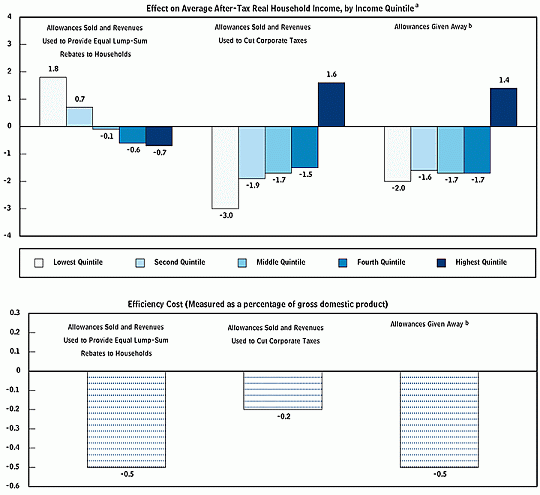
The question of how to rebate auction revenue back to people (to offset the increased costs of energy under a cap) reveals a tension between equity and efficiency.
If the goal is equity, the payroll tax rebate is probably not the way to go. On one hand, it's far more progressive than an income tax rebate (about a third of U.S. workers pay no federal income tax at all). On the other hand, there's reason to believe it's less equitable than a simply writing an equal check to every citizen. That's what a recent report from the Center on Budget and Policy Priorities recommends. (Technically it recommends refundable tax credits, more or less the same thing).
CBPP says flat rebates would be more equitable than income or payroll tax cuts -- the latter would less regressive, but regressive nonetheless:
CBO found that if all the revenue from auctioning emissions allowances were used to reduce payroll tax rates, households in the bottom 60 percent of the distribution would get a smaller benefit from the tax cut, on average, than they would lose from higher energy prices. Those in the next 20 percent would come out even and the top 20 percent of the population would get a tax cut that exceeded their increase in energy costs. [my emphasis]
In addition, "seniors and others without earnings would receive no rebate" -- no pay, no payroll tax.
To solve the first problem, you could put a cap on payroll tax rebates, so higher income workers don't get a windfall. To solve the second problem, you could make seniors, the disabled, and other folks with no earnings eligible for a special tax credit. But if you're going that route, why not just use the same tax credit for everyone?
If your goal is efficiency, however, the payroll tax rebate is better. Efficiency here means emission reductions with the least macroeconomic impact. A cap-and-trade refunded through payroll taxes effectively raises one tax (an fossil energy tax) and lowers another. The idea is to get less of what you're taxing (fossil energy) and more of what you're taxing less (work). That's why Obama's people are calling it the "Making Work Pay" measure.
Still, the CBPP says it's not worth it:
The efficiency gains are largest -- although still quite small -- when the rebate comes exclusively in the form of a payroll tax cut. But that approach leaves millions of low-income and senior households out in the cold.
Guess efficiency beat equity in the Obama budget team. That would be Summers and Orszag at work. Yay economists!
UPDATES: Two important notes to add:
First, there is a cap on the payroll tax deduction: the tax credit offsets payroll taxes "up to the first $6,450 of earnings." So that does reduce the regressivity somewhat. Thanks to Kate for pointing this out.
Second, it might not be clear in the post that the tax credit's effect is to offset payroll taxes, but the credit itself is administered via the income tax. Those who pay payroll tax but no income tax will just receive an income tax credit -- a check. The payroll tax is the target but the income tax is the instrument. Why this is, I'll leave for people who know way more about the tax code than me.
-
We need to stop blaming victims of breast cancer and start researching envirotoxicity
Having been touched by breast cancers in numerous women important to me, I've long been astounded by the extent to which discussions of the subject start by blaming women -- you picked the wrong parents, you didn't have your kids soon enough, you forgot to have kids, you ate too much, you ate the wrong things ... on and on and on.
Sandra Steingraber, Ph.D, an environmentalist and brilliant poet, writes about the medical-industrial complex and its instant assumption that the genesis of cancer is in the genes in her outstanding book Living Downstream. Sadly, her message seems to have been shrugged off by industry and the agencies charged with protecting public health. The media watchdog group FAIR (Fairness and Accuracy in Reporting) has a nice new piece in the February 2009 issue (alas, not yet available online) on the media's code of silence with respect to the environmental causes of cancer.
It's worth a trip to the library or magazine stand to check it out.
Meanwhile, there's a good discussion of the topic that starts at about 18:40 in this week's "CounterSpin," the FAIR radio program.
The bottom line: environmental insults are at least as significant as the usual factors discussed around incidence of breast cancer in the US -- but are studied far less, and are almost entirely absent from the wave of feel-good pink bushwa that floods the media every year during "Breast Cancer Awareness Month."
The sterling SF Bay-area group Breast Cancer Action has been a real leader in refusing to allow industry to bury the connection between their emissions and women's breast cancers. For a good example of their work, check out this factsheet on breast cancer and the environment.
-
EPA Administrator Jackson's first public appearance
Those of you who did not make it to New York on Jan. 29-30 for the 20th anniversary celebration of WE ACT for Environmental Justice, a national conference on Advancing Climate Justice: Transforming the Economy, Public Health and Our Environment, missed an inspirational high. You also missed a political milestone.
The event marked the first public speech by new EPA Administrator Lisa Jackson, who laid out the nation's new environmental-justice and climate-change priorities. President Obama echoed Jackson's sentiments and made a statement to the Muslim world by giving his first TV interview to Al Arabiya television.
Civilized, reasoned discussion and debate on environmental health and inequality, on the complexities of climate change economics, on cap-and-trade, cap-and-dividend, carbon charges, and on greening the economy as we invest in new infrastructure framed the formal content. But those substantive sessions were just the subtext.