Climate Technology
All Stories
-
Dell Inc. claims carbon neutrality
Dell Computer’s worldwide business operations are now carbon neutral, the company announced Wednesday. True carbon neutrality is, of course, a chimera for a giant IT company; notes business analyst Clive Longbottom, “You have to question whether they have taken all their workers’ commuting into consideration and the materials in making a computer, going all the […]
-
Using the power of business for people and planet
There are two critiques of Blessed Unrest, Paul Hawken's book on the enormous scope of the worldwide grassroots movements for change, that I'm interested in, one being the notion that the fact that there are millions of grassroots groups at work all over the world providing basic services, fighting for justice, and improving the lot of the planet is not necessarily something to celebrate. Rather, it signifies the failure of modern society to pursue the common good. Fair enough, but that's our reality at the moment.
The other critique I've heard is that Hawken celebrates the contributions of the nonprofit and grassroots movements for change to the exclusion of for-profits also doing good.
-
Employers scramble to make commutes less costly
Recognizing the very real possibility of losing quality employees to jobs with shorter, cheaper commutes, employers across the country are scrambling to help their workers save on gas. Many companies have started to strongly encourage telecommuting, even paying for at-home workers’ laptops, Blackberrys, and/or wireless connections. Microsoft has leased extra office space miles from its […]
-
The shape of the oil crisis
This is the first in a series on how we can build an energy future based on our best science and no longer critically dependent upon exhaustible and polluting fossil fuels.
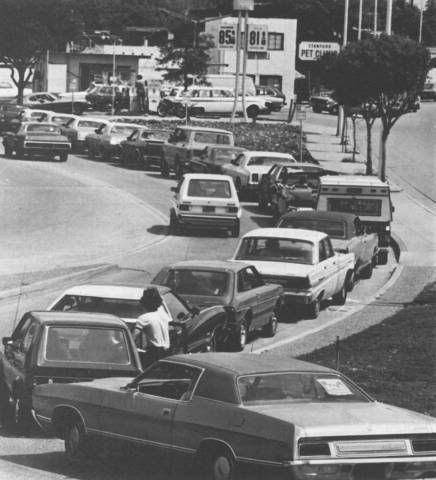 Lines formed at gas stations during the 1973 OPEC oil embargo.
Too often, discussions of our future energy system simply reflect the current array of political forces in Washington or the novelty-hungry attention of the media and not the long-term viability of technologies and proposed solutions. As the price of oil is the most pressing issue from a short-term perspective, I am starting this series of policy briefs with how the energy used in transport on land can be transferred from liquid fossil fuels to cleanly generated electricity; in the second part I will address how we can create the conditions for powering the grid in the post-fossil fuel era.
Oil supply: speculation and long-term trends
We can all now agree that it has been the ultimate in shortsightedness to continue building a society founded upon burning ever increasing amounts of easily exhaustible resources. Not only is it highly visible, petroleum at the pump, but, behind the scenes, the vital energy for agriculture and freight transport that now depend upon the output of oil wells, mostly located abroad. In the U.S. in particular, we have had a 25 year hiatus in facing this reality through political, cultural, and corporate resistance to change, which means that Americans are starting the race far behind the starting line. In addition, as it turns out, the burning of these fossil resources alters the global climate and creates local pollution and health problems. There are other ills and challenges in our world but currently fossil fuel addiction is one of the most pressing but also, fortunately, soluble problems.
-
Big Auto backs off support for tighter fuel-economy standards
New fuel-economy rules coming down the pike are likely to displease pretty much everyone, if a public hearing held Monday is any indication. In the current proposal from the National Highway Traffic Safety Administration, auto manufacturers must achieve a fleet-wide average fuel economy of at least 31.6 miles per gallon by 2015 — a jump […]
-
The beginnings of a continentalized global economy
Your faithful blogger was surprised to find himself representing part of the environmental blogosphere in a New York Times article on Sunday, "Shipping Costs Start to Crimp Globalization." It's very much worth reading, and prior to writing the article the reporter, Larry Rohter, talked with me about my first installment in this series, "Globalization death watch, Part I."
In his article, after noting the recent collapse of global trade talks, Rohter writes:
Some critics of globalization are encouraged by those developments, which they see as a welcome check on the process. On environmentalist blogs, some are even gleefully promoting a "globalization death watch."
Now, look at the dictionary.com definition of "gleeful":
full of exultant joy; merry; delighted.
Well, maybe the births of my sons called forth such feeling, but I'm not usually full of exultant joy, particularly when I think about global crises.
However, Larry Rohter may be forgiven his choice of words, considering the title of the blog post. I and, if I may be so bold as to speak for some other environmental bloggers, others think that the decline, even death of globalization would be a good thing. But just as the rise of globalization led to much suffering, so will its decline, and that's certainly not something to be "gleeful" about. To paraphrase Barack Obama's pithy phrase about getting out of Iraq, "we've got to be as careful getting out as we were careless getting in."
I'd like to go over some of the points Rohter highlights, and then explain later in the post why there is a better alternative to globalization.
-
Whole Foods tries to shake its elitist reputation
Whole Foods Market, with its gleaming displays of organic produce, antibiotic-free meat, and vegan baked goods, has long branded itself as a high-quality grocery retailer — thus earning the nickname Whole Paycheck and a reputation for elitism. But with the economy sagging — bringing with it, according to some analysts, consumer interest in organic food […]
-
New pedal from Nissan pushes back against excessive acceleration
Want to be an eco-driver but can’t seem to keep the pedal off the metal? Meet Nissan Motor Co.’s ECO pedal, which pushes back against excess foot pressure to encourage fuel-efficient driving. The ECO accelerator will be installed in some Nissan cars starting next year and be accompanied by a real-time dashboard display of fuel […]
-
High fuel prices causing globalization to lose momentum
It was unthinkable mere years ago, but globalization is starting to lose momentum. High and holding fuel prices — shipping a 40-foot container from Shanghai to the U.S. will cost ya $5,000 more today than a decade ago — are making global supply chains look far less attractive. Goods headed for the maw of the […]
-
Notable quotable
"The military-industrial complex needs enemies."
-- Brian Williams, news anchor of NBC, on The Daily Show with John Stewart, July 31, 2008.
