In the early 1990s, I knew a 10-year-old boy named Davy who had never been to Toys “R” Us. When I told his story, people would often respond to this part of his life with a sort of sentimental longing. “How wonderful that he has never been to that awful place,” they’d say. Davy’s lack of experience, however, was a marker not of his protected status, but of his deprivation.
Arriving at school barely able to keep his eyes open, Davy spent too many nights staying up late and caring for three younger siblings, one of them still in diapers. His mother was out most nights, and had a drug problem. There was often not enough to eat. The family had no car. Like many children, Davy had never been to Toys “R” Us because he was poor, because he was black, and because he was neglected.
The lap of luxury.
Photo: iStockphoto.
In my work as an anthropologist studying consumer issues, I have found it useful to think of the environment as more than air, land, and natural resources. Thinking about the consumer environment, from my perspective, requires also thinking about access to important resources: transportation, education, food, shelter, and increasingly, technology. The consumer environment also includes accessibility of businesses and services, whether social, medical, artistic, or electronic. This approach does not utterly ignore more traditionally defined environmental issues, but my aim is to contextualize choices and options in ways that can account for poverty as well as abundance — and to explore how those two extremes are connected.
Davy lived in the Newhallville neighborhood of New Haven, Conn., not a quarter mile away from the richest neighborhood in town. While his was a cubbyhole apartment carved out of what had once been a single-family home, the mansions lining the adjacent neighborhood’s tree-lined streets were three-story affairs, with servants’ quarters and multiple kitchens. The elegant simplicity on display at holiday time in that wealthy neighborhood — a single lighted candle, perhaps, in each of a stately home’s windows — neatly encapsulated the way wealth aspires to spurn its own involvement in hyper-consumption. To me, it represented a great divide: simple living versus simply surviving.
I Will Survive
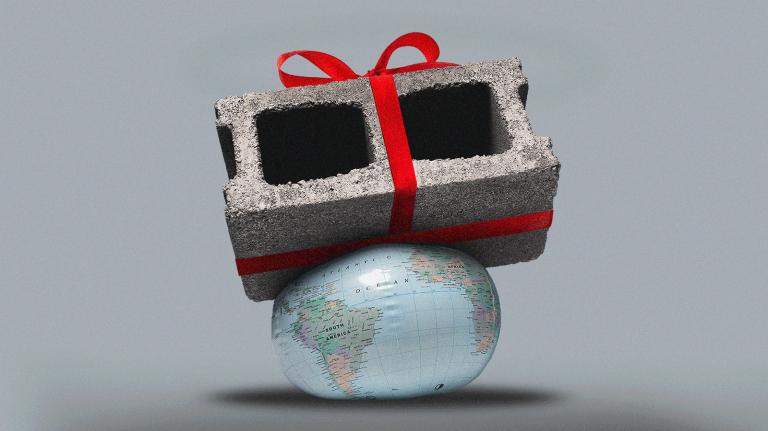
Simplifying, for the wealthy, has become a task, a burden, an end in itself. (When I say “the wealthy,” I mean nearly every citizen of every wealthy nation.) For so many people in wealthy worlds, simplifying has also become an industry which, ironically, turns out an array of alluring products: toxin-free paint so wholesome it’s known as “milk”; clothing woven from hemp fibers; even the fat, glossy magazine Real Simple. But conscious simplicity is not what it appears to be. After all, Thoreau’s idyll at Walden Pond was made possible by the fact that someone else did his laundry. Which is to say: for most people, living simply is a luxury, and one that still ends up consuming a great deal — whether new categories of goods, other people’s labor, or both.
While the wealthy struggle to shovel out from under their possessions and prepossessions, the poor must struggle on a daily basis to acquire much of anything of value — including flesh on their bones. This is most evident, perhaps, in places like Kenya or India or Brazil, where cadres of children scramble over mountains of garbage to find bits and pieces from which they can cobble together the stuff of life. In the U.S., poverty is usually not quite so nightmarishly stark, or indeed so visible. Still, with the official poverty level at a yearly income of $19,307 for a family of four, the environmental problems facing the poor in the United States are vast — and they don’t have much to do with managing the stresses of overabundance.
What is abundantly clear is that for the poor, access to most resources is limited at best, the result of a combination of financial limits and larger social disinvestment. While wealthier households struggle to balance schedules overloaded with activities and commitments, the poor often spend an inordinate amount of time negotiating basic needs. The limited nature of their consumer environment means that everyday tasks take much longer, and usually end up costing more. Given that low-income neighborhoods are unlikely to house large supermarkets, consumers are faced either with buying higher-priced and often lower-quality goods in local markets, or figuring out some way to travel the miles to the supermarket and back, often with kids in tow. Imagine grocery shopping for a family of four using only a bus or train. Distances become exponentially more important when relying on public transportation’s service schedules, routes, holidays, and glitches. (Interestingly, while contributing far less than “their share” to problems like automobile emissions, the poor model at least one portion of a solution, being the large bulk of public-transportation users. What they teach all of us, however, is that it is impossible to rely on public transportation and manage, as many well-off families do, to be in nearly three places almost simultaneously.)
Powerful folk beliefs in the United States portray the poor as profligate, undisciplined consumers. In fact, those who have carefully studied the day-to-day purchases and economic behavior of the poor know better, and the poor know best of all how carefully their resources are managed, bartered, exchanged. Without access to the supersized reservoirs of credit that the middle class can amass through both property and little plastic cards, the poor are often laid flat by large expenses: a refrigerator, a car, a hospital stay. Savings accounts, retirement funds, mad money — these are not options, not so much because the poor are incapable of thinking about these things, but because, as one anthropologist described it, “there’s a lot of month left at the end of the money.”
Simple gifts.
Photo: iStockphoto.
Consider this: many poor children have never had the opportunity to purchase a gift for a loved one. Whatever conflicts the affluent might feel about rampant consumerism, it is worth wondering whether — and how — something so seemingly simple as being able to buy your mother a present for Mother’s Day might also be a powerful moment of self-actualization. The power to buy is, in this society, inevitably and fundamentally, the power to be.
In Excess
As I sit at my kitchen table with my own daughter, a girl whom I urge to fashion homemade valentines and who loves to make biscuits from scratch, I am keenly aware that my sense of too-muchness is itself a sign of my privilege and my wealth — even if, like many, I experience this wealth as loss and emptiness. I am aware that the array of choices before me is itself a form of excess, of extravagance.
All around my modest Los Angeles neighborhood, poorer families than mine have collectively joined together to purchase their first homes, counting entire extended-family incomes in order to buy 1,200-square-foot houses whose median prices have topped the half-million dollar mark. Though we live side by side in this land-of-plenty, post-war neighborhood, the consumer environments we inhabit are worlds apart. Strapped for both space and funds, many families illegally transform their garages into living spaces, to earn a little rent or make them available for still other family members. Without proper ventilation and heat, these makeshift cottages are at best uncomfortable. Because many do not have rear exits, they can also be death traps. Every so often we hear about a space heater sparking a fire from which too many people were unable to escape.
I once heard it said that the United States is the wealthiest nation on the globe and in all of human history. Our history, as Americans, is one where swaths of ancient forests were stripped for timber and replaced by mirage-like forests of choices — forests through which many of us wander in the hopes of finding a clearing, space to breathe without choking. Perhaps we ought better to seek to uproot these trees.
Changing the world is a pretty tall order. Me, I tend to take small actions. I wrote about Davy in a book that examined his life and the lives of his fifth-grade class. My choice has been to donate that book’s royalties to the New Haven Scholarship Fund, a very small organization that gives very small scholarships to children graduating from New Haven’s notoriously rotten public schools. To combat an environment that gives me too many choices to count, I try to fight — not so much by changing all my choices, but by helping to make choices available to those who have too few.