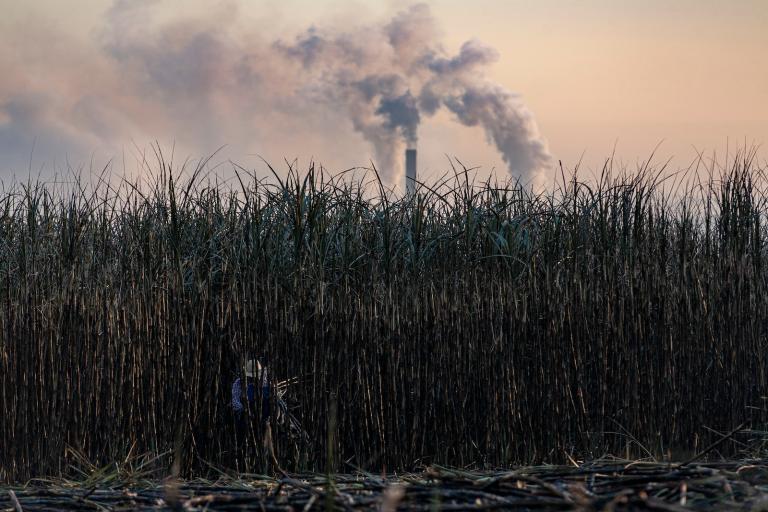

Photo by James Currie.
As members of Congress enjoy their August recess, big questions linger about whether we’ll have a new food and farm bill before the end of the year, let alone before the current bill expires Sept. 30. That might be part of why, earlier this week, President Obama at an Iowa campaign appearance implicated Mitt Romney’s running mate, Rep. Paul Ryan (R-Wis.), in the current farm bill debacle, accusing Ryan of “standing in the way.”
And while Obama was oversimplifying the issue — as often happens in election season — it’s worth taking a closer look at the role Ryan has played in this year farm bill process.
Back in March, as chair of the House Budget Committee, Ryan included $180 billion in nutrition and agriculture-related cuts to his now-notorious slash-and-burn budget document. The blueprint was so radical that the ranking Democrat on the House Agriculture Committee, Rep. Colin Peterson (D-Minn.), declared it “appalling” and a virtual guarantee that no farm bill would pass in 2012.
Democrats and even some farm-state Republicans balked at Ryan’s proposed cuts to subsidies and conservation programs along with his proposed caps on crop insurance payments. In the end, the Republican-led Agriculture Committee passed a farm bill that included over $30 billion in farm subsidy cuts over 10 years — about the same amount as in the Ryan budget, though accomplished through different means.
Of course, it’s tempting to throw around words like “refreshing” and “bold” — as the media like to do with Ryan — whenever a senior House member suggests cutting subsidies to Big Ag. But Ryan’s proposal for the food stamp program should encourage the media to throw around words like “cruel” and “cold-blooded” instead.
Ryan has proposed converting the food stamp program from one that can automatically increase spending to meet the nation’s need for hunger assistance into what is known as a “block grant” program. In a block grant, the federal government annually transfers a set chunk of cash to each state to spend on a specified program, in this case on food stamps.
In theory that kind of transfer provides states with what is euphemistically referred to as “flexibility.” In practice, block grants act as a cap on spending. If the economy takes a turn for the worse — or bumps along the bottom as ours is at the moment — the states could run out of money to feed hungry families.
Congress would then need to authorize more spending, such as it must do for extended unemployment benefits. For those keeping score at home, congressional gridlock has led to the expiration of extended unemployment benefits despite the fact that millions remain unemployed. I leave it to Grist readers to deduce the likelihood that food stamps would receive similar treatment.
Ryan’s proposal would “save” an estimated $133 billion over 10 years — dwarfing the cuts to subsidies for big commodity farmers. And while a farm safety net is a necessary part of federal agricultural policy, it’s worth noting that the current system provides most of those subsidies to a relative handful of large farms — a mere 10 percent of the nation’s farms, according to the Environmental Working Group.
Yes, the drought will definitely affect farmer income, though prices for farmland continue to increase at a fast pace. Of course, crop insurance payments will insulate many commodity farmers from much of the pain; in fact, an estimated 55 percent of commodity losses will be covered.
Regardless, drought doesn’t justify asking the poor to absorb more than four times the amount of cuts from the federal budget as asked of big farms.
Ryan’s proposed budget wasn’t binding, of course, and the House Agriculture Committee drafted its own version of the farm bill that left out Ryan’s block grant idea (though it did cut foods stamps by $16.5 billion over 10 years). And it’s really House Speaker John Boehner and Majority Leader Eric Cantor who are preventing the farm bill from coming up for a vote. But it’s unlikely Ryan would get behind a farm bill that didn’t make big strides toward ending food stamps as we know it (sound familiar?).
In short, whether or not Ryan is indeed “standing in the way” of the farm bill, his budget should leave no doubt that a President Romney and a Vice President Dreamboat Ryan would reform agriculture on the backs of the poor. This will be a choice election indeed.
A message from
Your support keeps our climate news free. All donations DOUBLED!
Grist is the only award-winning newsroom focused on exploring equitable solutions to climate change. It’s vital reporting made entirely possible by loyal readers like you.
At Grist, we don’t believe in paywalls. Instead, we rely on our readers to pitch in what they can so that we can continue bringing you our solution-based climate news. Donate today to keep our site free. All donations DOUBLED for a limited time.