Robert Bullard says he was “drafted” into environmental justice while working as an environmental sociologist in Houston in the late 1970s. His work there on the siting of garbage dumps in black neighborhoods identified systematic patterns of injustice. The book that Bullard eventually wrote about that work, 1990’s Dumping in Dixie, is widely regarded as the first to fully articulate the concept of environmental justice.
Since then, Bullard, who is as much activist as academic, has been one of the leading voices of environmental-justice advocacy. He was one of the planners of the First National People of Color Environmental Leadership Summit in 1991, at which the organizing principles of modern environmental justice were formulated. Bullard later helped the Clinton administration write the watershed executive order that required all federal agencies to consider environmental justice in their programs.
Under the Bush administration, progress made during the 1990s is under attack, with even the U.S. EPA working to dismantle that provision. As he has for 25 years, Bullard stands at the forefront of efforts to maintain environmental-justice gains, and to make mainstream environmentalists aware of the issues at stake.
Currently on sabbatical from his position as director of the Environmental Justice Resource Center at Clark Atlanta University, Bullard has just published his 12th book. The Quest for Environmental Justice: Human Rights and the Politics of Pollution brings together more than 20 contributors for a survey of the movement’s past and future.
Grist caught up with Bullard as he took a break from working on a Ford Foundation-funded study of how government actions have endangered the health and welfare of African Americans over the past seven decades. Most recently, this work has turned Bullard’s attention to the area devastated by Hurricane Katrina, which he describes as the latest urban environmental sacrifice zone.
How did you first become involved in environmental justice?
I was a young sociology professor just two years out of graduate school. My wife asked me to collect data for a lawsuit she had filed. A company had decided to put a landfill in the middle of a predominantly black, middle-class, suburban neighborhood — a neighborhood where 85 percent of the people owned their homes. Of course, the state gave them a permit, but the people said “no.”
I saw that 100 percent of all the city-owned landfills in Houston were in black neighborhoods, though blacks made up only 25 percent of the population. Three out of four of the privately owned landfills were located in predominantly black neighborhoods, and six out of eight of the city-owned incinerators. In a city that does not have zoning, it meant that these were decisions made by individuals in government.
That’s how I got dragged into this.
And you got hooked.
I got hooked. I started connecting the dots in terms of housing, residential patterns, patterns of land use, where highways go, where transportation routes go, and how economic-development decisions are made. It was very clear that people who were making decisions — county commissioners or industrial boards or city councils — were not the same people who were “hosting” these facilities in their communities.
Without a doubt, it was a form of apartheid where whites were making decisions and black people and brown people and people of color, including Native Americans on reservations, had no seat at the table.
Just before Hurricane Katrina, you were getting ready to look at natural disasters as part of a study of how government actions endanger the health of African Americans in the South. How does Katrina fit the historical pattern?
Katrina was not isolated. It was not an aberration, and it was not incompetence on the part of FEMA and Michael Brown and the Bush administration. This has been going on for a long time under Republicans and Democrats, and the central theme that drives all of this is race and class.
You’ve done a lot of work with schools. Why is that of particular concern?
Poor children in urban areas are poisoned in their homes. And when they go to school, they get another dose. And when they go outside and play, they get another dose. It’s a slow-motion disaster: the most vulnerable population in our society is children, and the most vulnerable children are children of color. If we protect the most vulnerable in our society — these children — we protect everybody.
Can you give a sense of the scale of the problem surrounding these schools?
Moton Elementary School, in New Orleans, is built on top of a landfill, causing lots of problems with the water in the school. The playgrounds in Norco, La., in Cancer Alley, are across from a huge Shell refinery. You stay there 15 minutes and you can’t breathe. And in South Camden, N.J., there are schools and playgrounds on the waterfront where you have all this industry, all this nasty stuff. Almost two-thirds of the children in that neighborhood have asthma. In West Harlem, the North River Water Treatment Plant covers eight blocks near a school. On the south side of Chicago, it’s the same kind of thing.
From coast to coast, you see this happening. It’s not just the landfill, it’s not just the incinerator, it’s not just the garbage dump, it’s not just the crisscrossing freeway and highway, and the bus barns that dump all that stuff in these neighborhoods — it’s all that combined. Even if each particular facility is in compliance, there are no regulations that take into account this saturation. It may be legal, but it is immoral. Just like slavery was legal, but slavery has always been immoral.
Let’s look at a specific case in which you’re an expert witness: In Dickson County, Tenn., a county that is just over 4 percent black, a landfill was sited in the middle of a poor black community several decades ago. The dump was later a candidate for Superfund status, yet black families contend that authorities told them their water was OK to drink, even as they were telling white families not to drink it. In 2003, one family whose land borders the dump began a lawsuit against the county and the company that allegedly dumped the industrial waste. What does it take for a community to stand up against such comprehensive injustice?
In every struggle, somebody has to step forward, just like Rosa Parks or Martin Luther King Jr. In this case, it’s the Holt family: they have drawn a line in the dirt and said “no.”
Every time I go there, I’m amazed at their spirits. These are fighters, from strong stock: this is a community of black people who owned land dating back over 100 years. They are resilient. But at the same time, they’re sick. Harry Holt is the patriarch in the family right now, and he has cancer. His daughter, Sheila Holt-Orsted, has cancer. His son has an immune deficiency.
That’s how these lawsuits play out: it’s a waiting game. The people with the money can wait the longest, and the people who are sick generally can’t, because at some point, sick people die. And they know that. That is the cruelty and the horrific nature of environmental racism.
What keeps you going?
People who fight. People like the Holt family. People who do not let the garbage trucks and the landfills and the petrochemical plants roll over them. That has kept me in this movement for the last 25 years.
And in the last 10 years, we’ve been winning: lawsuits are being won, reparations are being paid, apologies are being made. These companies have been put on notice that they can’t do this anymore, anywhere.
It’s no longer overt policy to practice environmental racism in this country, yet it keeps happening. Where is the locus of the problem now?
Now it’s institutional racism. You don’t have a lot of individuals out there wearing sheets and hoods. Instead you see it as the policies get played out. On their face, policies may appear to be race-neutral. They say, “We’re going to look at unemployment, poverty rates, and educational level,” but the poorest areas oftentimes correspond to racialized places. Without even talking about race, you can almost predict where these locally unwanted land uses, or LULUs, will go.
In your 2003 book Just Sustainabilities: Development in an Unequal World, you took a look at what sustainability means from an environmental-justice perspective. Is there such a thing as sustainability without justice?
No, there’s not. This whole question of environment, economics, and equity is a three-legged stool. If the third leg of that stool is dealt with as an afterthought, that stool won’t stand. The equity components have to be given equal weight. But racial and economic and social equity can be very painful topics: people get uncomfortable when questions of poor people and race are raised.
In your latest book, you wrote, “Building a multiethnic, multiracial, multi-issue, anti-racist movement is not easy.” That seems like a huge understatement. Has anything like that ever been done?
No. What we’re up against is really trying to disentangle and unpack a lot of baggage, from slavery to colonialism to neo-colonialism to imperialism, and all those -isms that have really served as wedges.
For example, before we had the First National People of Color Environmental Leadership Summit, there was very little interaction and understanding and collaboration among African Americans and Latino Americans and Native Americans and Asian and Pacific Islander Americans on anything. We had the civil-rights movement, but the modern civil-rights movement was not necessarily your model multiethnic, multiracial movement.
There was friction and lots of confrontations and animosities in terms of who’s going to lead and the extent to which paternalism and racism and sexism could be eliminated. The environmental-justice movement took on the huge task of breaking down mistrust and stereotypes and the internalized racisms that we’re all victims of. You have some dynamics that are really very complex. But we’ve made a lot of progress: we’ve worked out the relationships for partnering and respecting leadership styles.
There are a couple of cases in your latest book of people involved in local struggles who went on to hold elected office. How representative is that of environmental justice as a leadership incubator?
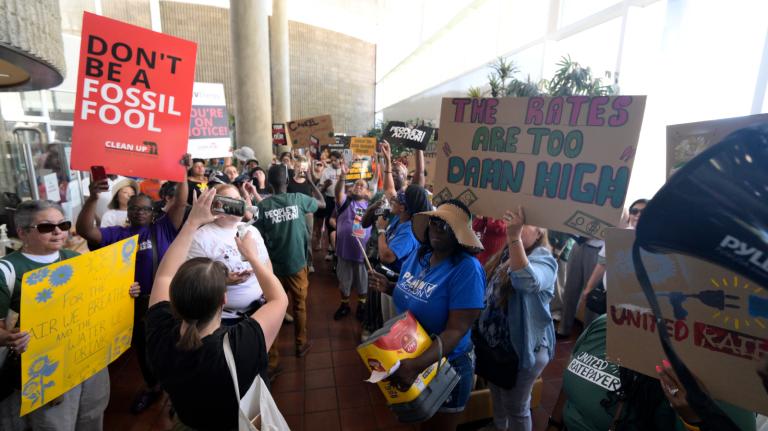
In at least a quarter of cases, the leaders that emerge to work on local environmental-justice issues get involved in electoral politics. They get elected to school boards, city councils, and run for state representative. And 35 percent of them are women.
In other cases, they become the go-to people when it comes to, “What about jobs? What about this facility? Will it be a good thing or is this just a sell job?” Whether they be retired school teachers or retired mail carriers or little old grandmothers who have lots of time to devote to these issues, this is the training ground for leaders.
Marshall Ganz has pointed out that many of the mainstream, national environmental groups are D.C.-based lobbying organizations that don’t have the really engaged grassroots constituencies you’re describing. How do you see these two different kinds of groups working together?
The environmental-justice movement was never about creating little black Greenpeaces or little brown Environmental Defenses or little red Audubon Societies. These organizations have their expertise and when we can work together and maximize our strengths, that’s when we win.
There’s division of labor that can work to the advantage of this whole movement. When the mainstream national environmental groups pair up with environmental-justice groups that have the ability to mobilize large numbers of constituents — to get people marching and filling up those courtrooms and city council meetings — that’s when you can talk about an environmental movement.
A great example of how it should be done is happening right now in Louisiana. The Natural Resources Defense Council is partnering with the Deep South Center for Environmental Justice and the Louisiana Environmental Action Network to work on testing and issues of environmental justice after Katrina. NRDC brings a lot of expertise, but is respecting those organizations based in New Orleans and Cancer Alley. They’re really showing how a national group and local groups can form a relationship that is principled.
So you’re hopeful?
On our side we have lots of committed troops on the ground and a growing movement of young people. Because of the way race operates in this society, there are some people — poor white people, for example — who have been given blinders; they’re blinded by racism and have voted against their own best interests. When we take the blinders off and allow every single American to rise and reach his or her potential without these artificial barriers, then we could really become a great country.
What environmental-justice issues might we be surprisingly close to breaking through on?
Globally we’ve got a long way to go, but the fact is we don’t have a lot of time — I think that reality will force collaboration. An awareness that what we do in the developed world doesn’t just impact us is now pretty much a given. But we have to move that to another level of action and policy: the framework that environmental justice has laid out can resonate across a lot of developing countries.
In the end, I think we’ll be able to get our message out because it’s based on principles and it’s based on truth and justice.
Click here to read more thoughts from Robert Bullard on Katrina and institutionalized racism.