Uncategorized
All Stories
-
Energy efficiency resources for business
I should have done this several days ago, but better late than never:
Check out Joel Makower's excellent list of resources for businesses looking to save (or make) some money through energy efficiency. As he says:
Energy efficiency (the more business-like alternative to "conservation") has a strong foundation in a bottom-line-centric world. And there are rich resources -- case studies, how-to manuals, calculators, incentive programs, technical assistance agencies, and more -- to help companies manage the process. There's also a sizeable industry that's grown up around helping companies audit, assess, implement, and finance energy-efficiency solutions.
And yet, we've barely begun to harvest the low-hanging fruit, let alone sow the seeds of an economy that can continue to grow and prosper using continually less energy from oil and other polluting resources.Get to it!
-
French SUV-haters deflate gas-guzzling tires
Most every cyclist who's rolled alongside cars for any amount of time knows the feeling, the one that makes you pump your fist at that driver who nearly ran you over, or that one whose tailpipe is emptying its contents into your face, or the one who's emissions are melting that glacier you liked so much (anger rising, rising). It's this sort of frustration that makes regular bicycle commuters and eco-conscious citizens of all stripes regularly curse outright at aggressive, too-large-vehicle drivers: "you just wait. You'll get yours."
Now some activists in France are dishing out those just desserts to a growing number of SUV drivers in wealthy neighborhoods in the form of empty, but undamaged, tires. The Deflators (or Les Degonfles), a group of French SUV-dislikers tired of the massive vehicles clogging Paris' streets, have been quietly deflating SUV tires in the dark of night. Repeatedly.
And without damaging the vehicles, it's essentially just setting free the air within, they argue, but with amusing side effects.
It's not all late-night pranks, though. Their masked leader has braved a televised debate with the president of the French SUV-owners' association and is apparently working on some sort of a movement anthem, set to appear as both a children's song and a dance mix (oh, those savvy French).
Though The Deflators, who also often post fliers and smear mud on the targeted vehicles, have been in touch with sympathizers and potential deflators on this side of the Atlantic, it seems the mischievous Parisians have much less cultural inertia to overcome than their American counterparts in their quest to spread the message that SUVs sucketh throughout the land, what with openly SUV-hostile city officials and a national SUV-owner tax. Also, SUVs in France, according to the Los Angeles Times, make up only about five percent of the market, whereas Americans would be up to their eyeballs in potential deflationary targets, with SUVs comprising about one-quarter of its market.
Of course, that doesn't mean SUV deflations are a bad idea in America, just a lot of work ...
-
Defeat from the jaws of victory
Call it environmentalism, Bush style. A new federal tax credit will help allay the extra cost of purchasing hybrid vehicles, but the Byzantine formula for calculating the savings provides greater financial incentives for buying heavy SUVs than more fuel-efficient cars.
Read the rest at Wired.
(Via TP.)
-
Pharmaceuticals may be saving species
You may have heard that measurable levels of pharmaceuticals have been turning up in water supplies, causing concern about the potential effects on wildlife. But did you hear that they may also help preserve endangered species?
As noted today on Green Media, a recent study shows that, in China at least, widespread availability of Viagra-type drugs has decreased the demand for endangered animal body parts used to treat erectile dysfunction in traditional Chinese medicine. In all, the study names eight animals that stand to benefit from this trend, including seals and green sea turtles.
Sadly, tigers and rhinos are not on the list, because their body parts are used in the treatment of many, many other ailments.
Clearly Pfizer needs to come out with pills to address these other disorders, so that other endangered species can be saved as well. Maybe they could combine effects into one pill, depending on which animals' parts are usually used:
Got arthritis? Suffer from insomnia? Ulcers, rheumatism, epilepsy, hemorrhoids, skin disease? Tooth ache, fever, acne? Alcoholic? Try our little orange-and-black striped pill! It's grrrreat!
-
Dirty Seeds Done Dirt Cheap
World’s 10 largest seed sellers control half the global market Seeds are at the core of almost everything humans eat — that’s why the tightening grip of seed-selling corporations is so worrisome. The world’s 10 largest seed-hawkers now control about half the global market, and its top three are among the world’s largest pesticide purveyors […]
-
![]()
![]()
Post-Katrina floodwaters are dirty, but so are other U.S. waterways
Last month, “toxic gumbo” entered the American lexicon with the speed and force of the floodwaters it describes. A LexisNexis search of major U.S. publications doesn’t return a single hit for the phrase in the year before Hurricane Katrina. But in the 30 days after the storm’s landfall, 66 articles contained the phrase. Measure twice, […]
-
Confessions of a sustainable mind
Former Grist intern Jocelyn Tutak has written a short but interesting piece for the Sustainable Style Foundation's SASS Magazine in which she describes her love/hate relationship with Dansko clogs:
My paying job keeps me on my feet - literally - for eight hours a day. At about a mile an hour (oh yes, I clocked it with a pedometer), I put in forty miles a week just at work. My feet were no longer happy with me and quite vocal about it. I needed arch support, and I needed it bad.
Enter Dansko's Professional clog, the shoe of choice for doctors, nurses, chefs, and nearly anyone else whose job requires more than a bit of standing. This shoe carries the "Seal of Acceptance from the American Podiatric Medical Association." So I do a little research. My coworkers swear by them, and I even get a deal on buying them for work. The website promotes peace and earth-friendliness, and began as a mom-and-pop business. By looking at the site, the shoes, and those I know who wear them, you'd think they were helping save the world with each pair sold, with each step taken with their anti-skid tread. All is well until I check the specs on this Danish wonder-clog: The inner frame of this happy little shoe is made with PVC.
For those of you who don't know (and really, who can keep all these plastics straight), #3 PVC, or polyvinyl chloride, has been deemed the worst of the bunch. Bill Walsh, founder of the Healthy Building Network wrote in Grist that "the weight of available evidence tells us that ... it may well be the single most important source of many of the worst toxic chemicals plaguing the global environment today."I can just picture it: Umbra on one shoulder and a tired, sore Jocelyn on the other. Who won out in the end? Find out.
BTW, to all you in the Seattle area on Tuesday ... the Sustainable Style Foundation will be hosting Green Drinks. There's a rumor some Gristers will be attending.
-
Personal virtue is not enough for environmentalists
A point I try frequently to make: If you want real, substantial, lasting environmental change, it is not enough simply to recycle or drive less or shop at Whole Foods or buy organic cotton t-shirts. It is not enough to advocate that others do so. The kind of environmental change we need will never happen solely through personal virtue. There just aren't enough virtuous people.
What's needed are structural changes -- changes in gov't policy and regulation at every level, changes in the way we build and run our communities, changes in the practices of large corporations, changes in international norms and treaties. Political advocacy, in the broadest sense, is the obligation of any true environmentalist.
Now, why do I pound on this point, even at risk of being a big downer for all the chipper eco-strivers who so love Umbra?
Look no further than this headline: "Environment High in Personal Values, Low in Political Priorities for U.S. Voters"
Grrr ...
-
Wet
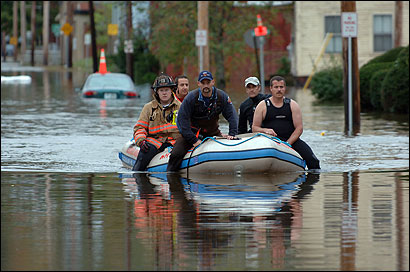
Is this image from post-Katrina New Orleans? A burly American rescue team dispatched to Mexico?
No, it's...
-
Hurricane Stan not as friendly as name might indicate
Mexico and northern Central America are still staggering from the aftermath of the latest Gulf Coast tempest, Hurricane Stan. Some are already calling Stan's impact worse than 1998's Hurricane Mitch.
Stan hit along Mexico's southern Veracruz coast on Tuesday as a Category 1 hurricane, and was downgraded to a tropical storm shortly thereafter -- but it's the landslides and flooding from the resulting rains that have been devastating. In Guatemala, storm-induced rains only ended on Sunday, and the army began evacuating people stranded in remote towns and villages. As many as 1,400 are feared to have died in villages inundated by mudslides; the government says it will declare them hallowed ground, as mass graves. Thousands are displaced and many fear their livelihoods have been destroyed.
In Mexico, Costa Rica, El Salvador, Honduras, and Nicaragua, more than 100 have been reported killed and thousands displaced from flooded areas. In Mexico, the storm destroyed key crops including coffee, and about 300,000 people -- primarily in the country's poorest regions -- were evacuated to shelters. About $1.85 billion will be needed to rebuild the hardest-hit areas, according to President Vincente Fox.
The Grist staff are taking the rest of the day off to go home and hug their kids and puppies.