Latest Articles
-
Thousands protest against coal in front of D.C.’s Capitol Power Plant
No one was arrested, but not for lack of trying. An estimated 2,500 people protested outside Washington, D.C.’s Capitol Power Plant on Monday — the nation’s largest act of civil disobedience against coal power. Anti-coal activists from all corners of the country braved the sub-freezing temperatures and six inches of snow the city received Sunday […]
-
Snow doesn't dampen turnout for anti-coal rally in D.C.
The day's scorecard:
1) Largest anti-coal action yet in the United States: Thousands and thousands of people flooding the streets around the Capitol Hill power plant.
2) Largest demonstration in many years where everyone was wearing dress clothes: The point was to stress that there's nothing radical about shutting down coal-fired power. In fact, there's everything radical about continuing to pour carbon into the air just to see what happens.
3) Smallest counter-protest in world's history: By my count, the Competitive Enterprise Institute managed to muster four demonstrators for its "celebration of coal" rally, which is about the right size. (But they were kind of sweet; they had signs that said: "Al Gore, Not Evil, Just Wrong.")
4) Number of arrests: None, zip, zilch, nada. The police said so many demonstrators showed up that they had no hope of jailing them all. So we merrily violated the law all afternoon, blocking roads and incommoding sidewalks and other desperate stuff, all without a permit or a say so. We shut down the power plant for the day. And we'd pre-won our main victory anyhow, when Nancy Pelosi and Harry Reid preemptively cried uncle last week and announced they were'nt going to burn coal in their plant any more.
5) Quantity of broad smiles afterwards: Almost unlimited. And in the air, there was the strong sense that we can do this. Really. What fun.
Bill McKibben, a Grist board member, is co-founder of 350.org, and author most recently of Deep Economy.
-
Photos of climate and coal protests in D.C.
Three rallies hit Capitol Hill on Monday. First, several thousand young attendees of the Power Shift climate conference rallied on the west lawn of the Capitol before heading off to lobby their representatives. Second, more than 2,000 people gathered for a high-profile protest at the Capitol Power Plant, demanding an end to the burning of […]
-
Berkeley's program to finance solar systems through property tax assessments is off to great start
The city of Berkeley, Calif. is pioneering a program to help homeowners finance solar systems through property tax assessments. How's that working out?
The first tranche of funds sold out in nine minutes.
And on Friday, the first two checks were handed out to proud owners of new solar systems. Meanwhile, we were able to tweak the federal tax code to ensure that program participants can still use the federal investment tax credit (thanks, Speaker Pelosi). And we are working with partners in eight states and counting to get enabling legislation on the books to allow more cities to replicate the model.
Note that this program can be set up to fund more than just solar electric. Solar hot-water and energy-efficiency upgrades can and should be included as well.
-
A slideshow of mass transit’s massive artistic potential
Here’s some snowy-day fun (if you happen to live in one of the places getting socked by storms): Dave Burdick put together a slideshow highlighting the surprising beauty of subway maps old and new — yeah, New York City is in there, but you won’t want to miss the Milky Way!
-
Checking out the scene in the nation's industrial-tomato capital
Tomorrow, I'm heading down to Immokalee, Florida, to check out conditions in our nation's tomato basket. During the growing season -- between December and May -- something like 90 percent of tomatoes consumed in the U.S. come from the area in south Florida anchored by Immokalee.
I'm going as part of a delegation of food-oriented writers and activists including authors Frances Moore Lappé and Raj Patel, Slow Food USA president Josh Viertel, and others.
For decades, working conditions in South Florida's prodigious tomato fields have ranged from ruthlessly exploitative to outright slavery. Even under the best conditions, wages are stagnant and workers live in poverty.
Yet workers in the area, represented by the Coalition of Immokalee Workers, have made headlines in recent years by forcing gigantic tomato buyers like Taco Bell and Burger King to pony up an extra penny a pound -- which would cost fast-food companies a tiny sliver of profit, but represent the first substantial wage gain for pickers in decades.
There's a catch: the state's growers cooperative, the Florida Tomato Growers Exchange, refuses to pass on the raise to workers. Thus workers still get 45 cents for every 32-pound basket they fill -- a wage that hasn't budged in years, eroded by steady inflation.
Immokalee is one of the hotspots of of a globalized, industrial food system. The plight of its workers -- many of them refugees from small farms in Mexico and Central America that have collapsed under the weight of that same system -- represents just another externalized cost of stocking supermarkets, fast-food outlets, and school cafeterias with "cheap" food.
For a great brief backgrounder on the Immokalee situation, check out Barry Estabrook's piece in the current Gourmet.
Look for a wrap-up of my Immokalee trip on Friday.
-
![]()
![]()
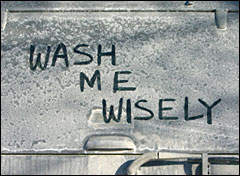
Umbra on cleaning cars inside and out
Dear Umbra, I recently bought a new-to-me car (fuel efficient!). It’s the nicest car I’ve ever owned, so I want to keep it well-maintained and clean. What are some environmentally friendly ways to keep my car clean, both inside and out? I’d rather not use gross chemicals and harsh soaps. Will good ol’ vinegar and […]
-
Why cap-and-trade requires that Bangladesh evict radical Islamists
David Frum is known as one of the more sensible, policy-oriented conservative writers -- he parted ways with the hyper-ideological National Review over non-lockstep comments about the woeful state of the Republican Party. So I came to his posts on cap-and-trade hoping to find some glimmer of ... something. Maybe hope that there is a way to connect with reasonable conservatives, common ground from which to begin a dialog.
First Frum wrote a post that got virtually everything about the policy wrong. Ezra Klein tried to set him straight. Frum responded with ... more misunderstandings. (Ezra tried again.) In particular I want to focus on two bits:
Yes people can escape the tax by using less electricity. But the tax is still falling on them - they are just feeling its effects in a different form, by reducing their consumption. They are still worse off, just worse off in a different way.
Uh ... there's literally no way to use less electricity without being "worse off"? There's no such thing as energy efficiency?
And then:
(Sorry - I know Ezra will say that the point is to persuade the utilities to rely on windmills instead. But that's energy fantasy, not energy policy!)
There's no such thing as renewable energy either!
I was in the midst of grappling with some reasonable way of responding to someone who doesn't believe in energy efficiency or renewable energy when I came across this comment on the post, from reader sinz54:
There is a big difference here: If an American company dumps waste into the Hudson River, they are hurting mostly AMERICANS. So that's a national problem for our fellow citizens. Whereas if an American company dumps carbon dioxide into the atmosphere, it is primarily the undeveloped world that will be hurt by it. Unlike America, nearly all of Bangladesh (population 200 million) will be flooded out when the north polar ice cap melts. So we Americans are essentially restricting our economy, and impoverishing our own people, to keep the undeveloped world safe from global warming. Why are we doing them this multi-trillion-dollar favor without them paying us for it? The world cannot control global warming without U.S. cooperation. We should strike a very hard bargain for that cooperation. For example, I would insist that Bangladesh clean up its act and kick *ALL* radical Islamists out of their country before we do anything to keep their country from being flooded. We've got the political leverage. Let's use it!
I am rarely speechless, but ... I really don't know what to say about this stuff. I don't see how a group of people in this universe are going to make it back to the real world in time to create bipartisan climate policy.
-
Global warming could delay, weaken monsoons: study
CHICAGO — Global warming could delay the start of the summer monsoon by five to 15 days within the next century and significantly reduce rainfall in much of South Asia, a recent study has found. Rising global temperatures will likely lead to an eastward shift in monsoon circulation which could result in more rainfall over […]
-
'So am I'
I promised an economy run on clean, renewable energy that will create new American jobs, new American industries, and free us from the dangerous grip of foreign oil. This budget puts us on that path, through a market-based cap on carbon pollution that will make renewable energy the profitable kind of energy; through investments in wind power and solar power; advanced biofuels, clean coal, and more fuel-efficient American cars and American trucks.
...
I realize that passing this budget wont be easy. Because it represents real and dramatic change, it also represents a threat to the status quo in Washington. ... I know that oil and gas companies wont like us ending nearly $30 billion in tax breaks, but that's how we'll help fund a renewable energy economy that will create new jobs and new industries. In other words, I know these steps won't sit well with the special interests and lobbyists who are invested in the old way of doing business, and I know they're gearing up for a fight as we speak. My message to them is this:
So am I.