Latest Articles
-
Grid reliability statistics look good, if you don't consider the flaws
Refashioning our electric grid to move generation closer to load creates a host of benefits. (Two-hundred and seven, according to Amory Lovins.) Among them is an increase in grid reliability, since generation closer to load necessarily reduces the need for transmission to connect remote generators to that load. Carnegie-Mellon has estimated that we could free up something like 15 percent of our total grid capacity if we moved to a locally generated system.
But you wouldn't know that from the way some utilities calculate reliability statistics. The Columbus Dispatch reports that in spite of a wave of recent outages due to winds knocking out power lines, reliability statistics still look surprisingly good. Why?
The reliability statistics themselves are controversial. Major storms, such as the September wind storm that knocked out power to 700,000 AEP customers, are not included on the list. Utility officials contend, and regulators agree, that major storms would cause breakdowns in even the best systems, and are therefore not helpful in measuring overall reliability.
That means the September wind storm, the January ice storm, and this week's high winds will not be considered when the PUCO puts together reliability statistics for AEP.
"For analysis purposes, you've got to remove the anomalies," said Selwyn Dias, vice president for regulatory and finance at AEP Ohio.So rather than build a more reliable grid, we will simply assume the grid we have -- and its innate exposure to weather-related outages -- is immutable.
Tomorrow: I'm favored to be the top pick in the upcoming NBA draft, once you remove the anomalies of my height, 30-percent shooting percentage, and lack of credible crossover move.
-
Superb NYT story captures both coal's peril and the barriers to its elimination
"Is America Ready to Quit Coal?"
So asks a must-read story by Melanie Warner in the Sunday New York Times.
And so, slowly, fitfully, that possibility -- the possibility not just of cleaning up coal or using less coal but eliminating coal -- creeps its way into the American public consciousness.
The headline isn't the only thing worth celebrating. I would quibble with some details, but overall this piece comes closer than anything I've ever seen in the national media to getting the big story right.
It starts off by describing what too few people understand: coal is in a perilous position. Already building new coal plants is extremely expensive; any new regulations -- on CO2, MTR mining, coal ash, you name it -- could put new plants permanently off the table.
But the more interesting parts, to me, are those that describe the barriers in the way of quitting coal. Here are the big three, in order of importance:
The fear that that there's no alternative.
"[W]hether renewables can keep the lights on and our iPods charged remains an open question."
Loss aversion is, in your author's humble opinion, at the core of the coal fight. If the American people can be convinced an alternative is possible, they will not accept dirty, unhealthy energy, any more than they accept tainted water or cars without seat belts. But the fear of letting go of the devil they know, the fear of jumping into the unknown, is incredibly potent.
"Charging iPods" trivializes it; electricity provides basic sustenance, shelter, and comfort for families. For children. This is primal lizard-brain stuff. You do not mess with it lightly. Those looking to dethrone coal in the public imagination would do well to focus most of their firepower not on coal itself but on establishing the credibility and reliability of the renewables/efficiency alternative. It can't be cutting edge and whizbang forever. It's got to be safe for soccer moms in suburban Atlanta.
The fear of rising prices.
-
Many political conflicts stem from undue population pressure on water and grasslands
As land and water become scarce, competition for these vital resources intensifies within societies, particularly between the wealthy and those who are poor and dispossessed. The shrinkage of life-supporting resources per person that comes with population growth is threatening to drop the living standards of millions of people below the survival level, leading to potentially unmanageable social tensions.
Access to land is a prime source of social tension. Expanding world population has cut the grainland per person in half, from 0.23 hectares in 1950 to 0.10 hectares in 2007. One-tenth of a hectare is half of a building lot in an affluent U.S. suburb. This ongoing shrinkage of grainland per person makes it difficult for the world's farmers to feed the 70 million people added to world population each year. The shrinkage in cropland per person not only threatens livelihoods, but in largely subsistence societies, it also threatens survival itself. Tensions within communities begin to build as landholdings shrink below that needed for survival.
The Sahelian zone of Africa, with one of the world's fastest-growing populations, is an area of spreading conflict. In troubled Sudan, 2 million people have died and over 4 million have been displaced in the long-standing conflict of more than 20 years between the Muslim north and the Christian south. The more recent conflict in the Darfur region in western Sudan that began in 2003 illustrates the mounting tensions between two Muslim groups -- camel herders and subsistence farmers. Government troops are backing Arab militias, who are engaging in the wholesale slaughter of black Sudanese in an effort to drive them off their land, sending them into refugee camps in neighboring Chad. At least some 200,000 people have been killed in the conflict and another 250,000 have died of hunger and disease in the refugee camps.
The story of Darfur is that of the Sahel, the semiarid region of grassland and dryland farming that stretches across Africa from Senegal in the west to Somalia in the east. In the northern Sahel, grassland is turning to desert, forcing herders southward into the farming areas. Declining rainfall and overgrazing are combining to destroy the grasslands.
-
Markey on cap v. tax and ways to properly regulate carbon markets
In Houston last week for CERAWeek, Rep. Ed Markey -- chair of the Energy/Environment Subcommittee and the Global Warming & Energy Independence Select Committee -- gave an interview to the Houston Chronicle.
He had this to say on the tax vs. trade question:
Q: A cap-and-trade system is widely assumed to be the form the climate change bill will take, but economists and many others say a carbon tax would be a simpler, more efficient method to reach the same goals. Is the door completely closed on a carbon tax?
A: I think it's much more likely that a cap-and-trade system will be used. They've already reached a consensus in Europe, that 400-million-person continent, that that's the way to go, and it's the overwhelming way we're going with. I understand economists, and how they want to have a debate over what's more efficient, but in the end we can construct it as a cap-and-invest bill that is imposed in a fair, predictable way and will create incentives for innovation. What I use as an analogy is the 1996 Telecommunications Act. Up until then not one single home had broadband access. My goal in that act was to create the incentives for the deployment of broadband that could then lead—because of that huge additional capacity that was constructed—to the creation of thousands of other companies that could use that broadband capacity. I didn't know the names of the companies would be Google, eBay, Amazon, YouTube and thousands of others that created 3 to 5 million new jobs in America. But 10 years later people look back at the black rotary phone era as ancient history, but it's not that long ago. And I think we can do that same thing here. We have the opportunity to create 3 to 5 million new jobs in the energy sector if we unleash a technological revolution, because we have created through a cap-and-trade system a set of incentives that provides that opportunity. And I'm very confident that the same thing will happen. That's been my experience as chairman over telecommunications, chairman over regulation of the financial marketplace: the incentives have to be put in place in a predictable way that creates the incentives for the change that the country needs.As to the fear of financial speculators, he had this to say:
-
Climate Central takes on Iowa corn
Climate Central bills itself as "a think tank with a production studio." This is what they do:
Using both staff experts and an extended blue ribbon network of scientists, Climate Central assesses and synthesizes the latest science, technology, and policy proposals. Our experienced communications team turns that information into creative, easily understood, and graphically rich pieces for print, television and the web.
They've got some serious names behind the project, including John Holdren and Jane Lubchenco before they were snapped up by the Obama administration. (Full disclosure: Grist board member Ben Strauss is a member of the CC team.)
CC just got up and running recently -- the full site doesn't debut until Spring -- but it's already turning out some great stuff. The latest is "Iowa: Corn and Climate," a video that recently aired on PBS's The News Hour with Jim Lehrer. Here it is (starts about a minute in):
The coolest thing, though, is that the video comes with an annotated transcript that takes virtually every sentence and substantiates it with a relevant bit of science, news report, or infographic. You get the public-friendly video and the wonk-friendly reference work, all in one package. Not bad.
CC aims to be an impeccably credible source of information on a highly contested set of subjects. It looks like they're off to a great start.
-
Seattle Greendrinkers show Grist some love
 Photo: David Lattimer.
Seattle, we love you! And we love that you showed us the love Tuesday night at Greendrinks.
Our event at the LEED-designed Veer Lofts in South Lake Union drew some 450 Greendrinkers excited about catching up with old friends, mingling with new ones, and sharing green ideas and good times with all.
Generous donations from Pizza Fusion, Sierra Nevada Brewing Company, Snoqualmie Wines, Guayaki Teas, Clif Bar, Essential Baking Company, and Full Circle Farm provided sustainable (and delectable) sustenance -- and kept the crowd buzzing.
We also had photographers roaming the scene, asking Greendrinkers to hold up signs showing what it is they love. We got responses ranging from bikes, to national parks, to "snuggles." Check out the photos for yourself in our Flickr slideshow (below). Then share your own by joining our Grist Local Flickr group.
And if you wish that you'd known a little sooner about this great green event in Seattle, subscribe to our Grist Local: Seattle email list to receive weekly news about green goings-on in the Emerald City.
-
Uber-denier Inhofe misquotes Hadley, gives big wet Valentine's kiss to Pielke
Once again, the office of Denier-in-Chief (DIC) Sen. James Inhofe (R-Oil) has put out a press release riddled with misstatements. This one has a twist, though: a Valentine's love letter to denier-eq. Roger Pielke, Jr.
The DIC's last two releases were notable for their outright lies and distortions [see here and here.]
So it's no surprise that the DIC's pre-Valentine's Day missive is one big disinformation-fest, starting with the headline:
Climate of Change: UK Met Office Issues 'Blistering Attack on Scientific Colleagues' For 'Apocalyptic Climate Predictions'
You will not be surprised to learn that the U.K. Met Office issued no attack on scientific colleagues for "apocalyptic climate predictions." Dr. Vicky Pope, head of climate change advice at the Met Office did write a column for the U.K.'s Guardian that begins:
News headlines vie for attention and it is easy for scientists to grab this attention by linking climate change to the latest extreme weather event or apocalyptic prediction. But in doing so, the public perception of climate change can be distorted. The reality is that extreme events arise when natural variations in the weather and climate combine with long-term climate change. This message is more difficult to get heard. Scientists and journalists need to find ways to help to make this clear without the wider audience switching off.
That is really all Pope has to say about "apocalyptic predictions." She doesn't actually criticize any predictions that I would consider to be apocalyptic.
Indeed, Pope herself is the principal source of the major recent apocalyptic prediction made by climate scientists -- ironically in a December article in the Guardian, "Met Office warn of 'catastrophic' rise in temperature" (see here):
In a worst-case scenario, where no action is taken to check the rise in Greenhouse gas emissions, temperatures would most likely rise by more than 5°C by the end of the century.
You want an apocalyptic prediction? Try 5-7°C warming this century. So the implication of the DIC's press release and headline -- that Pope thinks the business as usual emissions trajectory the DIC wants to keep us on is not apocalyptic -- is quite, quite wrong.
The only prediction she talks about that comes close to being apocalyptic is:
-
A zero-emission bus tours California, Toyota flirts with ethanol, and more green auto news
Thursday in San Francisco, it was easier to get an electric bus than an electric car. Proterra, a commercial hybrid- and electric-vehicle manufacturer in Golden, Colo., finished its weeklong California clean bus tour in the city by the bay. The sleek EcoRide BE35 climbed the hills of San Francisco, flaunting its environmental and fiscal charms […]
-
![]()
![]()
From Nukes to Nincompoops
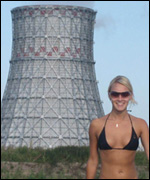
Fallout girl Meet Alyona Kirsanova of Novovoronezh. She likes long walks on the beaches of Three Mile Island and thinks nuclear fusion is hot. But will she be crowned Miss Atom 2009? We can hardly contain our excitement. Personal ads we can believe in “In search of patriotic, busy, Chicago-Hawaiian man, must like basketball and […]
-
Improving on the ambiguity of privately owned public spaces
This article is part of a collaboration with Planetizen, the web’s leading resource for the urban planning, design, and development community. Cities are filled with spaces intended for the public — but many of them are clearly owned and operated by the private sector. Though cities bend rules to get these spaces built, the public […]