Latest Articles
-
Voting has ended: Grist readers have chosen top eco-hero and eco-villain of 2008
Way back before the holiday season, we posted our lists of green heroes and green villains for 2008. Because we are totally Web 3.7 participatorynewmediacroudsourcingcitizenjournalist types, we even opened it up to your votes!
So you voted. And voted, and voted. Then, on Jan. 8, we warned you: only 24 hours left to vote!
Turns out we really meant, er, 24 days. Give or take a week. So you voted some more. But now voting's really closed! For realz. And, without further ado (or delay), we're ready to declare winners.
With 730 votes ... the Grist 2008 Eco-Hero of the Year is ... [drum roll]
 The Sierra Club's Bruce Nilles! [crowd roars]
Nilles is director of the Sierra Club's National Coal Campaign, which has helped coordinate the extraordinary grassroots movement that's sprung up in the last few years to fight against new coal plants. This victory for Nilles is really a victory for that movement, which has -- with very little help from the establishment or resources from big-money funders -- pulled off an amazing string of victories that is still going on. Nice job, movement. And nice job, Bruce.
And now, turning to less pleasant matters:
With 405 votes ... the Grist 2008 Eco-Villain of the year is ...
 Flaccid Apparatchik Stephen Johnson! [boos, angry shouts]
Johnson, who most everybody thought would be a harmless technocrat, turned out to be one of the worst U.S. EPA administrators in the nation's history, blatantly ignoring the advice of EPA staff and scientists in order to carry out the political hatchet jobs handed down by Dick Cheney. We will miss writing headlines about you, Mr. Johnson. But that's about all we will miss.
Onward to 2009 [already in progress]!
-
Computer maker expands recycling efforts
PC giant Dell today continues its campaign to be the world’s greenest technology company by rolling out a pair of new recycling programs. The company is adding six states to its partnership with Goodwill Industries that lets customers drop off unwanted electronic devices for recycling at Goodwill retail stories. The network of 1,100-some collection points […]
-
Is Gen. Jones trying to grab part of the energy and climate portfolio?
Yes -- and no (unless you worry about Iraq, Afghanistan, and Al Qaeda, in which case, yes, you should worry that Jones might be talking his eye off the proverbial bomb ball).
The WashPost reported Sunday:
President Obama plans to order a sweeping overhaul of the National Security Council [NSC], expanding its membership and increasing its authority to set strategy across a wide spectrum of international and domestic issues ...
New NSC directorates will deal with such department-spanning 21st-century issues as cybersecurity, energy, climate change, nation-building and infrastructure.A highly placed source confirms for me that national security adviser and retired Marine Gen. James Jones wants to play in areas like the outercontinental shelf (i.e. offshoring drilling) and smart grid.
-
Is tidal energy a possibility in Puget Sound?
Seattle may not be solar-panel savvy or a wind-power winner, but could it be a viable source of tidal energy? That's what a number of scientists, governmental bodies, and public utilities folks are trying to figure out. And they shared their progress, and their plans for the future, with attendees at the Puget Sound Georgia Basin Ecosystem Conference in Seattle.
Generating tidal energy involves taking advantage of the rhythmic rise and fall of tidal currents by planting some sort of windmill-ish technology below the surface of the water, especially in areas where water flow is restricted into a narrow passageway, such as an inlet.
Like their land-based brethren, though, these underwater windmills could have environmental impacts that include affecting salmon and marine mammal migration, disturbing bottom fish habitat, and impacting fish harvests. But just how much of an impact would tidal power have on the Puget Sound -- and how would that balance with the benefits of renewable energy generation? Well, unfortunately, no one really knows. There are limited studies on actual impacts -- and limited on-site experimentation as well.
-
CNN, ABC, WashPost, and AP blow Australian wildfire, drought, heat-wave story
If the U.S. media refuse to make the connection between record breaking wildfire, drought, and heat waves and human-caused global warming, why would anyone be surprised if the U.S. public doesn't put it as a higher priority or make the connection itself (see here)?
Australia knows it's facing climate-driven impacts that threaten it with complete collapse (see here). AFP (French international media) get this: "Australian wildfire ferocity linked to climate change: experts." So does Reuter's climate change correspondent in Asia: "Australia fires a climate wake-up call: experts."
I saw the CNN and ABC stories, and you can read the AP's stories, which have been published in the Washington Post and NY Times (though the NYT redeemed itself, see below). The media love a good calamity of Biblical proportion:
-
Hopes for new U.N. climate meeting hinge on Obama’s attendance
On Monday Reuters broke the story that U.N. Secretary-General Ban Ki-moon is organizing a summit in New York next month, where he hopes to get heads of state from major greenhouse-gas emitters (the U.S., China, and India) to talk about climate action plans. (Grist reported on the first hints of such a conference a few […]
-
While Geithner's bailout flounders, it's time to explore other financial models
Things are looking a bit grim for the U.S. banking system.
On Tuesday morning, U.S. Treasury chief Tim Geithner rolled out his new plan for rescuing the banks, committing more than $1 trillion to convince private investors to buy up the "toxic assets" that are fouling up the system.
Lobbyists for the big banks praised the plan, the New York Times reported. Investors were less impressed. Shares of Bank of America, Citigroup, and Morgan Stanley plunged by well more than 10 percent Tuesday; Goldman Sachs fell by a relatively merciful 8 percent. Overall, the Dow Jones Industrial Average shed nearly 400 points.
Why the ugly reaction? Martin Wolf, the venerable markets reporter for the Financial Times, ventured an answer on a TV news program (part I and part II): the U.S. banking system appears to be insolvent, sunk under the weight of bad investments. According to Wolf, the Obama team is too "politically frightened" to tell the public and investors that our banking system has essentially failed.
To a casual observer me, Wolf's analysis seems obviously right. What's weighing the system down is bad real estate bets. Essentially, our bank execs -- decorated with fancy b-school degrees and robustly compensated for their trouble -- bet heavily U.S. real estate prices would rise indefinitely. Now that prices have plunged, they're left with reams of essentially worthless mortgage-backed paper. And as the economy continues to unravel, real estate prices look set to continue falling -- which means still more of the assets held by the banks will become "toxic," i.e., worthless.
And here's where we get to the trouble with the Geithner plan: He seems to be assuming that private investors can be convinced, by government guarantees and financing, to buy assets that are essentially worth nothing. But where's the upside in buying worthless assets in the first place?
One of two outcomes now look likely: 1) a wholesale nationalization of the U.S. banks (an extremely dicey proposition for a Democratic president); 2) or the the descent into bancruptcy of a vast and iconic bank like Citigroup -- with who knows what consequences.
None of this should be contemplated with panic. Rather, as the banking system teeters, we should be thinking about other finance models, other styles of economic development. In the weeks to come, I'll be focusing on other models laid out in Woody Tasch's Inquiries into the Nature of Slow Money: Investing as if Food, Farms, and Fertility Mattered and Gus Speth's The Bridge at the Edge of the World: Capitalism, the Environment, and Crossing from Crisis to Sustainability.
Update [2009-2-11 7:42:54 by Tom Philpott]:Martin Wolf has now aired his dire view in the pages of the FT. Wolf lays out two scenarios for the banks: the rosy one being acted on by the Obama team, and a more urgent one, which he says he says he has "little doubt" is correct. The second scenario is as follows:
Under the second view, a sizeable proportion of [U.S.] financial institutions are insolvent: their assets are, under plausible assumptions, worth less than their liabilities. The International Monetary Fund argues that potential losses on US-originated credit assets alone are now $2,200bn (€1,700bn, £1,500bn), up from $1,400bn just last October. This is almost identical to the latest estimates from Goldman Sachs. In recent comments to the Financial Times, Nouriel Roubini of RGE Monitor and the Stern School of New York University estimates peak losses on US-generated assets at $3,600bn. Fortunately for the US, half of these losses will fall abroad. But, the rest of the world will strike back: as the world economy implodes, huge losses abroad - on sovereign, housing and corporate debt - will surely fall on US institutions, with dire effects.
-
E.U. to launch environment project ‘auction’
BRUSSELS — The European Union will offer almost 100 environmental projects from developing countries around the world in an auction to try to attract donors to back them, the European Commission said Tuesday. The “Auction Floor,” to be held in Brussels on March 13, will allow developing projects to meet potential donors such as local […]
-
![]()
![]()
The rundown on eco-friendly ice melt
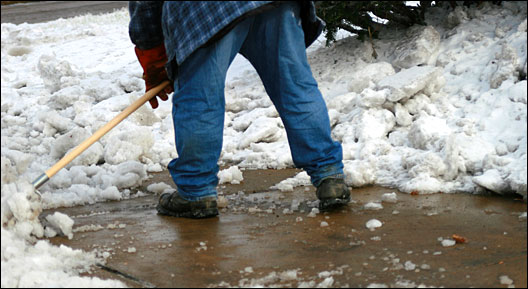
Shovel more, salt less. In my family, perhaps in every family, there are stories so apocryphal that a simple phrase becomes a stand-in for the whole tale. One of ours is “salting the plants.” That refers to the time my mother, a high-school student prone to merry pranks, snuck in to her school dining […]
-
Green(ish) news from around the capitol
• Sen. Maria Cantwell (D-Wash.) is expected to be named the new chair of the energy subcommittee of the Energy and Natural Resources Committee on Wednesday, according to a press release from her office. • First Lady Michelle Obama stopped by the Department of Interior on Monday to visit with Secretary Ken Salazar and employees, […]