Latest Articles
-
White House will save paper by putting federal budget online
Instead of printing 3,000 copies of its 2,200-page budget, the White House has elected to put the gigantic tome online. “This step will save nearly 20 tons of paper, or roughly 480 trees,” says White House Budget Director Jim Nussle, who estimates that bringing the budget presentation into the new millennium will save nearly a […]
-
Australia will phase out plastic bags
Following in China’s footsteps, Australian Environment Minister Peter Garrett has announced a goal to phase out plastic bags in the country by the end of 2008.
-
Energy stocks are looking attractive
The following essay is a guest post by Kari Manlove, fellows assistant at the Center for American Progress.
-----
 CNNmoney.com just released a summary outlook on the solar, wind, biofuel (mainly ethanol), and efficiency industry financial sectors. The two looking most optimistic are wind and efficiency, and thus both sectors are overflowing with opportunity.
According to one investment portfolio manager, efficiency investments are reliable and essentially fundamental. In his words, investing in efficiency is like putting your money on the arms dealer in a war or conflict -- no matter which side wins (or which sector), the arms dealer simply can't lose.
-
Still time to vote for Gristmill in 2008 Weblog Awards
You didn’t know Gristmill was a candidate for something? Right, and I suppose next you’ll tell me that you were paying attention to some other voting thing-y going on. Well, chill. There’s still time to elect Gristmill as the Best Tropical Topical Blog in the 2008 Weblog Awards. But only until tomorrow night, Friday, Jan. […]
-
![]()
![]()
A food writer looks back at 2007, from supermarket monstrosities to organic-garden epiphanies
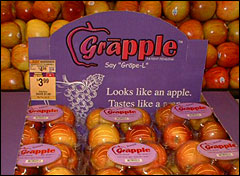
While I peeled the apples for Apple Brown Betty recently (see recipe below), I had time to think about the food-related highs and lows of the past year. What was my most disconcerting food experience of 2007? Three interactions with the industrial food system vie for first place. We’re holding out for grape-sized apples. Photo: […]
-
Iditarod sled dog race forced to change starting point
The famous Iditarod sled dog race is undergoing permanent changes as organizers cope with urban sprawl and a warming climate. For the ceremonial start to the competition on Mar. 1, racers will travel 11 miles instead of the traditional 18 miles. The race itself will kick off Mar. 2 from Willow, Alaska, 30 miles north […]
-
How Obama and Clinton stack up on food and ag
Now that the Democratic campaign has narrowed to two clear front-runners — each of whom has managed a surprise victory over the other in a major primary — the time has come to take a look at how they stack up on food and ag policy. If elected, would these prospective presidents kowtow to Big […]
-
Richardson drops out of presidential race, takes clean-energy fervor back to N.M.
New Mexico Gov. Bill Richardson dropped out of the race for the Democratic presidential nomination today, after tanking in the Iowa caucuses and the New Hampshire primary. In making his announcement, he looked on the bright side: “A year ago … we were the campaign with the most aggressive clean energy plan and the most […]
-
Supporting the next generation of farmers and ranchers
This is the first of five farm bill fact sheets from the Sustainable Agriculture Coalition. For the diehard policy wonks out there, you can also download the Sustainable Agriculture Coalition's matrix (PDF) showing the status of sustainable agriculture priorities in the House and Senate versions of the farm bill.
Soaring demand for organic and local foods means exciting market opportunities for beginning farmers and ranchers, but the current public policies required to support their entry are woefully inadequate. The future health and vitality of agriculture, the food system, and rural communities depends on policies in the 2008 Farm Bill that encourage this next generation of producers to get a start on the land.
Now is the time to call your senators and representatives and tell them to urge the Senate and House Farm Bill conferees to include important provisions for beginning farmers and ranchers in the final farm bill.
-
Eban Goodstein invites you to join in the largest climate teach-in ever

"If there's no action before 2012, that's too late. What we will do in the next two to three years will determine our future. This is the defining moment."
-- Dr. Rajendra Pachauri, chair of the Intergovernmental Panel on Climate ChangeIf these words don't get you off your butt, you better check and make sure you have a pulse. Yet what can we (everyday Americans, readers of Grist) do now, today, that will be strong enough to change the course of our future? Strong enough to overcome the powerlessness and denial gripping our country?

It is clear that we are standing at a critical moment in human history. Unless we begin to cut global-warming pollution within a few short years, a window for our children and the creatures of this earth will close. Forever.
Instead of stabilizing at 3 to 4 degrees F more warming, the best our kids will be looking at will be more than 5 degrees F. And every 10th of a degree matters, because it raises the possibility that we might trigger some catastrophic outcome -- massive sea-level rise, loss of forests globally driven by intensified fire, or large-scale methane releases from the tundra, pushing temperatures even higher.
Today, cutting emissions on the scale required in the United States seems barely possible. Our nation is, truly, paralyzed. Yet this is a peculiarly American kind of paralysis, one we all understand from high school civics. Our system of government, with its checks and balances, was designed for gridlock, allowing an organized minority to block movement toward change. And yet we all also learned how we overcome this gridlock. When our government fails, Americans set aside their everyday business and drive the country in a new direction. From abolition to women's suffrage, labor rights to civil rights to anti-war causes, again and again, social movements reclaim the moral vision at the heart of America and set a new course for the country.
Over the next year, a powerful, nonpartisan movement demanding global-warming solutions will sweep across this country and change the future, change our future.
Or it won't.
Each of us now has to decide: Will I be a leader in that movement? The science is clear. Our future will be determined, literally, by the readers of this post, who have heard the truth and have said yes -- or will say yes -- to this challenge. And unlike our forbearers, we are not threatened by dogs, fire hoses, blacklisting, firing, beating, torture, imprisonment, or lynchings. We are free (if we choose) to create the future.
Here is how today, this week, you can lead: