Latest Articles
-
Maisie Ganzler of an eco-friendly catering company answers Grist’s questions
Maisie Ganzler. What work do you do? I’m director of communications and strategic initiatives for Bon Appétit Management Company. How does it relate to the environment? Bon Appétit is an onsite restaurant company committed to socially responsible practices. Our café and catering services feed about 200,000 people every day in corporations, colleges and universities, and […]
-
![]()
![]()
What climate scientists have learned from Western wildfires
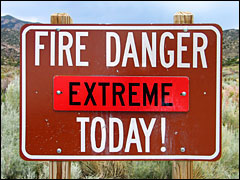
Many wildland firefighters carry an instrument called a sling psychrometer. It consists of two encased thermometers, and is swung above the head on a short rope — making the firefighters appear not unlike David readying to slay Goliath. The instrument gives a quick field reading of relative humidity, one of the most important factors in […]
-
Umbra on battling cockroaches
Dear Umbra, Help! I’m having a mysterious cockroach problem. I found four in my apartment in two weeks, and not in the expected places: one in a stack of papers (I know, I should pay my bills faster), one near my vitamin bottles, one nowhere near water in my bathroom, and, the worst one, crawling […]
-
Prancing With the Stars
Celebs gather in Malibu to protest plans for offshore natural-gas facility Famous beautiful people and other denizens of Malibu, Calif., gathered on a beach yesterday to protest a proposal by energy company BHP Billiton to build a liquefied-natural-gas facility 14 miles off the coast. “We have to use our voices and band together and stop […]
-
License Plates Never Looked So Good
Inmates exposed to toxins in e-waste recycling program, says report A federal recycling program that uses cheap prison labor to recycle computers and other electronics exposes inmates to unsafe conditions, says a report released by activist and environmental groups last week. Prisoners paid from 23 cents to $1.15 an hour by government-owned Federal Prison Industries, […]
-
Go for Choke
Deliberate forest fires cause choking haze in Southeast Asia Southeast Asia has been suffering through hellish smog over the last few weeks thanks to Indonesian farmers and owners of timber and palm-oil plantations who have set massive fires to clear land. Slash-and-burn practices are illegal in Indonesia, but nonetheless take place every year and rarely […]
-
A short hike reveals various lizard, insect species

I was poking around in an empty lot today about a mile from downtown when I heard a clicking sound. I looked up and saw this owl staring at me. It was snapping its beak and may have been defending a nest. I took the picture and bailed before the confrontation escalated.
I also took a short hike today with my wife and two daughters. Dusk is the best time to hike because the nocturnal wildlife is waking up, and for a brief period, you will see twice as much traffic.
Kids love bugs. If you have kids, bookmark this site. Note the comments on the photo of the Japanese beetles while you are there. My oldest daughter (now a young woman at the college we were visiting for parents' day) was the hand model for the photos of the tarantula, mantis, and giant black-faced spider shown below:
-
A weekend at Bioneers
This weekend the eco/new-agey/NoCal faithful gathered in Marin for the annual Bioneers conference. I've gone several times in the past, and it's always an interesting experience, and not for the obvious reasons ...
-
No, seriously
I spend a lot of time contemplating priorities; it's the economist in me, I suppose. If I had my way, a campaign to end natural-resource subsidies would be near the top of the list for the environmental movement: it's a win-win-win situation for the environment, taxpayers, and innovation. The problem is that it's an opposition campaign; it's opposed to subsidies instead of "for" something. In addition, subsidies are not something people get very excited about (although they should).
-
A new essay

What follows is a new essay by Bill McKibben, addressing -- in the context of reviewing five new books -- just how close we are to ecological catastrophe, and what reasons there are for hope.
The essay will appear in the Nov. 16 edition of the New York Review of Books. The NYRB editors gave Tom Engelhardt's excellent TomDispatch permission to publish it in advance; he in turn gave me permission to run it here. Thanks to Tom and to the NYRB editors.
Don't miss this one.