Latest Articles
-
Umbra on carpeting
Dear Umbra, Our home is mostly wood floors, but we would like to have a carpeted den. My gut instinct is that the carpet pad (looks like the foam from the inside of a car seat all smooshed together with other pieces) is full of chemicals that will constantly offgas. Am I right? If so, […]
-
Al Gore: Coming to a theater near you
An Inconvenient Truth, the documentary about Al Gore's quest to raise the alarm about global warming (covered in Grist here), has been picked up by Paramount and will be distributed worldwide -- it opens in the U.S. on May 26.
Gore and Powerpoint? I smell March of the Penguins numbers here people! (Amusingly, the movie poster actually features penguins -- as opposed to, you know, Al Gore.)
-
Organic arugula, Lake Tahoe, and poverty
In kicking off its seven week series, the talented and witty team at Grist pondered the paradox of U.S. environmentalism: "In much of popular and political culture, the movement is dismissed as the pet cause of white, well-off Americans -- people who can afford to buy organic arugula, vacation in Lake Tahoe, and worry about the fate of the Pacific pocket mouse."
This perception, and how the environmental community responds to it, will determine whether it becomes a movement for everyone, or just for those with a Nalgene in every cupboard and a Gortex in every closet.
Many Americans, environmentalists included, see poverty as a necessary evil, a "by-product of civilization" that will always be with us. In other words, its existence is natural. This analysis of poverty may seem pragmatic, but it morally justifies the continuation of a social system that provides comfort and extravagance for a few, while leaving others to scrape, toil, and struggle to meet their basic needs.
The environmental movement has a sophisticated analysis of environmental degradation, eco-systems, and the political forces influencing the planet. Does the environmental movement have an analysis of poverty? If so, what is it? How do you explain the existence of poverty in the most affluent nation in the world? As an anti-poverty activist (and environmentalist) I'm interested in knowing what Grist readers think.
-
Seaweed’s Big Adventure
Scientists discover biodiversity hotspot on Caribbean atoll That ex-girlfriend was right — there are other fish in the sea! Scientists have discovered a biodiversity hotspot in the Caribbean, home to a (possibly) new fish species and a mini-rainforest of seaweeds. Over a two-week period at the coral-covered Saba Bank Atoll, 12 researchers braved heavy seas […]
-
Fiber Tactics
Asbestos trust fund derailed in the Senate Remember the titanic struggle erupting in the Senate all of eight days ago, as a landmark bill to create a $140 billion industry-financed trust fund for victims of asbestos-related illnesses moved to the floor for debate? Well, pack up your lawn chair: It’s over. Yesterday, the bill effectively […]
-
Royaling for a Fight
Oil and gas companies set to receive $7 billion taxpayer windfall To supplement their already record-breaking profits, oil companies are set to receive around $7 billion in royalty relief over the next five years — possibly up to $35 billion, depending on the outcome of an ongoing lawsuit — and the feds claim they are […]
-
Incentives should reward fuel efficiency, not hybrids per se
 Hybrid cars are good for us, right? So policymakers should provide incentives -- things like tax breaks, access to HOV lanes, and free parking for hybrid drivers.
Well, not so fast, says a great article in today's Washington Post. There's growing reason to believe that those incentives for hybrids will make things worse -- actually generating more gasoline use, not less. That's because many of the incentives confuse the means for the end.
Reducing fuel use (and attendant GHG emissions, air pollution, etc.) is the goal; getting drivers into hybrids is simply one instrument in pursuit of that goal.
But one of the more popular incentives to boost fuel efficiency has been to encourage hybrid ownership by offering hybrid drivers access to HOV lanes, even when the drivers are alone. And as the article rightly points out:
An incentive -- whether it's access to a carpool lane or cut-rate financing -- still aims to put another car on the road, and that undermines efforts to encourage carpooling.
Giving over HOV lanes to hybrids is probably counterproductive. In Virginia, where allowing hybrids in HOV lanes was pioneered, officials are worried that solo drivers in hybrids are clogging the high-capacity lanes and thereby discouraging carpools (because carpooling is no longer any faster than driving alone). In fact, 25 percent of all Virginia HOV lane users are hybrid drivers. And despite their hype, hybrids are not so fuel efficient that they can offset the fuel efficiency of an ordinary car with two or three riders. So the fuel efficiency of Virginia hybrids may become illusory as the vehicle fleet actually consumes more gas because drivers give up carpooling.
Same goes for other popular incentives: tax breaks and free or reduced-price parking. These incentives encourage people to drive by making it cheaper.
And if some incentives are wrong-headed, it's because they seem to miss the reason why hybrids are good in the first place. If we want to reduce fuel use, it's hard to see why hybrids deserve special tax breaks not afforded to buyers of other fuel-efficient, gas-powered cars (some of which are actually more efficient than certain hybrids). What's so special about hybrids?
-
![]()
![]()
Could a Western wildfire be the country’s next Katrina?
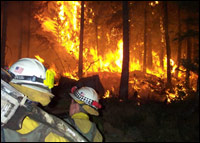
At the end of summer in southern Oregon’s Cascade foothills, when trees and brush have turned tinder dry and thunderstorms regularly roll overhead, Millie Chatterton and her neighbors start thinking about the lightning strike that could touch off disaster. The Biscuit burns in 2002. Photo: USFWS. Chatterton can’t forget the afternoon in 1987 when she […]
-
Forests may prevent more CO2 emissions than the equivalent acreage of biofuels
 The latest proposal to include airlines in European emissions trading schemes will have predictable results:
"If the idea of emissions trading is to make energy intensive activities more expensive, then there will be some impact on ticket prices," said Andy Kershaw, Climate Change Manager at BA.
For obvious reasons, consumers will always end up footing the bill when businesses pay the true cost of protecting the environment. That reality is not hard for most of us environmentalists to understand. It costs to protect the environment.
-
![]()
![]()
What green looks like to the world’s emerging economies
Give a child a hammer, they say, and everything is seen as a nail — or at least in need of a good pounding. Likewise, give an environmentalist a brush loaded with green paint, and she or he may set to turning everything one verdant hue. Pretty, perhaps, but problems can arise when well-off painters […]