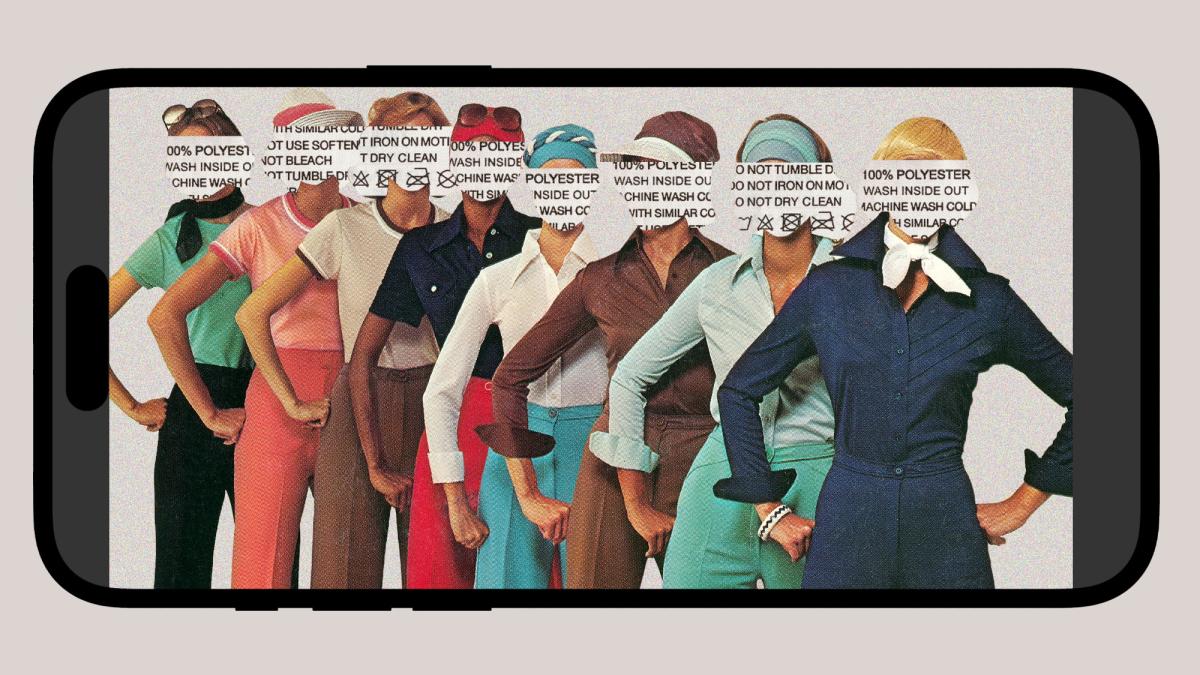
Even if you’re not wearing polyester now, it’s probably sitting somewhere in your closet — after all, it is the most ubiquitous fabric for textiles on Earth. Is that bad?
Judging by social media, the answer is solidly “yes.” Influencers want you to know it’s a form of plastic, fashioned from melted crude oil or PET bottles and extruded into threads. That disgust factor (“ugh, I’m wearing plastic?”) might help explain why “polyester” is now trending as an insult on TikTok.
“Polyester lifestyle,” says the top comment on a viral video in which an 18-year-old imagines his oddly specific dream life — wearing blue-light glasses in a coffee shop while a Claude agent does half his job during lunch break; getting a call that he has to pack for a sudden business trip to Europe while watching the sunset from the tennis court — as a 1987 composite sketch of the Unabomber gradually fades into view.
There’s just one problem with the story that “polyester” is, as Mashable put it last month, “Gen Z’s new way to call you fake”: The term has already been used this way for about half a century. The Oxford English Dictionary gives examples from 1979 (“A gleaming brazen polyester clown”) and 1987 (“Clifton wears polyester suits and a polyester smile”).
“TikTokkers just seem to be leaning into the ‘inauthentic’ and ‘low-quality’ edge of that meaning,” said Kory Stamper, a lexicographer and author.

While it may be hard to imagine now, polyester was once sold as “miracle” fabric. Wrinkle-free, quick-drying polyester promised housewives liberation from the drudgery of ironing. The 1950s and ’60s were the era of “plastic fantastic,” when chemical companies promoted plastic and synthetic materials as convenient and durable. As polyester became less expensive, chemical companies ramped up its production, outpacing cotton starting in the ’60s.
As cheap polyester flooded the market, the novelty wore off, and it turned from “treasure to trash,” as the anthropologist Jane Schneider once wrote. The environmental movement was born on Earth Day in 1970, and awareness of pollution spread alongside a suspicion of artificial fibers. As hippie culture took off, people longed for a more authentic, “back to nature” kind of life. (It’s not a coincidence that people started using “plastic” as an adjective meaning superficial or insincere, too.)
As the ’70s came to an end, the shiny, synthetic men’s suits that once seemed modern now felt cheap and tasteless. In 1981, a John Waters film called Polyester played on the fabric’s tacky associations, starring a father in a polyester-clad suit who owns an adult movie theater. “Polyester and pornography — the fabric could hardly sink lower,” wrote Anneke Smelik, an emeritus professor of culture and history at Radboud University in the Netherlands, in a study detailing the cultural history of polyester.
That same anti-synthetic sentiment is back in force today. The vitriol isn’t exactly subtle: One TikTok influencer with a clothing brand said that polyester makes you “sweat like a dog and smell like f***ing shit.” (Those qualities were true of the polyester suits of the ’70s, but textile manufacturers worked to improve the sweat problem and polyester is widely used in athletic wear today, partly because it can be designed to wick sweat away from your skin.) Wellness influencers on both the right and the left warn about the microplastics shed by synthetic clothing; scientists are concerned about the health effects of exposure to PFAS and other toxic chemicals that are used to treat the fabric during production, in order to help it repel water and resist stains.
But the line between “synthetic” fabrics and “natural” ones like wool, silk, bamboo, and cotton is blurrier than you’d think, Smelik said. It’s not like rolls of cotton grow off the plant: The raw materials all undergo intense chemical processes in order to become the soft, huggable fabric we enjoy putting next to our skin.
There isn’t even an obvious winner from an environmental standpoint, she said. Growing natural fabrics requires resources like land and water: It can take more than 700 gallons of water to produce a single cotton shirt. The cotton industry was a major driver in drying up the Aral Sea in Central Asia, turning what was once the world’s fourth-largest lake into its largest dry lakebed. Polyester is less resource-intensive to make, but, as it’s fashioned from oil, it does generate more greenhouse gas emissions. A new report from the Apparel Impact Institute found that the global fashion industry’s emissions rose 7.5 percent in 2023 and 6.3 percent in 2024, in part because of the increased production of fiber, particularly polyester. The fabric’s durability also becomes a curse when you throw it away: Polyester breaks down very slowly, fragmenting into microplastics that persist in ecosystems for generations.

There’s also consumer behavior to keep in mind: The perception that cotton is natural and better for the environment allows people to buy more clothes and not feel bad about it, because hey, at least I’m not buying polyester. The truth is that the most environmentally friendly solution is simply buying less and wearing the clothes you already have as long as you can. “Fast fashion remains fast fashion, and that is a huge problem,” Smelik said.
As good as the new generation of polyester insults are — including “Polyester Prince,” the new nickname for one prominent influencer who sells polyester clothes, and “polyester jester” to mock anyone wearing synthetic fast-fashion outfits — Smelik sees the current social media discussion around polyester as a regression to the 1970s. “It is so uninformed, and it leaves out all complexity,” she said. “You know, it becomes very polarized — like, ‘natural is good, and artificial is not.’”