In 1843, Congress gave Samuel Morse $30,000 to try to send a telegram from Washington, D.C., to Baltimore. Rather than bury the transmission wires underground, where technical issues would be hard to identify, the inventor of Morse code strung them along wooden poles and trees. When the system was completed about a year later, the first transmitted message read: “What hath God wrought?”
This was the beginning of the modern electrical grid, and although demand for electricity has increased exponentially since then, the system for distributing electricity remains remarkably similar to its initial, 19th century version, especially the utility poles. Trees have to meet stringent standards to become a utility pole, remaining free of knots, scars, swelling, or contact with the ground, but poles are still vulnerable to extreme weather — prone to electrical fires, wildfires, and frigid temperatures.
As the country grapples with skyrocketing power demand, extreme weather events now spur contentious debates about what kinds of energy work best. Conservatives blamed the California heat wave blackouts in 2020 on renewable energy, and climate advocates blamed the freeze in Texas in 2021 on the state’s reliance on natural gas, with each side claiming that its resources are more reliable. Winter Storm Fern barreled across the country this week, resurrecting concerns over the grid in Texas, where the state has added ample solar batteries, and in New England, which lost access to hydropower from Canada.
So far, power plants across the country have held up just fine, whether running on renewables or fossil fuels. But the storm revealed another vulnerability in the country’s aging power grid — the wires and poles that carry electricity from house to house.
“That last mile of the grid is extremely vulnerable,” said Costa Samaras, the director of the Wilton E. Scott Institute for Energy Innovation and a professor at Carnegie Mellon University. “The equipment’s old, or the poles themselves are old, and they can break under extreme events. Those types of boring infrastructure investments are really critical to ensuring that we have reliability and resilience under extreme events.”
In most of the country, this infrastructure “is becoming one of the main drivers of electricity cost increases,” said Michelle Solomon, a manager in the electricity program at Energy Innovation, a clean energy think tank. The bill has come due on much of the grid, Solomon explained. There’s currently a transformer shortage in the United States, and the Trump administration’s tariffs has made replacing infrastructure significantly more expensive.
“When we think about how to reduce electricity costs for consumers, certainly making sure that we’re finding ways to reduce the cost of those components is really important,” Solomon said.
As of Wednesday afternoon, at least 300,000 customers in in Tennessee, Mississippi, and Louisiana still lacked power, according to the website PowerOutage.us.
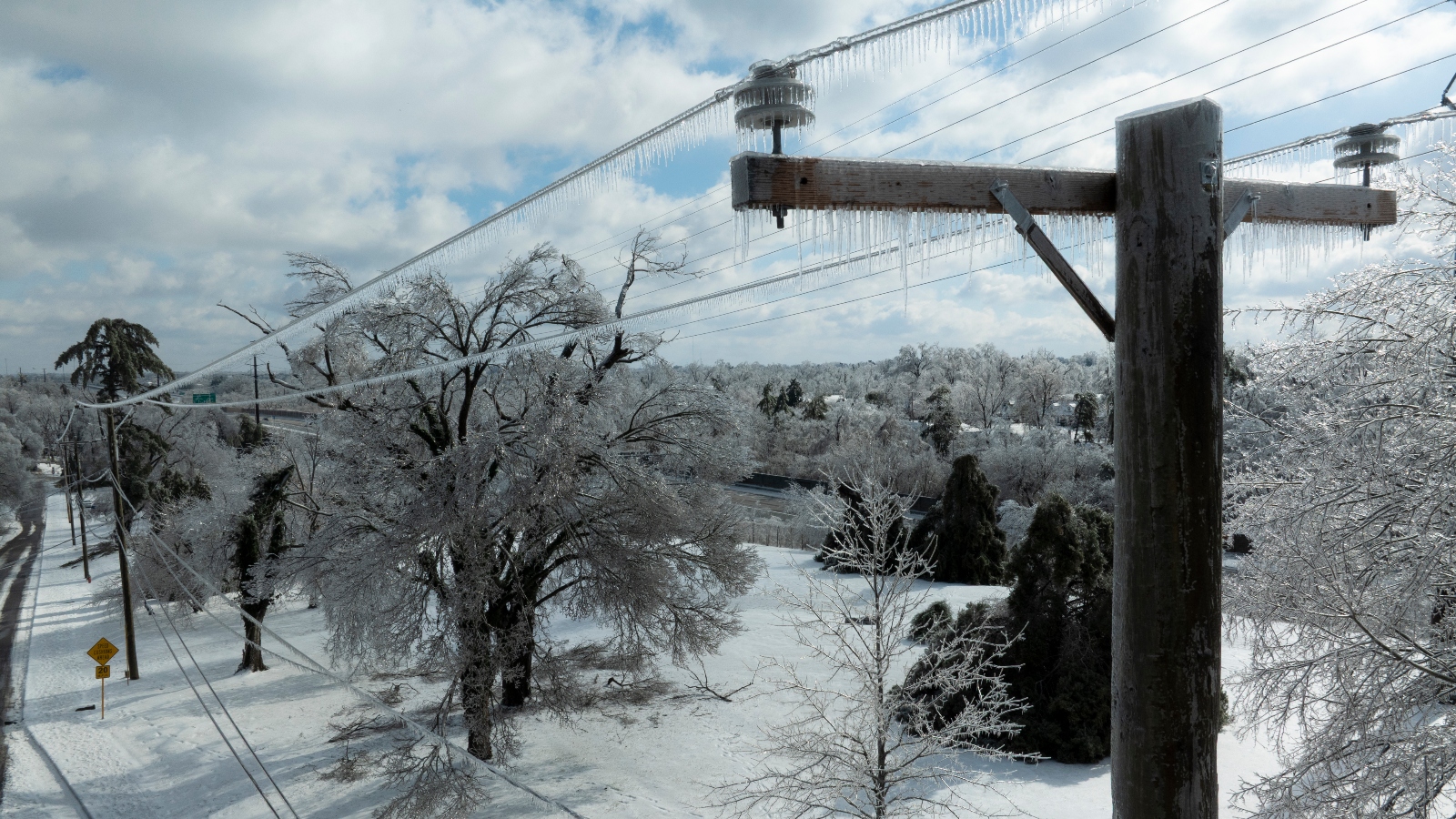
The biggest damage done by Winter Storm Fern was to a series of power lines owned by the Tennessee Valley Authority, or TVA, a federal power provider established under the New Deal in the 1930s. The storm toppled more than two dozen transmission lines that feed power to smaller utilities across Mississippi and Tennessee, and iced over some of the TVA’s other infrastructure. That left some of those smaller utilities without the energy they needed to keep the lights on.
Meanwhile, the TVA’s power plants made it through without disruption. The authority weatherized its main coal and gas plants after the catastrophic Winter Storm Elliott in 2022, which caused the first rolling blackouts in the TVA’s history and cost the authority $170 million. This time around, the generation plants all stayed online despite record levels of power demand.
The worst-affected utility during this week’s winter storm has been Entergy, which serves most of Louisiana along with parts of Texas and Mississippi. Winter Storm Fern knocked out power for more than 171,000 customers at its peak and took out hundreds of pieces of infrastructure — the utility estimates that at least 30 transmission lines, 860 poles, and 60 substations went out of service.
Entergy is used to getting knocked around by extreme weather. After Hurricane Ida struck Louisiana in 2021, Entergy lost more than 30,000 poles. Its main transmission tower carrying power into New Orleans collapsed in 150-mile-per-hour winds, cutting off power deliveries to the Crescent City. Not all this damage was inevitable: Entergy’s critics pointed out that nearby Florida had spent billions to harden its grid against storms with stronger poles and underground power lines. This allowed the Sunshine State to restore power much more quickly after similar hurricanes.
The smaller utilities that cut power during Winter Storm Fern often don’t have the resources to pursue such repairs. Power poles only get replaced every 50 years or so, and replacing a pole network can cost millions of dollars. It’s this repair work, rather than the need to serve new data centers, that explains why power prices have risen over recent years. Researchers at Lawrence Berkeley National Laboratory found that the “primary driver of increased electricity-sector costs in recent years has been distribution and transmission expenditures — often devoted to refurbishment or replacement of existing infrastructure.” By far the greatest cost increase was in California, where utilities have had to spend billions of dollars to harden their grids against wildfires.
Even when utilities do invest in grid resilience, some storms can still break through. More than 30,000 customers of the North East Mississippi Electric Power Association lost power during the peak of the outage brought on by Winter Storm Fern, and the utility had only restored power to 5,000 customers as of Tuesday morning. The electric co-op spends about $2 million a year to remove trees and other vegetation around its power lines, according to a spokesperson, but the storm outpaced those efforts.
“When large trees — some more than 30 feet tall — fall due to extreme ice loading, there is limited ability to prevent damage entirely,” said spokesperson Sarah Brooke Bishop. “We continually evaluate opportunities to strengthen and improve system resilience, but events of this magnitude will still result in significant impacts.”
Changing the material of the poles could help mitigate damage. A standard wood pole is pressure-treated to protect against fungi, humidity, and insects — but in extreme conditions, there’s only so much you can do to prevent wood from rotting. The first fiberglass composite poles were installed in Hawaii in the 1960s to withstand high humidity and wind speeds. Composite poles installed in Mexico and Grand Bahama have survived hurricane-force winds and are an increasingly appealing choice for utility companies looking to protect customers from the vagaries of extreme weather.
The upfront costs of installing these fiberglass poles are substantial though. Composite poles cost roughly $5,000 before installation costs — compared to roughly $1,000 for a wooden pole — but they require less upkeep and are cheaper in the long run. Repurposing old wind turbine blades could lower the cost, although the wind industry’s expansion under the Trump administration looks uncertain.
The fastest and easiest way to improve reliability, Solomon said, would be by incentivizing local battery storage. “By strategically placing batteries at certain spots on the grid where you might otherwise need to do an upgrade,” she explained, utilities could avoid some of the long-standing outages brought on by downed power lines. Homeowners could be compensated for purchasing their own batteries and allowing some of that energy to flow back to the grid in times of crisis.
Ultimately, there’s no way around the fact that “our distribution system requires generation reinvestment,” Samaras said. Burying lines underground, building smarter controls to identify problems underground, and creating a strong network of distributed energy resources will all be required to deal with the growing threat of extreme weather.
Correction: This story has been corrected in order to clarify which states are served by the Tennessee Valley Authority. The spelling of Michelle Solomon’s last name has also been corrected.
A message from
Your support keeps our climate news free.
Grist is the only award-winning newsroom focused on exploring equitable solutions to climate change. It’s vital reporting made entirely possible by loyal readers like you.
At Grist, we don’t believe in paywalls. Instead, we rely on our readers to pitch in what they can so that we can continue bringing you our solution-based climate news. Donate today to keep our site free.